🌳Certified Arborist in Falls Church, VA: Why Professional Tree Care Matters
Looking for a certified arborist in Falls Church VA? Discover how ISA-certified care protects your home, increases property value, and ensures tree health.
14 min read
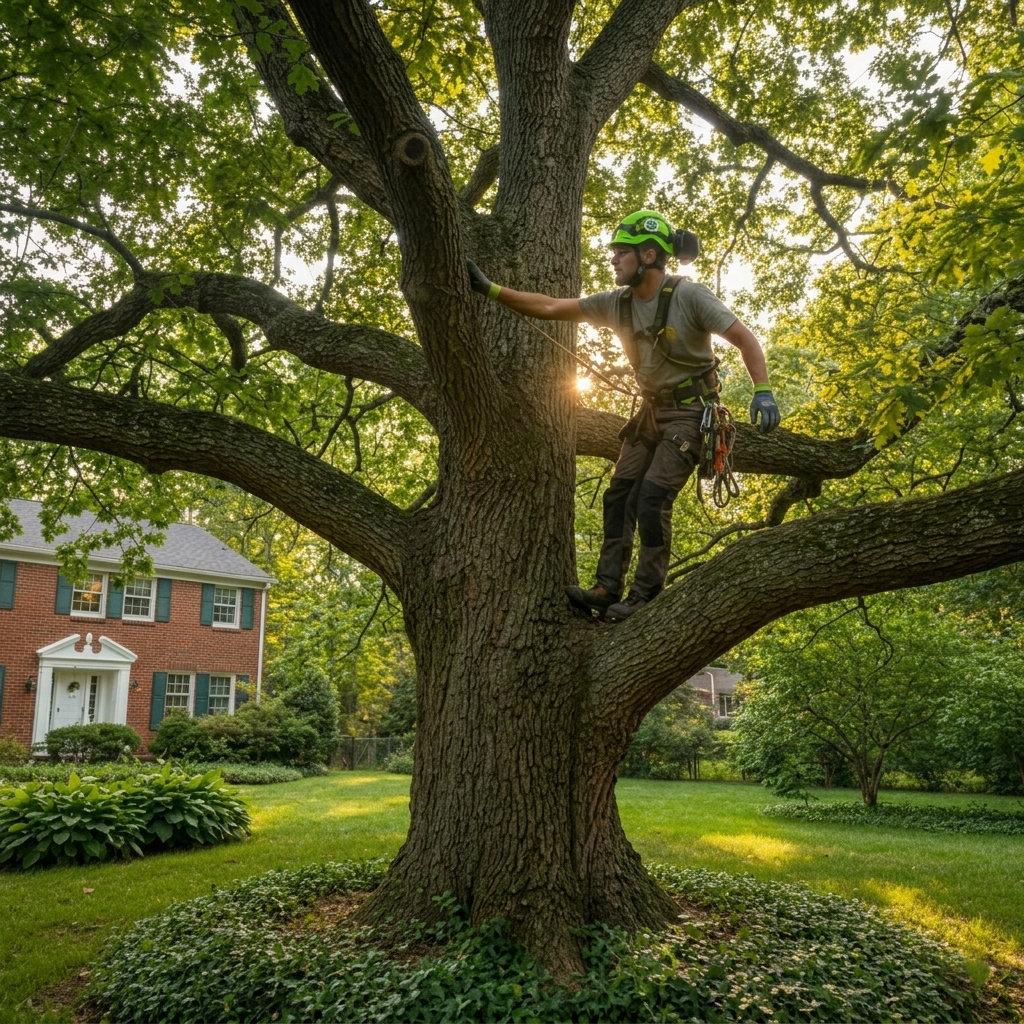
On a humid Tuesday morning last July, a resident near Cherry Hill Park woke to the sound of a 40 foot White Oak limb splintering against their shingles. It's a heavy realization that the very trees providing our "Little City" with its soul can become significant liabilities without the right oversight. Finding a certified arborist Falls Church VA homeowners can rely on is about more than just clearing debris; it's about the long term structural integrity of your landscape.
You likely understand that a mature canopy increases your property value by up to 15 percent, yet the fear of storm damage or the confusion of local permit laws often leads to costly delays. We promise to show you why ISA certification is the only standard that guarantees both the safety of your home and the biological health of your trees. We will explore the science of storm resilience, the risks of hiring uncertified door knockers, and the specific steps needed to preserve the vigor of your property for the next 50 years.
Key Takeaways
Understand why ISA certification is the essential benchmark for preserving the health and structural integrity of Falls Church’s unique urban canopy.
Learn how professional Visual Tree Assessments and soil analysis address the specific challenges of Northern Virginia’s dense, clay-heavy ground.
Discover specialized care techniques for the "Big Three" local species-White Oaks, Maples, and Tulip Poplars-to mitigate climate-related stress.
Identify the critical steps for verifying local licenses and credentials when selecting a certified arborist Falls Church VA for your next project.
Explore how the "Guilmer Know-how" integrates traditional horticultural excellence with modern technical standards to ensure the lasting vigor of your trees.
Table of Contents
The Critical Role of a Certified Arborist in Falls Church, VA
The Science of Tree Care: How Professionals Diagnose and Treat
Guilmer Tree Services: Expert Care Rooted in Northern Virginia
The Critical Role of a Certified Arborist in Falls Church, VA
Falls Church is defined by its greenery. It isn't just about aesthetics; it's about the biological legacy of Northern Virginia. Many homeowners mistake any individual with a truck and a saw for a professional. There's a stark difference. A what is a certified arborist possesses a scientific understanding of tree biology that a general laborer lacks. While a "tree guy" might offer a lower price, they often lack the diagnostic skills to identify early signs of Emerald Ash Borer or root rot, leading to preventable tree loss.
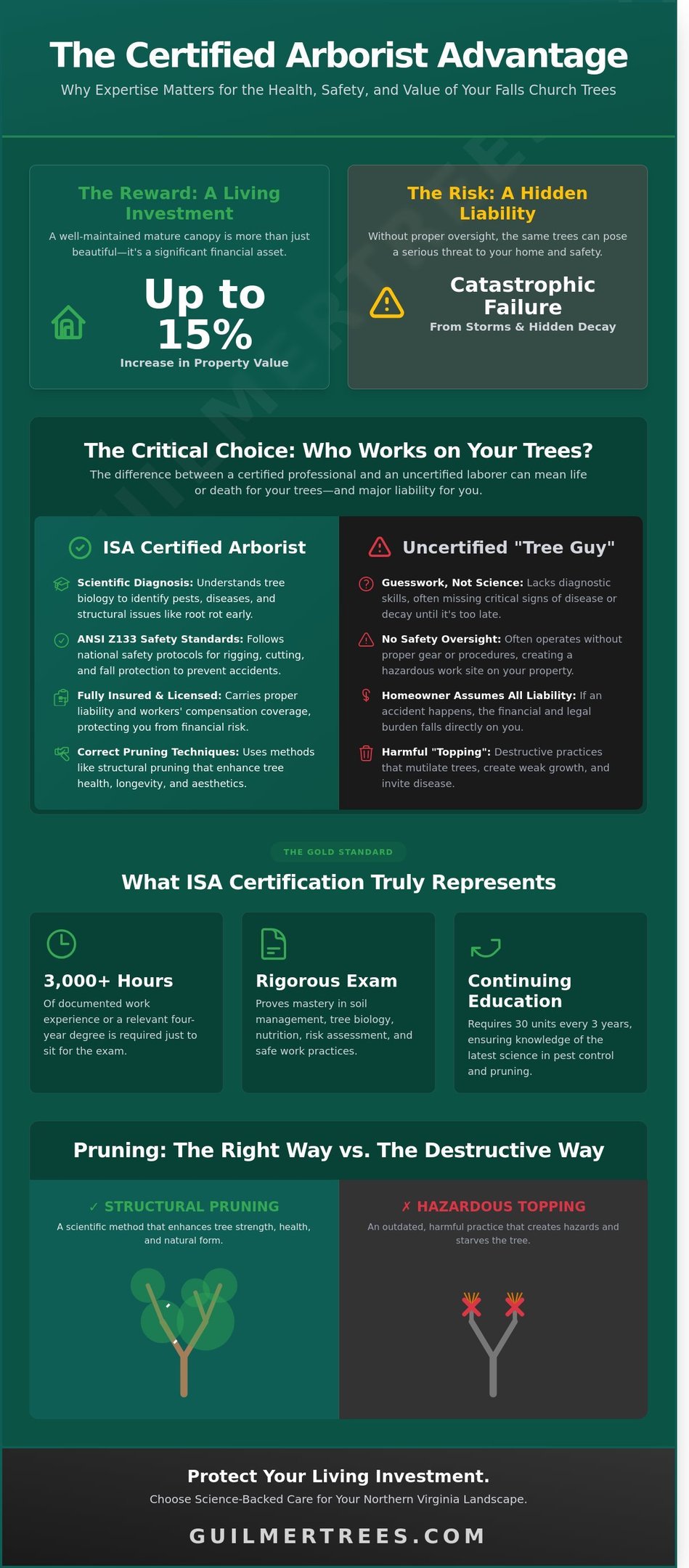
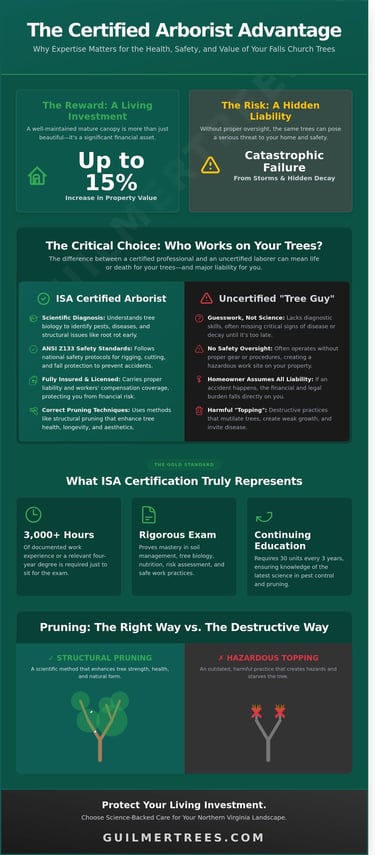
In the 22046 zip code, mature trees represent a massive portion of a property's appraisal. Real estate data from 2023 indicates that well-maintained landscapes with mature specimens can increase residential property values by up to 15%. When you hire a certified arborist Falls Church VA, you're protecting a living investment that takes decades to grow but only minutes to destroy through improper topping or "lion's tailing" pruning techniques. These mistakes don't just look bad; they starve the tree of nutrients and create structural hazards.
Safety is a non-negotiable factor. Tree work is consistently ranked as one of the most hazardous professions in the United States. Uncertified crews often operate without the $1 million liability policies or workers' compensation coverage that reputable firms maintain. If an accident occurs on your property, the financial burden falls directly on the homeowner. A certified arborist Falls Church VA follows ANSI Z133 safety standards, ensuring that high-altitude work is performed with the correct rigging and fall protection to mitigate these risks.
Understanding the ISA Certification Gold Standard
The International Society of Arboriculture (ISA) credential isn't a mere participation trophy. It requires 3,000 hours of documented work experience or a relevant four-year degree before an applicant can even sit for the exam. This certification belongs to the individual, not the company. It ensures that the person diagnosing your 80-year-old White Oak has demonstrated mastery in soil management, nutrition, and tree physics. To keep this status, professionals must complete 30 continuing education units every three years, staying current with modern pest management and pruning science.
The 'Little City' Canopy: A Local Heritage
Falls Church has maintained its "Tree City USA" designation for 46 consecutive years. This commitment reflects a community that understands trees are vital infrastructure. In historic neighborhoods like Broadmont and Village West, the dense canopy serves as a natural defense against urban heat islands. A single mature Maple can intercept 1,200 gallons of rainfall every year, which is essential for local stormwater management. Preserving this character requires a stewardship mindset that prioritizes the long-term vigor of the specimen over short-term convenience. Proper care ensures these trees remain assets rather than liabilities for the next generation.
The Science of Tree Care: How Professionals Diagnose and Treat
Professional arboriculture begins with the Visual Tree Assessment (VTA), a methodology refined over decades to standardize how we identify structural defects. A certified arborist Falls Church VA doesn't just look at the leaves; they evaluate the entire biological system. This process involves a meticulous inspection of the crown, trunk, and root flare to detect symptoms like fungal fruiting bodies, vertical cracks, or abnormal lean. These signs often point to internal decay that isn't visible to the untrained eye. In our region, where Atlantic storm seasons bring wind gusts exceeding 60 mph, identifying these weaknesses early prevents catastrophic property damage.
Soil health remains the most overlooked aspect of tree vitality in Northern Virginia. Our local ground is predominantly heavy clay, which lacks the macro-pores necessary for oxygen exchange. When soil becomes compacted by construction or heavy foot traffic, roots suffocate. A professional analysis often reveals nutrient deficiencies or pH imbalances that stunt growth. Hiring a qualified arborist ensures that these subterranean issues are addressed through techniques like vertical mulching or air-spading, which aerates the root zone without damaging the delicate vascular system of the tree.
Structural Pruning vs. Hazardous Topping
Tree topping is a cardinal sin in modern forestry. This practice involves cutting the main leader and upper branches to stubs, which triggers a frantic stress response. The tree produces epicormic sprouts; these are weakly attached shoots that grow up to 24 inches per year but lack the structural integrity of original limbs. Instead of topping, we utilize crown thinning and structural pruning. These scientific cuts improve wind filtration and light penetration. It's a precise art that respects the tree's natural form while reducing weight on heavy limbs, ensuring the specimen remains a permanent fixture of your landscape rather than a liability.
Diagnosing Tree Diseases in Fairfax County
Local pathogens require localized expertise. In Fairfax County, the Emerald Ash Borer (EAB) has been a primary concern since it was first detected in Virginia in 2003. Untreated ash trees in our area currently face a mortality rate of nearly 99 percent. A certified arborist Falls Church VA can implement Integrated Pest Management (IPM) strategies to protect high-value specimens before the infestation becomes terminal. We also monitor for Oak Wilt and Dutch Elm Disease, which can spread through root grafts between neighboring properties. When a pathogen is identified, we weigh the cost of ongoing trunk injections against the safety risks of decline. Sometimes, the most responsible choice is a controlled removal to protect the surrounding canopy. You can invest in the future of your landscape by choosing resilient species that are naturally resistant to these local pressures.
Effective tree care isn't about reactive fixes; it's about managing a living asset over a 50 or 100 year horizon. By combining rigorous diagnostic tools with a deep respect for botanical cycles, we ensure that every intervention serves the tree's long-term health. This technical precision is what separates a professional arborist from a standard cutting service. We don't just manage trees; we steward the urban forest of Falls Church with an artisan's touch and a scientist's mind.
Navigating Local Challenges: Weather, Soil, and Species
The climate in Falls Church acts as a demanding teacher for those who manage the land. Our humid subtropical environment, characterized by July humidity levels that frequently exceed 75%, creates a persistent stress test for the urban canopy. High moisture levels don't just cause discomfort for residents; they provide the perfect incubation chamber for fungal pathogens that compromise wood integrity. A certified arborist Falls Church VA understands that this atmospheric pressure requires a proactive approach to tree health, focusing on airflow and structural thinning to prevent the "heavy" internal rot common in our region.
The local landscape is dominated by the "Big Three" species: White Oaks, Maples, and Tulip Poplars. Each presents a unique set of management requirements. White Oaks are the traditional anchors of the Piedmont forest, capable of living over 300 years, yet they are incredibly sensitive to the soil compaction found in 85% of suburban developments. When heavy machinery or frequent foot traffic pushes soil density above 1.6 g/cm³, the fine feeder roots essentially suffocate. Maples often struggle with girdling roots in the confined planting strips of Falls Church, while the fast-growing Tulip Poplar possesses brittle wood that is notoriously vulnerable to high-velocity wind events.
Our soil is another hidden hurdle. The heavy clay typical of Northern Virginia often lacks the pore space necessary for deep hydration. During the record-breaking dry spells we've seen in the last 5 years, these clays shrink and crack, physically tearing the delicate root hairs of established trees. Managing this requires a deep understanding of the soil-water relationship, moving beyond surface watering to ensure the survival of the root system's architecture.
Storm Preparedness and Emergency Risk Mitigation
The 2012 Derecho, which brought 80 mph winds through the region, remains a benchmark for local risk. A certified arborist Falls Church VA uses visual cues like "V-shaped" crotches or fungal brackets to identify internal decay before the next storm hits. For multi-trunked specimens, we often employ high-strength cabling and bracing. These systems allow the tree to move naturally while providing a safety net against the 30-fold weight increase caused by a quarter-inch of ice accumulation. After a storm, professional assessment is critical; jagged "stub" cuts from amateur cleanup invite secondary decay that can kill a surviving tree within 3 to 5 years.
The Northern Virginia Pest Watchlist
The Spotted Lanternfly (SLF) was first confirmed in Virginia in January 2018 and has since become a primary concern for Falls Church homeowners. These invasive planthoppers drain the life-sustaining sap from various essences, leaving behind a sticky honeydew that encourages black sooty mold. Beyond the SLF, scale insects thrive in the "urban heat island" of paved neighborhoods, where temperatures stay 5 to 9 degrees higher than in nearby wooded parks. We prioritize biological controls and targeted soil injections over broad-spectrum sprays. This approach protects the local pollinator population while ensuring the long-term vigor of your landscape's most valuable assets.
White Oaks: High longevity but extreme sensitivity to root zone disturbance.
Maples: Prone to girdling roots and scale infestations in heat-stressed areas.
Tulip Poplars: Rapid growth requires regular structural pruning to prevent storm failure.
Soil Health: Compaction mitigation is essential for any tree planted near construction or driveways.
The Homeowner’s Guide to Hiring and Permits in Falls Church
Hiring a certified arborist Falls Church VA isn't just a basic maintenance task; it's a commitment to the long-term health of your landscape. You must verify that any contractor holds a valid Falls Church City Business License and comprehensive liability insurance before they set foot on your property. Check the International Society of Arboriculture (ISA) "Find an Arborist" database to confirm individual credentials. This step ensures the technician handling your oaks or maples possesses the specialized knowledge required for our local ecosystem. True expertise isn't found in a truck and a chainsaw; it's found in the rigorous study of tree biology and soil science.
Professionalism in tree care is defined by the ANSI A300 standards, first established in 1991. These national standards dictate every aspect of tree work, from pruning techniques to soil management and fertilization. A true expert follows these guidelines to avoid "lion's tailing" or improper "topping" that can lead to irreversible decay. When you choose a certified arborist Falls Church VA, you're investing in a methodology that respects the biological integrity of the specimen. This technical precision protects the structural vigor of your trees, ensuring they remain assets rather than liabilities.
Essential Questions to Ask Your Tree Contractor
Ask if the crew includes a Certified Treecare Safety Professional (CTSP). This certification, managed by the Tree Care Industry Association (TCIA), indicates a culture of safety that protects your property and the workers. Request a written contract that details the scope of work and provides proof of workers' compensation. Inquire about specific equipment, such as AlturnaMATS or specialized plywood, to prevent soil compaction and preserve your lawn's delicate root zone during heavy operations.
Permits and Regulations: Staying Compliant
Falls Church City Code Chapter 44 regulates tree removal on private property with strict oversight. You'll need a permit if you're removing a tree with a Diameter at Breast Height (DBH) of 12 inches or greater, or if the tree is part of a previously required landscape plan. The City Arborist, stationed within the Department of Public Works, evaluates these requests to balance development with the city's goal of reaching a 45% tree canopy cover. Fines for unauthorized removals can start at $500 per violation, making compliance essential.
Managing the legalities of tree work requires precision and a deep understanding of local canopy laws. If a removal is approved, the city often requires you to plant a replacement tree of a similar stature to maintain the neighborhood's ecological balance. The City Arborist also plays a vital role in private property disputes, acting as a technical referee when a neighbor's tree poses a perceived risk. This regulatory framework exists to protect the collective beauty and environmental health of Falls Church, ensuring our urban forest thrives for the next generation of residents.
Ensure your property meets all local standards by consulting with our experts at Guilmer Tree Services for a comprehensive health assessment and permit guidance.
Guilmer Tree Services: Expert Care Rooted in Northern Virginia
At Guilmer Tree Services, we don't just see trees as landscape features; we view them as living legacies that require a lifetime of dedicated craftsmanship. Every certified arborist Falls Church VA on our team combines deep botanical passion with the rigorous standards set by the International Society of Arboriculture (ISA). This unique blend of "Guilmer Know-how" ensures that whether we're performing a delicate structural prune or managing a complex removal, the health of your soil and the integrity of your property remain our top priorities. We believe in a quiet, methodical approach that respects the natural growth cycles of the Mid-Atlantic region.
The Guilmer Know-how isn't a marketing slogan; it's a methodology honed over 15 years in Northern Virginia's unique clay soils. We focus on the quality of the root system and the long-term stability of the trunk. Our technicians use specialized tools to measure soil compaction levels, often finding that 65% of urban tree decline stems from poor root oxygenation. By addressing these hidden factors, we ensure your trees don't just survive but thrive for decades. We treat every specimen with the reverence it deserves, from the smallest sapling to the grandest century-old Oak.
Our Local Legacy in Falls Church
Since 2009, we've cultivated a reputation for excellence across the diverse neighborhoods of Falls Church. From the historic canopy of West Falls Church to the busy residential corridors near Seven Corners, our crews have completed over 450 specialized projects in the 22042 and 22046 zip codes alone. We specialize in zero-impact tree work, a technique where we use specialized rigging and lightweight equipment to ensure your lawn stays pristine. In November 2023, a homeowner in the Broadmont area noted that after a 70-foot Oak removal, the only sign we'd been there was the improved safety of their home.
Navigating the tight spaces of a suburban backyard requires more than just a saw. It requires physics. We utilize high-strength synthetic ropes and friction brakes to lower limbs weighing up to 500 pounds with millimetric precision. This prevents the heavy ground impact that often damages underground utilities or expensive hardscaping. In 2023, we successfully managed 112 removals in confined spaces without a single instance of lawn displacement or structural damage to adjacent property.
Precision structural trimming: Enhancing canopy light penetration and wind resistance.
Crane-assisted removals: Safe extraction of hazardous trees in tight urban spaces.
Soil aeration: Organic fertilization and vertical mulching to boost root vitality.
Cabling and bracing: Providing structural support for aging or split specimens.
Partnering for Your Tree’s Future
True stewardship extends far beyond a single afternoon of work. We partner with local residents to create multi-year maintenance plans that anticipate the needs of your landscape as it matures. During the 2023 summer storm season, our rapid response team stabilized 14 critical sites within 24 hours of the initial call, preventing further property damage for our long-term clients. This reliability is why 85% of our Falls Church clients choose us for recurring health assessments. We handle the technical complexities so you can simply enjoy the shade.
When you work with a certified arborist Falls Church VA from our firm, you're investing in a stable, vision-driven future for your green space. Our commitment to the living world means we never recommend a removal when a treatment plan can restore vigor. We provide the expertise needed to navigate the changing climate of Northern Virginia, ensuring your landscape remains a sanctuary for generations to come.
Schedule your professional tree assessment with Guilmer Tree Services today!
Preserve the Vitality of Your Northern Virginia Canopy
Investing in the long-term health of your landscape requires more than basic maintenance. It demands a scientific understanding of the unique relationship between Northern Virginia's acidic soils and the structural needs of native species like the White Oak. When you work with a certified arborist Falls Church VA, you're securing 20 years of horticultural expertise dedicated to preserving the local canopy. Our team ensures every project meets the strict requirements of Falls Church City Code Chapter 35, handling the complex permit process so you don't have to. We maintain full licensing and insurance to protect your property during every phase of care. Whether you need a routine health check or an emergency 24/7 response after a summer storm, we treat every tree as a vital living legacy.
Secure Your Landscape with a Certified Arborist Assessment
Your trees represent a bridge between the past and the future. We're here to ensure that bridge remains strong, vibrant, and safe for your family.
Frequently Asked Questions
What is the difference between a tree trimmer and a certified arborist in Falls Church?
A certified arborist is a professional who has completed 3 years of full-time work and passed a rigorous ISA examination, whereas a tree trimmer might only have basic equipment skills. The arborist treats each specimen as a complex biological system rather than a simple obstacle. Hiring a certified arborist Falls Church VA ensures your trees receive care rooted in horticultural science. This expertise protects the long-term vitality of your canopy.
How much does a certified arborist cost for a consultation in Northern Virginia?
A professional consultation in Northern Virginia typically ranges from $150 to $350 depending on the number of trees. This fee includes a site visit where the expert analyzes soil conditions and identifies specific pathogens. You'll receive a detailed health report that outlines necessary treatments or structural supports. It's a small price to pay for the preservation of high-value landscape assets that increase property values by 7%.
Do I need a permit to remove a tree on my property in Falls Church City?
You must obtain a permit from the Falls Church City Urban Forestry division if the tree has a diameter of 12 inches or greater. This requirement applies to both healthy and declining specimens to protect the city's 45% canopy coverage goal. Failure to secure this documentation before removal can result in fines exceeding $2,500 per violation. Always check the current 2024 municipal codes before starting any major work.
How can I tell if my oak tree is hazardous or just needs pruning?
An oak is considered hazardous if it exhibits more than 30% canopy dieback or shows deep vertical cracks in the trunk. Pruning is usually enough if the issues are limited to small dead branches or minor crossing limbs. A certified arborist Falls Church VA uses specialized tools like resistographs to check for internal decay. This technical assessment determines if the tree's root system can still support its weight during high winds.
What should I do if a neighbor's tree looks like it might fall on my house?
You should document the visible decay with dated photographs and notify your neighbor in writing via certified mail. Virginia law recognizes that property owners are responsible for nuisance trees that pose an actual threat of falling. If the tree is within 10 feet of a power line, you can also contact Dominion Energy. Professional documentation from a tree expert provides the legal evidence needed for insurance claims if damage occurs.
Are certified arborists more expensive than regular tree services?
Certified arborists typically charge 20% more than uncertified tree services due to higher insurance premiums and specialized education costs. This price difference reflects the precision of their work; they don't use climbing spikes that damage the cambium layer. Investing in quality care now prevents the $5,000 cost of removing a tree that died from improper topping or poor pruning techniques. Quality work preserves the specimen's health for decades.
How often should I have my trees inspected by a professional in VA?
You should have your trees inspected every 3 years to ensure they're developing a strong structural architecture. Younger trees might need more frequent visits, perhaps every 12 months, to guide their growth through corrective pruning. In Virginia's climate, these regular checks help identify pests like the Emerald Ash Borer before they cause 100% mortality in your ash specimens. Regular monitoring is the hallmark of responsible land stewardship.
Does Guilmer Tree Services provide emergency storm cleanup in Falls Church?
Guilmer Tree Services offers 24-hour emergency storm cleanup to clear fallen limbs and stabilize damaged trunks in Falls Church. Our crews arrive with heavy-duty equipment to safely remove debris from roofs and driveways. We follow strict safety protocols to handle tensioned wood that could snap unexpectedly. This rapid response helps restore your property's safety while respecting the remaining landscape's integrity and the health of surviving plants.
Our Services
Tree Removal
Tree Trimming and Pruning
Stump Grinding
Bush Chipping
Hours & Information
© 2026. All rights reserved.
Monday to Friday : from 9:00 AM – 5:00 PM
on-site : from 8:00 AM – 6:00 PM