🌳Emergency Tree Service in Northern Virginia: The Expert Guide to Storm Response
Need emergency tree service in Northern Virginia? Our expert guide helps you identify storm hazards, navigate insurance, and find a trusted arborist. Stay safe.
13 min read
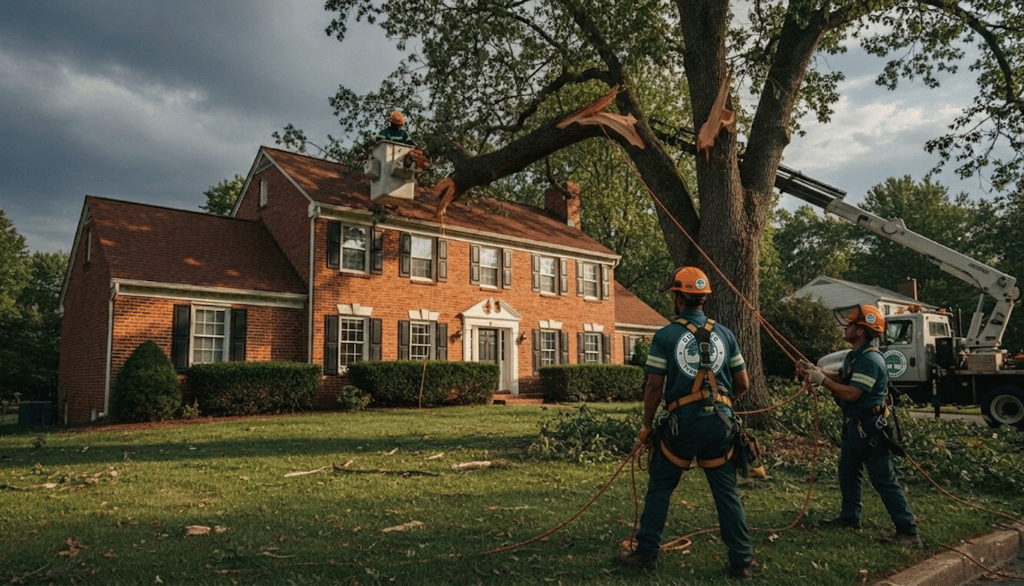
On the evening of March 2, 2024, a homeowner in Falls Church stood by their window as a 70-foot Silver Maple swayed dangerously toward their master bedroom during a 60-mph gust. This terrifying moment highlights why local homeowners prioritize a dependable emergency tree service Northern Virginia to safeguard their properties. You recognize that these grand specimens are vital to our local ecosystem, yet their sheer scale demands professional respect when structural integrity is compromised by a storm. It's a balance between appreciating the botanical beauty of our region and managing the physical risks that come with aging timber.
We agree that the uncertainty of a leaning trunk or a hanging limb is a burden no family should carry. You deserve a response rooted in horticultural expertise rather than the opportunistic tactics of storm chasers who appear after the rain. This guide provides the exact steps to identify hidden tree hazards, navigate the complexities of insurance documentation, and select an arborist who values the long-term health of your soil and canopy. We'll explore how to secure your landscape and find peace of mind through rigorous, professional storm response that respects the life of the tree and the safety of your home.
Key Takeaways
Distinguish between routine maintenance and immediate threats by identifying what constitutes a true arboreal emergency in the volatile Northern Virginia climate.
Learn to recognize early warning signs of internal rot and structural instability before adverse weather turns a vulnerable tree into a significant hazard.
Streamline your recovery by mastering the documentation and equipment requirements needed for a rapid, professional response during a storm crisis.
Navigate the financial complexities of storm damage by understanding how the "Tree on Structure" rule affects your coverage for emergency tree service Northern Virginia.
Discover how deep-rooted local horticultural expertise can protect your property's value and ensure the long-term health of your landscape's canopy.
Table of Contents
The Emergency Response Process: From Call to Site Restoration
Why Local Expertise Matters: The Guilmer Tree Service Approach
What Constitutes a Tree Emergency in Northern Virginia?
Nature doesn't follow a human schedule. In the specialized field of Arboriculture, we define a tree emergency as any situation where a specimen poses an immediate, structural threat to life, property, or public infrastructure. It's not merely a fallen branch; it's a disruption of the delicate balance between our urban forest and our built environment. When a 50-foot Oak loses its structural integrity, the transition from a majestic landscape feature to a multi-ton liability happens in seconds.
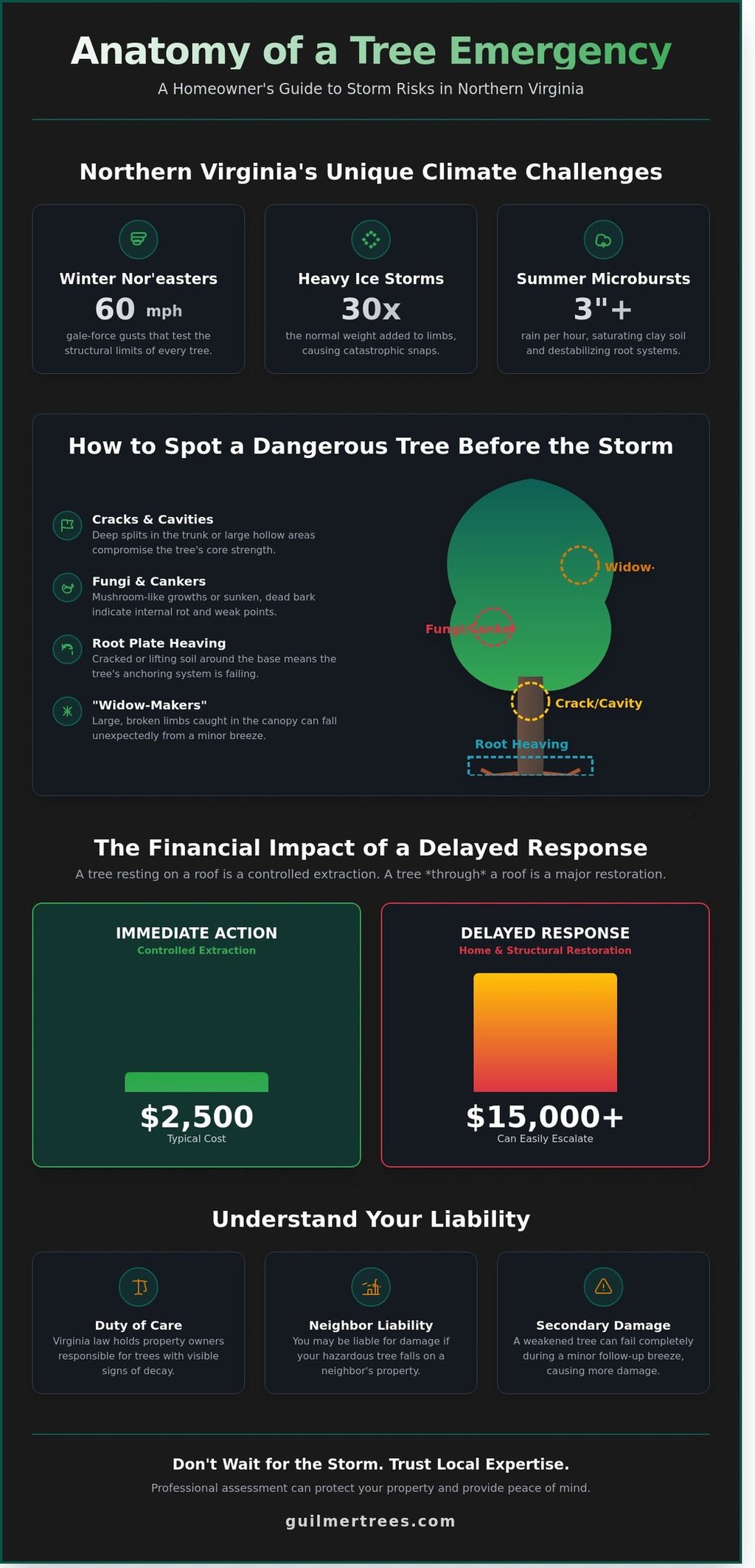
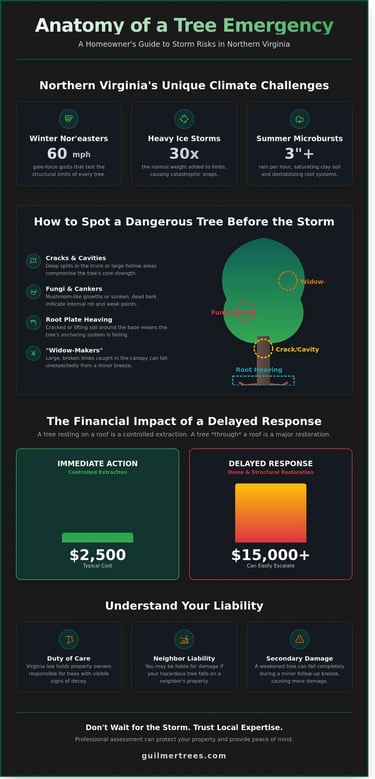
Northern Virginia's climate creates a specific set of challenges for local flora. We face a unique trifecta of weather patterns: winter Nor'easters with 60 mph gusts, heavy ice storms that can add 30 times the weight to a single limb, and summer microbursts that drop three inches of rain in under an hour. These events saturate the clay-heavy soils common in Fairfax County, significantly weakening the root plate's grip. When the ground becomes a slurry, even a healthy-looking tree can become a candidate for an emergency tree service Northern Virginia specialist.
Distinguishing between a hazardous lean and natural growth is vital for peace of mind. Many trees exhibit a phototropic lean, where they've spent 20 years growing toward the light. This is generally stable. However, a hazardous lean is characterized by fresh soil heaving at the base, cracked earth, or exposed feeder roots. If you see daylight under a root ball after a storm, the tree's anchoring system has failed. Homeowners in Falls Church often hesitate to call, but waiting until morning frequently doubles the final bill. A tree resting on a roof at 10 PM is often a controlled extraction; by 6 AM, if that tree has shifted and punctured the structural ridge beam, a $2,500 removal can easily turn into a $15,000 home restoration project.
Common Emergency Scenarios in Fairfax and Arlington
In densely populated areas like Arlington, trees resting on power lines or blocking driveway access represent the most frequent calls. We often see uprooted root balls following periods of heavy saturation where the soil can no longer support the tree's lever arm. Another silent threat is the "widow-maker," a large limb that has snapped but remains hanging precariously over a sidewalk or deck. These require emergency tree service Northern Virginia expertise to remove without triggering a secondary fall.
The Legal and Safety Risks of Delayed Response
Virginia law maintains a strict "Duty of Care" for property owners. If a tree shows visible signs of decay or structural instability, the owner is often held liable for any resulting damage to neighboring properties. Local authorities in Falls Church and Alexandria prioritize public safety clearances, meaning they may intervene if a tree threatens a public right-of-way. Beyond the legalities, the risk of secondary damage is high; a weakened tree that survived the initial wind may fail completely during a minor follow-up breeze, leading to catastrophic structural collapse.
How to Spot a Dangerous Tree Before the Storm Hits
True stewardship of a landscape requires more than just planting; it demands a patient, expert eye to recognize when a specimen's health is failing. In our region, the soil often dictates the fate of the canopy. Northern Virginia's heavy clay holds moisture significantly longer than sandy soils, which often leads to root instability during our 43 inches of annual rainfall. During peak storm season, these saturated conditions combined with 60 mph gusts create a dangerous lever effect on tall, heavy-headed trees. Identifying these risks early reduces the need for emergency tree service Northern Virginia professionals to arrive after a limb has already met your roofline.
Species-specific knowledge is essential for accurate risk assessment. Red Maples and Silver Maples are common throughout the area, but their fast growth rates often result in brittle wood that snaps under ice or wind. Conversely, our majestic White Oaks are incredibly sturdy, yet they can hide internal "heart rot" for decades without showing crown thinning. One specific indicator we look for is the canker. A canker is a localized area of dead bark or sunken wood on a stem or branch that serves as a primary point for structural failure during high-stress weather events.
Structural Red Flags: Cracks, Cavities, and Fungi
The geometry of a tree tells the story of its structural integrity. We pay close attention to branch unions. A "U-shaped" union is typically strong, but a "V-shaped" union indicates "included bark," where two stems grow against each other without a solid wood connection. This creates a natural cleavage point that's prone to splitting. Fungal growth is another critical warning. If you see "conks" or shelf mushrooms growing from the base of the trunk, it means fungi are actively digesting the internal wood fibers. To better protect your property, you should Identify & Assess Hazard Trees by checking for deep vertical cracks. These fissures often signal that the trunk is splitting internally under the weight of its own canopy.
Root Zone Health: The Foundation of Stability
A tree's stability is only as good as its silent anchor. We often see trees fail because of root damage that occurred years prior. Any construction, such as installing a driveway or a fence within the last 36 months, can sever up to 50% of the critical structural roots if the work happened within 15 feet of the trunk. You can spot root failure by looking for soil heaving or fresh cracks in the earth near the dripline. When assessing a lean, determine if it's new or historical. A tree that has grown with a curve has likely compensated for its lean over time, but a straight trunk that suddenly tilts more than 15 degrees is a sign of imminent failure. When storm clouds gather, knowing these signs helps you decide if you need an emergency tree service Northern Virginia team on site. For a thorough check of your property's most valuable specimens, consider a professional health evaluation to ensure long-term safety and peace of mind.
The Emergency Response Process: From Call to Site Restoration
When a storm strikes Fairfax or Loudoun County, the first 60 minutes of contact dictate the success of the recovery. Homeowners seeking emergency tree service Northern Virginia should prepare three vital pieces of information during the initial call: clear digital photos of the damage, the exact site coordinates, and the proximity of the failure to active power lines. This data allows our dispatch team to mobilize the correct configuration of 75-foot bucket trucks or compact spider lifts designed for narrow residential access. Safety protocols remain paramount during active weather. We coordinate directly with local utility providers to ensure lines are de-energized before our technicians begin the stabilization process.
Rapid Assessment and Hazard Mitigation
Upon arrival, the arborist’s priority is a 360-degree evaluation to establish the "fall zone." This perimeter protects residents and nearby structures from secondary failures. We use strategic limb removal to redistribute weight, which prevents a partially uprooted specimen from shifting unexpectedly. Our team applies technical knowledge on how to identify and assess hazard trees to differentiate between stable limbs and those under extreme tension. This phase is about control; we secure the area within 15 minutes to prevent further property loss.
Advanced Removal Techniques: Crane-Assisted Extraction
For trees that have breached the building envelope, traditional felling isn't a safe option. We deploy 40-ton cranes to perform vertical extractions. This technique lifts massive trunk sections directly upward, preventing the "seesaw" effect that causes additional structural damage to the roof or siding. To protect the delicate root systems of surrounding flora and your lawn's integrity, we utilize high-density polyethylene mats. These distribute the 80,000-pound weight of the equipment, preventing the severe soil compaction that often leads to the long-term decline of your remaining landscape.
Site restoration is the final, non-negotiable stage of our emergency tree service Northern Virginia. A storm leaves behind a chaotic volume of organic debris that can harbor pests if left unmanaged. Our process includes:
Industrial Chipping: We process limbs up to 18 inches in diameter on-site, converting storm waste into usable mulch.
Structural Pruning: We remove "hangers" or broken branches left in the standing canopy to prevent future hazards.
Debris Removal: Every leaf and twig is raked and hauled away, leaving the property in a state of horticultural balance.
Our approach mirrors the meticulous standards of a production nursery. We don't just clear a path; we restore the order of your outdoor living space. By treating every emergency with the same precision we use for transplanting high-value specimens, we ensure your property remains a safe, thriving environment for years to come.
Navigating Insurance and Costs for Emergency Tree Service
Managing the aftermath of a storm requires a blend of horticultural expertise and administrative precision. In the Commonwealth of Virginia, insurance coverage for tree incidents isn't universal; it's governed by the "Tree on Structure" rule. Most homeowners policies trigger coverage only when a specimen impacts a covered structure like a house, garage, or permanent fence. Standard Virginia homeowners policies rarely extend coverage to specimens that fall into an open yard without impacting a structure or blocking a primary driveway.
Documenting the scene before any saws start turning is vital for a successful claim. You should capture a minimum of six high-resolution images from varying angles. These photos must clearly show the point of impact on the structure, the root ball's condition, and any identifying features that prove the tree's original location. Adjusters look for these specific visual cues to validate that the event was a sudden peril rather than a result of long-term neglect.
When you hire an emergency tree service Northern Virginia, you'll encounter "Reasonable and Customary" fees. These rates are regional benchmarks that insurance companies use to cap payouts. During a declared storm emergency, mobilization costs often see a 20% to 35% surge due to the high demand for specialized labor and the inherent risks of working in unstable conditions. Understanding these financial bounds helps you manage expectations when the final invoice arrives.
Working with Your Insurance Provider
Selecting a licensed and fully insured company is the only way to protect your liability. If an uninsured crew suffers an injury on your property, the financial burden could fall on you, potentially voiding your own coverage. Many reputable firms offer a "Direct Pay" option where they coordinate directly with your adjuster, though many homeowners still opt for the reimbursement model to maintain control over the process. A detailed arborist report is your most powerful tool; it provides the technical justification adjusters need to approve a claim, detailing why specific equipment or rigging was necessary for safe removal.
Factors Influencing Emergency Service Pricing
The cost of a emergency tree service Northern Virginia isn't arbitrary; it's a reflection of technical difficulty and resource allocation. Several variables dictate the final quote:
Time and Logistics: Requests at 2:00 AM or during active gale-force winds carry premium hazard pay for the crew.
Equipment Requirements: The use of a 60-ton crane or a specialized spider lift can add $1,500 to $3,000 to the base operating cost.
Technical Rigging: Trees entangled in power lines or leaning over delicate glass structures require slow, meticulous roping techniques that increase man-hours.
Debris and Stumps: Removing the trunk and branches usually accounts for 15% of the total bill, while stump grinding is often treated as a separate, non-emergency service.
To ensure your property is managed with technical mastery and artisan care, consult with our expert team for a professional evaluation.
Why Local Expertise Matters: The Guilmer Tree Service Approach
At Guilmer Tree Service, we approach every call with our "Savoir-faire" philosophy. It isn't just about clearing a path after a storm; it's about respecting the biological clock of Northern Virginia's urban forest. Our team doesn't just see a fallen limb. We see the history of a 50-year-old White Oak or the future of a young Maple. Based in Falls Church, our crews understand the specific challenges of the local Piedmont clay soil. This heavy ground holds moisture differently than sandy coastal plains, often leading to root heave during the 60 mph gusts we saw during the 2023 storm season. By understanding these subterranean dynamics, we provide an emergency tree service Northern Virginia residents trust to preserve their landscape's value.
Our deep roots in the community mean we're familiar with the specific species that dominate Fairfax, Arlington, and Alexandria. We don't believe in the "slash and dash" method common in the industry. Instead, we view every emergency as a moment to stabilize the living structure of your property. Our 24/7 commitment ensures that when a storm hits at 2:00 AM, you're reaching experts who live and work in your neighborhood, not a distant dispatch center. We've spent decades perfecting the art of the "long view," ensuring that the actions we take tonight don't compromise the health of your canopy ten years from now.
Professionalism and Botanical Integrity
True professionalism in arboriculture requires more than a chainsaw. Our expert pruning techniques focus on structural integrity, which can prevent future emergency calls by reducing wind resistance in the crown. Statistics show that nearly 80% of storm-related tree failures involve specimens with pre-existing structural defects that could've been mitigated. We offer a proactive hazardous tree assessment to identify these vulnerabilities before the clouds gather. When we do respond to an emergency tree service Northern Virginia request, our focus remains on clean, respectful site restoration. We treat your lawn and garden with the same reverence we show the trees themselves, leaving the site pristine and ready for recovery.
Your Partner in Northern Virginia Tree Care
We aren't just contractors; we're your neighbors. Choosing a local expert means you're gaining direct access to specialists who understand the local climate cycles and pest pressures unique to the Potomac basin. Our tradition of quality values the slow, steady growth of a healthy landscape over quick, temporary fixes. We take pride in our role as stewards of the local environment, from the historic streets of Alexandria to the wooded lots of Fairfax. If you're concerned about a leaning trunk or a cracked bough, don't wait for the next storm to act. Contact us today for a hazardous tree assessment and experience the peace of mind that comes with the Guilmer signature of excellence.
Protect Your Landscape’s Future Today
Managing the aftermath of a storm requires more than just a quick fix; it demands a deep understanding of arboricultural health and structural integrity. You've learned how to identify high-risk hazards like leaning trunks or cracked limbs before they fail. When disaster strikes, our team employs specialized crane-assisted removal to protect your property from further damage. Since 2021, we've served the Falls Church community with a commitment to the longevity of the local canopy.
Choosing a licensed and insured partner ensures your site restoration meets professional Virginia standards. We don't just clear debris; we preserve the living legacy of your landscape through technical precision. If you're facing an immediate hazard, don't wait for the situation to worsen. Accessing professional emergency tree service Northern Virginia homeowners trust is the most effective way to restore safety to your home.
Request 24/7 Emergency Tree Service in Northern Virginia
The resilience of your trees defines the beauty of your property for years to come.
Frequently Asked Questions
Does insurance cover tree removal if the tree hasn't fallen yet?
Most standard homeowners' insurance policies won't cover the cost of tree removal if the tree is still standing. Carriers generally view the removal of a dead or leaning tree as a preventative maintenance responsibility for the property owner. In 92% of cases, coverage only triggers after a tree falls and causes direct damage to a covered structure like your home, garage, or fence.
What should I do if a neighbor's tree looks like it might fall on my house?
You should document the hazard with photographs and send a certified letter to your neighbor to put them on formal notice. Under Virginia civil law, once a neighbor is notified of a specific "nuisance" tree that poses an actual danger, they can be held liable for subsequent damages. We recommend hiring a certified arborist to provide a written risk assessment to include with your formal correspondence.
How much does emergency tree removal cost in Northern Virginia?
The cost for emergency tree service Northern Virginia homeowners typically pay ranges from $1,500 to over $5,000 depending on the complexity of the job. Prices fluctuate based on the tree's size, its proximity to structures, and whether we need a 60 ton crane for safe extraction. We provide transparent, detailed estimates that reflect the technical rigor and specialized equipment required to manage storm damaged timber safely.
Can I remove a fallen tree from a power line myself?
You must never attempt to move a tree in contact with power lines because the risk of fatal electrocution is extremely high. Residential distribution lines in our area often carry 7,200 to 14,400 volts which can arc to your body even without direct contact. You're required to wait until Dominion Energy or NOVEC technicians de-energize the line before our crews can safely begin the clearing process.
How quickly can Guilmer Tree Services respond to an emergency in Falls Church?
Our specialized teams typically arrive at Falls Church properties within 2 to 4 hours of an emergency call. We maintain a fleet of ready-to-deploy equipment to ensure we can stabilize a dangerous situation before further damage occurs. This rapid response is a fundamental part of the Guilmer Know-how, focusing on the immediate protection of your home and the preservation of your remaining landscape assets.
What happens to the wood and debris after an emergency removal?
We process 100% of the organic debris by either chipping it into mulch on-site or hauling larger logs away for professional milling. Our high capacity chippers handle branches up to 18 inches in diameter, leaving your property clean and free of clutter. We respect the lifecycle of every tree and ensure that even storm-damaged wood is repurposed into useful materials for the local community.
Do I need a permit for emergency tree removal in Fairfax County?
You don't need a permit for an emergency tree service Northern Virginia project in Fairfax County if the tree presents an immediate threat to life or property. While local ordinances protect the regional canopy, emergency exemptions allow for the instant removal of hazardous specimens. We suggest you take 4 to 6 clear photos of the hazard before we start work to satisfy any future county inquiries or insurance claims.
How can I tell if my tree was struck by lightning?
Look for a distinct vertical strip of bark missing from the trunk or a deep, charred crack running toward the ground. Lightning strikes can reach 50,000 degrees Fahrenheit, causing the tree's internal moisture to boil and explode the bark outward. You'll often see the canopy begin to wilt within 24 to 48 hours as the electrical surge destroys the tree's delicate vascular system and root ends.
Our Services
Tree Removal
Tree Trimming and Pruning
Stump Grinding
Bush Chipping
Hours & Information
© 2026. All rights reserved.
Monday to Friday : from 9:00 AM – 5:00 PM
on-site : from 8:00 AM – 6:00 PM