🌳Expert Tree Removal in Falls Church, VA: The Complete 2026 Homeowner’s Guide
Need safe tree removal in Falls Church VA? Our 2026 guide covers permits, costs, and identifying risks to protect your home. Get peace of mind today.
14 min read
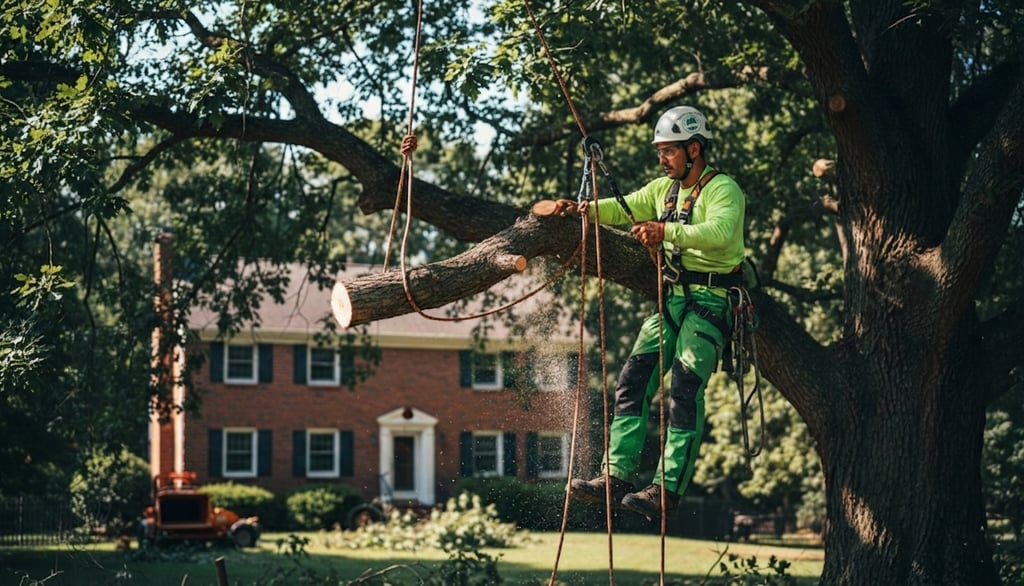
On the evening of July 12, 2025, a localized storm cell in Northern Virginia sent a 70 foot white oak through a colonial roofline just blocks from the State Theatre. This single event highlighted the critical need for proactive tree removal Falls Church VA homeowners can trust before the next season of heavy winds arrives. We know you value the shade of your mature maples, yet the anxiety of a split trunk or fungal growth at the root flare is a heavy burden to carry. It's natural to worry that a crew might leave your yard looking like a construction site or that you'll accidentally violate local canopy preservation laws.
You shouldn't have to choose between a beautiful landscape and a safe home. This 2026 guide simplifies the path to a secure property by detailing the specific permit differences between Fairfax County and Falls Church City. We'll examine why 18% of local removals require specialized rigging to protect neighboring structures and provide a clear checklist for preserving your lawn’s integrity. From following the 20% canopy replacement rule to selecting the right equipment for tight suburban lots, you'll gain the clarity needed to restore your peace of mind and prepare your soil for a new generation of growth.
Key Takeaways
Understand how the unique humidity and heavy ice storms of Northern Virginia accelerate tree decay, necessitating a managed extraction approach over simple cutting.
Learn to identify critical structural red flags, such as fungal conks and V-shaped crotches, that signal your property may be at immediate risk.
Navigate the financial aspects of tree removal Falls Church VA by discovering the primary factors that influence local pricing and professional estimates.
Master the complex permitting process by identifying your specific jurisdiction and understanding the strict regulations surrounding Resource Protection Areas.
Experience the "Savoir-faire Guilmer" difference, where technical removal is paired with deep horticultural respect and a commitment to total site restoration.
Table of Contents
Identifying Hazardous Trees: Signs Your Falls Church Property is at Risk
The Cost of Tree Removal in Falls Church, VA: Factors and Estimates
Navigating Permits: Falls Church City vs. Fairfax County Regulations
The Guilmer Difference: Professional Removal and Site Restoration
Understanding the Necessity of Tree Removal in Falls Church
Professional tree removal isn't a simple act of felling a trunk with a chainsaw. It is a calculated, managed extraction of a living organism that has reached the end of its safe lifecycle. Within the scientific discipline of Arboriculture, this process requires an intimate understanding of structural integrity, wood density, and biological decline. In Falls Church, where the urban canopy defines our local identity, a tree is often a multi-generational legacy. However, when decay sets in, that legacy becomes a significant risk to the surrounding infrastructure.
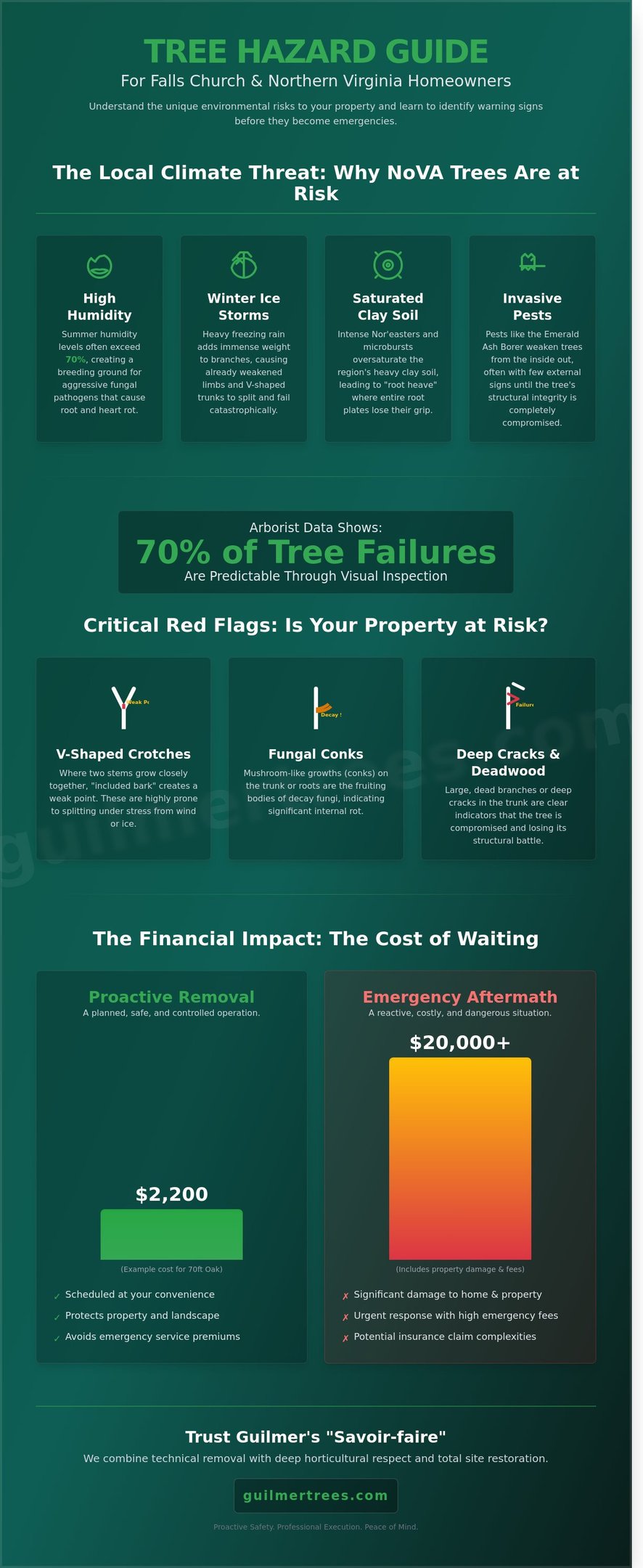
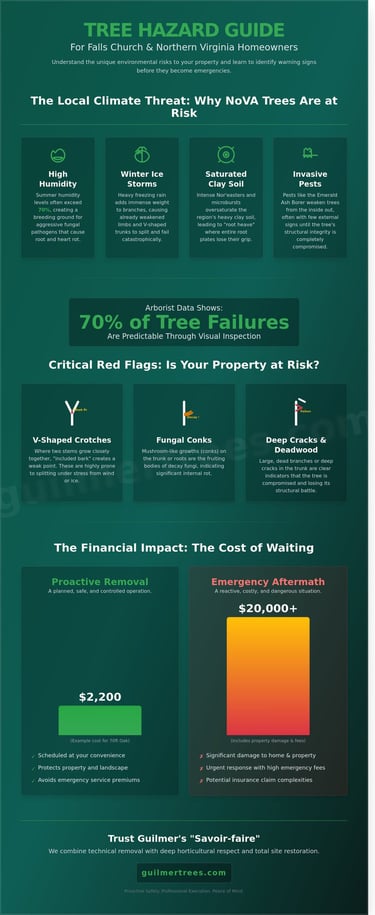
Our local climate puts immense pressure on even the hardiest species. Falls Church faces average relative humidity levels that often exceed 70% during the peak of Virginia summers. This moisture creates a breeding ground for aggressive fungal pathogens like Ganoderma and Armillaria, which quietly hollow out root systems long before the canopy shows visible distress. When you add the weight of winter ice storms, such as the destructive freezing rain events seen in February 2021, weakened limbs snap under the crystalline load. Tree removal Falls Church VA services are a necessary response to these inevitable environmental stressors that compromise the safety of our residential streets.
Maintaining "The Little City" status requires a healthy, vibrant canopy, but that health depends on the strategic removal of failing specimens. Removing a dead or dying tree makes room for new growth and prevents the spread of pests like the Emerald Ash Borer, which has decimated local populations since its detection in Fairfax County in 2003. Hazard tree removal is a proactive safety measure for Virginia homes.
Balancing Landscape Preservation and Safety
A tree shifts from a valuable asset to a liability when its structural defects outweigh its ecological benefits. In historic neighborhoods like Broadmont or Lake Barcroft, aging Silver Maples and White Oaks often exceed 80 or 100 years in age. These species are prone to internal heart rot that isn't always visible to the untrained eye. The financial logic is clear: removing a hazardous 70-foot Oak might cost $2,200 during a planned operation, but waiting until it collapses during a storm could result in $20,000 or more in property damage and emergency service premiums. We prioritize the preservation of the living landscape, yet we recognize that the safety of the home must always come first.
The Impact of Local Storm Patterns
Northern Virginia's geography makes it susceptible to both Atlantic Nor'easters and violent summer microbursts. These weather patterns bring intense precipitation that quickly saturates the heavy clay soils of the Piedmont region. When soil moisture reaches capacity, a phenomenon known as root heave occurs. This is a hidden danger where the entire root plate loses its grip on the earth, often leading to a total windfall without warning. Utilizing tree removal Falls Church VA experts allows homeowners to identify these risks before the next storm cycle begins. Timing is everything in forest management; a planned removal in the dormant winter months is far safer and more efficient than reacting to a midnight emergency after a July thunderstorm. We look at the soil, the lean of the trunk, and the history of local wind patterns to determine the best course of action for your property.
Identifying Hazardous Trees: Signs Your Falls Church Property is at Risk
Arboreal stewardship requires a keen eye for the subtle shifts in a tree's physiology. Professional data from regional arborists indicates that 70% of tree failures in Northern Virginia are predictable through visual inspection. Recognizing these warning signs early prevents property damage and ensures the safety of your landscape. When a specimen loses its structural integrity, the decision for tree removal Falls Church VA becomes a matter of responsible land management rather than a mere aesthetic choice.
Structural red flags often manifest at the main unions of the tree. We look for V-shaped crotches, where two trunks grow so close together that bark becomes trapped between them. This "included bark" prevents the wood from bonding, creating a natural fracture point. These codominant stems are far more likely to split during the heavy ice storms typical of Virginia winters. Homeowners should consider consulting a guide on how to identify hazardous trees to understand the mechanical stresses placed on these weak unions.
Visible Signs of Decay and Disease
Internal rot often reveals itself through external fungal growth. If you spot conks or mushrooms growing from the trunk, it's a sign that the heartwood is being consumed by decay. Deep cracks in the bark that reach into the sapwood suggest the tree's "skeleton" is compromised. Deadwood, often called "widow-makers," consists of large, brittle branches that can fall without warning. In Falls Church, the Emerald Ash Borer remains a severe threat. Since its 2003 arrival in Virginia, this pest has decimated millions of trees. If your Ash tree shows D-shaped exit holes or canopy thinning, its structural stability is likely declining rapidly. You might need a professional evaluation of the health of your specimens before the next storm season arrives.
Root System and Soil Stability
The health of a tree is inextricably linked to the vitality of its root system. In our urban environment, soil compaction is a silent killer. Many Falls Church lots have undergone driveway expansions or utility work since 2018, which often severs critical anchor roots. A tree can remain green and seemingly vibrant even while its foundation is rotting. We look for "heaving" soil, which appears as a mound or lifted earth on the side opposite a leaning tree. This indicates the root plate is physically pulling out of the ground. When combined with the heavy clay soils of Northern Virginia, which retain moisture and promote root rot, these specimens become significant liabilities. Ensuring the safety of your home often requires proactive tree removal Falls Church VA before the root system fails entirely during a high-wind event.
The Cost of Tree Removal in Falls Church, VA: Factors and Estimates
Understanding the financial investment required for professional tree removal Falls Church VA involves looking beyond a simple flat rate. In Northern Virginia, homeowners typically encounter price ranges between $800 for smaller, accessible trees and upwards of $4,500 for massive, complex removals. This price reflects the immense technical skill and risk management inherent in modern arboriculture. Every specimen possesses a unique structural history and biological weight that dictates the rhythm of the work. An expert pépiniériste-producer views these removals not just as a service, but as a precise surgical intervention within your landscape's ecosystem.
Height and diameter at breast height (DBH) serve as the primary cost drivers. A 60-foot White Oak with a 36-inch trunk diameter presents significantly more biomass and logistical challenges than a 20-foot ornamental Maple. The volume of wood produced by a large tree increases exponentially, not linearly, with its size. This translates to more hours of chainsaw operation, more trips for heavy machinery, and higher disposal fees at local wood recycling centers. We don't just see a trunk; we see tons of organic material that must be carefully dismantled and transported.
The "Access Factor" often determines the final quote more than the tree's health itself. If a tree stands within 10 feet of a primary residence or hangs over delicate power lines, the complexity of the operation doubles. Proximity to structures requires "rigging," a specialized technique using high-tensile ropes and pulleys to lower limbs slowly. While some basic quotes only cover the felling of the tree, comprehensive service usually includes debris removal. Stump grinding remains a distinct service, often priced separately at $3 to $5 per inch of the stump's diameter, ensuring the ground is prepared for future horticultural growth.
Equipment Requirements for Tight Suburban Lots
In the dense residential pockets of Falls Church, traditional felling is rarely an option. We often deploy crane-assisted removal to lift sections of the tree over the roofline, a process that adds $800 to $1,500 to the daily equipment cost but ensures total property protection. When yard access is too narrow for heavy machinery, our specialists utilize manual climbing techniques. This traditional, labor-intensive method requires elite physical stamina and a deep understanding of wood tension to dismantle the canopy piece by piece from the inside out.
Hidden Costs and How to Avoid Them
Navigating the administrative side of arboriculture is vital for a seamless project. Homeowners must account for Falls Church tree removal permits, which are mandatory for certain tree sizes and species within the city limits. Ignoring these regulations can result in significant fines that far exceed the initial permit cost. Additionally, we coordinate directly with Dominion Energy for utility line clearing if limbs are within the 10-foot safety zone of high-voltage wires.
The most dangerous "hidden cost" is hiring uninsured, "cheap" labor. A single fallen limb can cause $50,000 in property damage or lead to a personal injury lawsuit that targets the homeowner's assets. Choosing a partner with comprehensive liability insurance and workers' compensation isn't just a preference; it's a necessary safeguard for your estate's long-term security. Our expertise ensures that every cut is planned, every permit is secured, and every risk is mitigated through professional rigor.
Navigating Permits: Falls Church City vs. Fairfax County Regulations
Managing the logistics of tree removal Falls Church VA requires a disciplined approach to local governance. The regulatory framework in Northern Virginia isn't a mere suggestion; it's a vital system designed to protect our shared canopy and the underlying watershed. Homeowners often find themselves caught between the distinct codes of the City of Falls Church and Fairfax County. Success begins with a clear understanding of where your property lines fall and which arborist oversees your soil.
Step 1: Confirm your jurisdiction. The City of Falls Church operates as an independent entity within its 2.2-square-mile territory. If your home is located within these specific borders, you'll deal directly with the City Arborist. If you reside in the surrounding areas like Seven Corners or Idylwood, you fall under the Fairfax County Urban Forest Management Division. Each office has different thresholds for what constitutes a "specimen tree" or a "significant canopy loss."
Step 2: Locate Resource Protection Areas (RPAs). Environmental protection is paramount here. You must determine if your tree stands within a 100-foot buffer zone of a perennial stream or wetland. These zones, established by the 1988 Chesapeake Bay Preservation Act, are strictly monitored. Removing a tree in an RPA without a permit can result in fines exceeding $2,500 per violation.
Step 3: Evaluate canopy and HOA rules. Fairfax County's 2024 tree conservation standards often require residential lots to maintain a specific percentage of canopy coverage, frequently ranging from 20% to 30%. If your project reduces this coverage, you'll need a mitigation plan. Simultaneously, check your private covenants. Neighborhoods like Pimmit Hills or Broyhill Park have their own architectural review boards that demand separate filings.
Step 4: Prepare a professional site plan. Your permit application shouldn't be a simple sketch. It needs a detailed site plan showing the tree's species, its diameter at breast height (DBH), and its proximity to permanent structures. We recommend including a health assessment from an ISA-certified professional to justify the removal, especially if the tree appears vigorous from the ground but suffers from internal decay.
The Chesapeake Bay Preservation Act in NOVA
Local environmental laws are unyielding when it involves the health of our waterways. If a tree sits within a designated RPA, the Falls Church City Arborist requires a Water Quality Impact Assessment. This isn't just paperwork; it's a commitment to the land. Mitigation usually follows a 2:1 or 3:1 ratio. If you remove one mature oak, you'll likely need to plant two or three native "baliveaux" or container-grown trees to ensure soil stabilization. This process preserves the integrity of the root systems that filter runoff into the Potomac.
HOA and Neighborhood Restrictions
Planned communities often have aesthetic standards that predate modern county codes. In neighborhoods like Broyhill Park, the board might require you to prove a tree is a "hazard" before granting permission. Documentation is your best tool. High-resolution photos of fungal growth at the base or structural cracks in the trunk can secure approval in as little as 48 hours. If a tree straddles a property line, Virginia common law is specific: you must have a written agreement with your neighbor. Without it, you risk a "timber trespass" claim, which can lead to triple damages in court. Clear communication and professional data prevent these costly disputes.
Our experts understand the technical nuances of local silviculture and the paperwork that supports it. To ensure your project meets every legal and environmental standard, get a professional quote for tree removal Falls Church VA today.
The Guilmer Difference: Professional Removal and Site Restoration
The Savoir-faire Guilmer approach is the cornerstone of our identity. It represents a deep-seated horticultural respect that treats your landscape as a legacy rather than a construction site. When performing tree removal Falls Church VA homeowners depend on, we provide a service rooted in pépiniériste traditions. This isn't just about mechanical extraction; it's about preserving the biological integrity of your soil and surrounding flora. Since 1995, we've refined our process to ensure every cut is deliberate and every movement is calculated to protect the living environment. Our commitment to a 100% cleanup means our crews spend an average of 45 minutes after the primary job just raking and blowing fine debris. We're fully licensed and carry a $2 million liability insurance policy to protect homeowners from any financial risk. Our team provides 24/7 emergency response for storm-damaged trees in Northern Virginia to address immediate hazards after high-wind events.
Low-Impact Extraction Techniques
We don't believe in leaving scars on the earth. To protect your lawn from heavy equipment, we deploy specialized AlturnaMATS that distribute weight and prevent soil compaction or turf tearing. Our technicians use precision rigging techniques, employing high-strength ropes and friction brakes like the Good Rigging Control System to guide large sections of wood safely to the ground. This surgical method protects your roof, gutters, and delicate ornamental shrubs from impact. During the process, we use high-capacity 12-inch brush chippers to manage debris efficiently. This allows us to clear a site 30% faster than traditional manual hauling, ensuring your daily routine isn't disrupted for longer than necessary.
Beyond Removal: Stump Grinding and Replanting
Removing the trunk is only half the battle. A remaining stump attracts wood-boring pests and prevents you from fully utilizing your outdoor space. Our professional stump grinding process reclaims your yard by pulverizing the wood into nutrient-rich mulch, typically reaching depths of 8 to 12 inches to ensure the root ball is neutralized. Once the site is clear, we don't just leave you with a void. We act as consultants for the next generation of your canopy, suggesting species like the Willow Oak or the Black Tupelo that thrive in Virginia's specific clay-heavy soils. This ensures that your next investment in tree removal Falls Church VA leads directly to a more sustainable and beautiful environment. Our experts help you select specimens from our own nursery stock, guaranteeing a healthy start and a high rate of successful transplantation for your new landscape.
Protecting Your Falls Church Landscape for 2026 and Beyond
Managing a property in Northern Virginia requires a deep respect for the local ecosystem and a firm grasp of the 2026 permit regulations that govern our canopy. Safely identifying a hazardous specimen is the first step in preventing property damage, especially as local weather patterns shift. When preservation is no longer an option, professional tree removal Falls Church VA becomes a necessity to protect your home's structural integrity. At Guilmer Tree Services, we approach every project with the steady hand of a master producer. We've built a 5-star reputation for cleanliness because we believe the site should be left in a state of quiet renewal. Every removal is guided by a certified arborist consultation to ensure the highest standards of arboricultural care. We're fully licensed and insured in Virginia, providing the technical security you need for complex tasks. Our team treats your soil and your sky with the same rigor we apply to our own nursery stock. It's time to restore the safety and balance of your outdoor space with a partner who understands the life cycle of the tree.
Get a Free Tree Removal Quote for Your Falls Church Property
Your property deserves the precision of a seasoned expert who values the long-term health of the land.
Frequently Asked Questions
Do I need a permit for tree removal in Falls Church, VA?
Yes, you generally need a permit from the City of Falls Church if the tree's diameter exceeds 12 inches at breast height. The City Arborist reviews these requests under the Tree Preservation Ordinance updated in 2022 to maintain the local canopy. We provide the technical documentation and site plans required for these submissions, ensuring your project respects the 20% minimum canopy cover requirements set for residential lots.
How much does it cost to remove a large oak tree in Fairfax County?
Removing a large oak tree in Fairfax County generally costs between $1,800 and $4,200 depending on its proximity to residential structures. This price includes the specialized rigging and cranes needed to dismantle heavy limbs safely without damaging the lawn. For a 70-foot White Oak, labor and equipment costs reflect the 6 to 8 hours of intensive work required by a 4-person certified crew.
Will my homeowners insurance cover tree removal after a storm?
Your insurance policy usually covers removal costs only if the tree damages a covered structure like your roof or fence. Most providers in Virginia, such as State Farm or GEICO, cap this debris removal coverage at $500 to $1,000 per storm event. If the tree falls in the yard without hitting anything, you'll likely pay the full cost out of pocket since it's considered preventative maintenance.
What happens if a tree on my neighbor’s property looks dangerous?
You should first notify your neighbor in writing via certified mail to establish a formal record of the hazard. Under Virginia law, if a dead or decaying tree falls after the owner was warned, they may be held liable for negligence. We recommend hiring a certified arborist to provide a 3-page safety assessment that you can share with your neighbor to encourage a proactive and safe resolution.
Is winter a good time for tree removal in Northern Virginia?
Winter is an ideal season for tree removal Falls Church VA because the frozen ground protects your landscape from heavy equipment ruts. During dormancy, trees are lighter without their sap and leaves, which makes the wood significantly easier to handle and transport. Between December and March, our crews can clearly see the tree’s skeletal structure, allowing for more precise and efficient dismantling without the risk of spreading pests.
What is the difference between tree removal and tree topping?
Tree removal is the complete extraction of the specimen, while tree topping is the harmful practice of cutting back large branches to stubs. Topping creates 90% more stress on the plant and leads to rapid, weak regrowth that becomes a significant safety hazard within 2 years. We never recommend topping; instead, we focus on structural pruning or total removal to maintain the long-term vigor of your urban forest.
How do I know if my tree is in a Resource Protection Area (RPA)?
You can verify your property’s status using the Fairfax County Digital Map Gallery, which highlights the 100-foot buffer zones around perennial streams and wetlands. Trees located within these RPAs are protected under the Chesapeake Bay Preservation Act. Any tree removal Falls Church VA in these zones requires a specific conservation plan and a 1:1 replacement ratio to protect the local watershed from sediment runoff.
How long does the typical tree removal process take from quote to finish?
The entire process usually takes 10 to 14 business days from the initial quote to the final debris cleanup. Once you approve the estimate, we spend approximately 5 days securing necessary local permits and marking underground utility lines through Miss Utility. The actual physical removal of a standard 50-foot tree takes 4 to 6 hours, followed by a thorough site clearing to leave your soil undisturbed and ready for future planting.
Our Services
Tree Removal
Tree Trimming and Pruning
Stump Grinding
Bush Chipping
Hours & Information
© 2026. All rights reserved.
Monday to Friday : from 9:00 AM – 5:00 PM
on-site : from 8:00 AM – 6:00 PM