🌳Fallen Tree Removal in Arlington, VA: A Homeowner’s Complete Action Guide
Your guide to safe fallen tree removal in Arlington VA. Learn immediate steps, navigate insurance, and understand local codes to restore your yard after a St...
13 min read
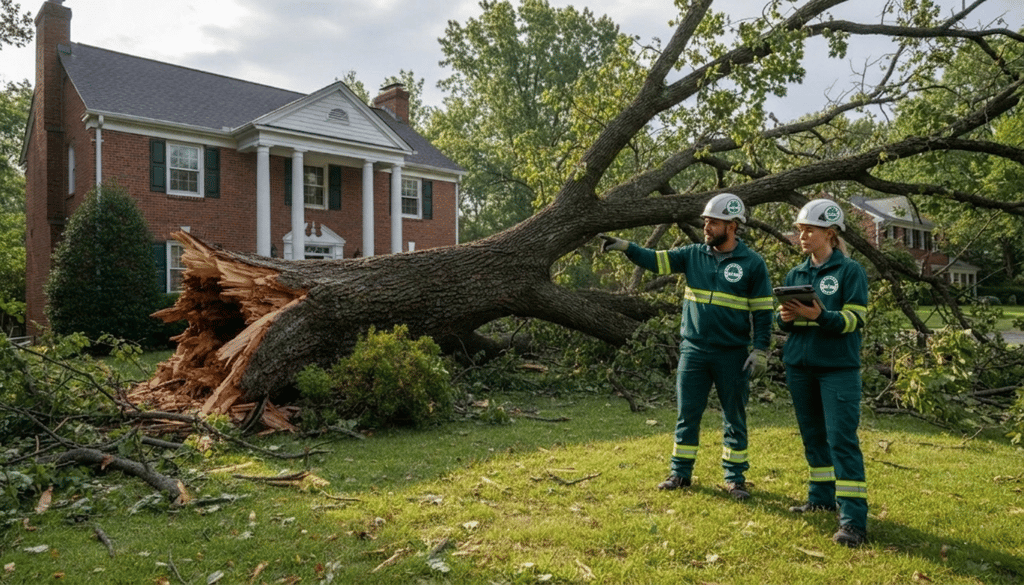
On the morning of July 29, 2023, many Arlington homeowners woke to find that decades of botanical growth had been undone in a single night of high-velocity winds. Watching a majestic specimen fail is more than a logistical headache; it's the loss of a living piece of your property's history. When you're faced with the immediate need for fallen tree removal Arlington VA, the pressure to act quickly can lead to costly mistakes. You likely feel the weight of this sudden change, balancing the urgency of safety with the desire to preserve what remains of your landscape’s dignity.
We'll provide you with the technical clarity needed to handle this transition with the same care used to plant these trees years ago. You'll learn how to navigate the specific codes of Arlington County, identify when a root system is truly compromised, and manage the insurance process to ensure your yard is restored properly. We'll walk through a professional removal strategy that prioritizes both your home’s safety and the long-term health of your soil.
Key Takeaways
Learn the critical three-step triage process to secure your property and determine when to contact emergency services versus a private specialist.
Understand local Arlington regulations and how Virginia’s "Act of God" rule dictates liability between neighbors after a storm.
Discover how professional rigging and crane techniques facilitate safe fallen tree removal Arlington VA with zero impact on your existing landscape.
Gain insight into the variables affecting emergency removal costs and the vital steps needed to restore soil health after an uprooting.
Table of Contents
Immediate Steps: What to Do When a Tree Falls in Arlington
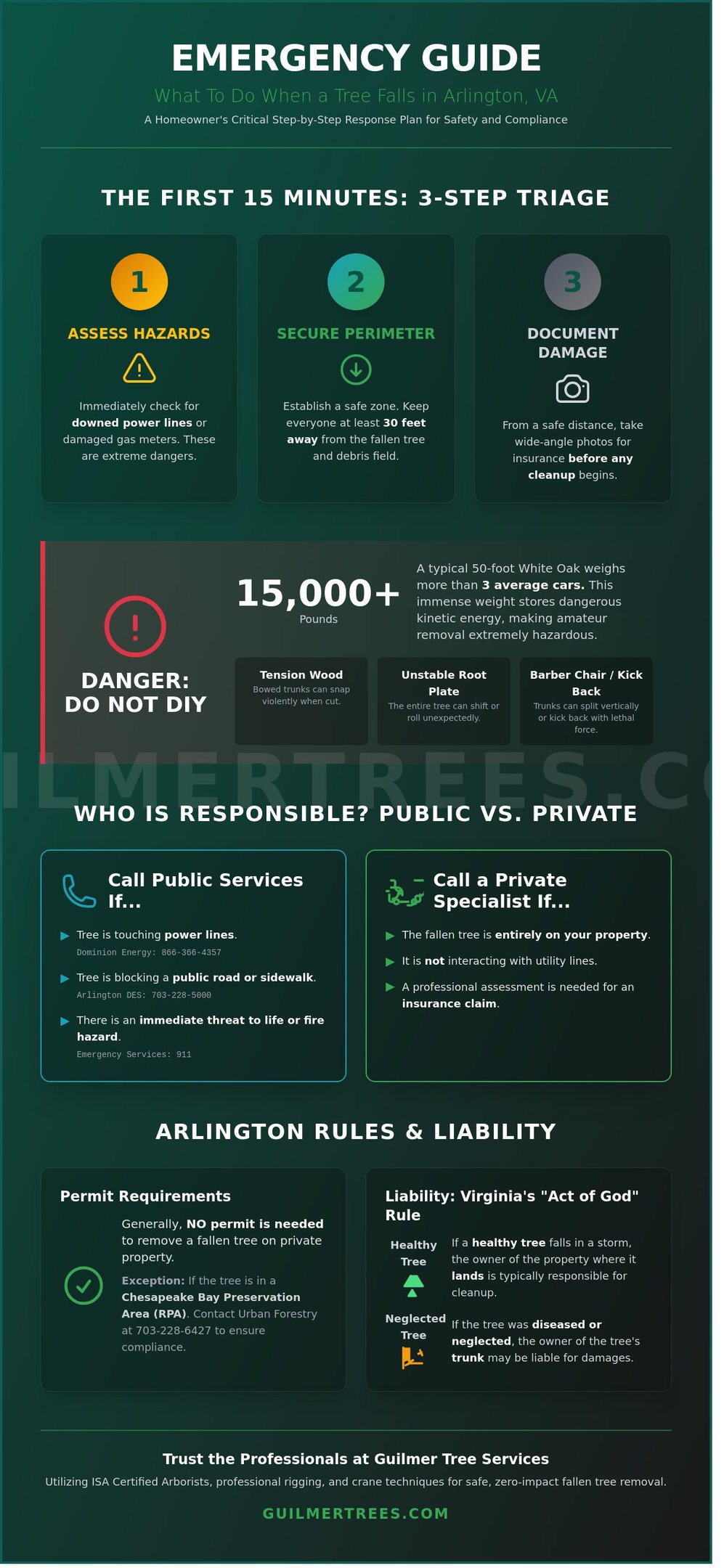
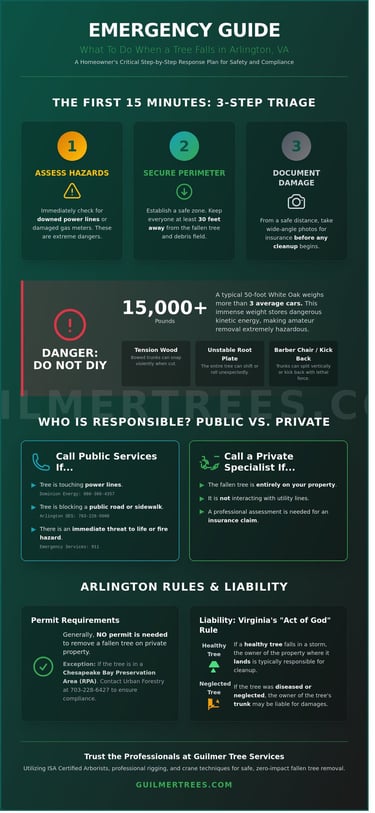
The sudden failure of a mature canopy tree is a jarring event that demands a disciplined response. In Arlington, where urban forests meet dense residential infrastructure, the initial 15 minutes after a fall dictate the safety of your household. Homeowners must follow a strict three-step triage. First, assess the area for downed power lines or damaged gas meters. Second, secure a perimeter at least 30 feet from the debris. Third, document the structural failure from a safe distance before any cleanup begins. Identifying these high-hazard situations is vital. Look for tension wood where the trunk is bowed under pressure; this stores kinetic energy that can release violently during cutting. If you notice cracked soil or a lifted root plate, the tree remains unstable and could shift at any moment.
Attempting DIY removal on large uprooted specimens is a risk that often leads to secondary property damage or severe injury. A typical 50-foot White Oak can weigh over 15,000 pounds. Without the specialized rigging used in professional fallen tree removal Arlington VA, the trunk can barber chair or kick back when the weight is shifted. Adhering to Arboriculture best practices ensures that the removal process respects the physics of the wood and the safety of the surrounding landscape. If the tree isn't blocking a public road or touching a power line, it's a private matter. You don't need to call 911 unless there's an immediate threat to life or a fire hazard; instead, contact a specialized service to manage the technical extraction.
Utility and Public Safety Contacts
Distinguishing between public and private responsibility is the first hurdle. If a tree interacts with power lines, contact Dominion Energy at 866-366-4357 immediately. Stay at least 35 feet away as the ground can become energized. For trees blocking the Arlington County Right-of-Way (ROW), such as sidewalks or public streets, report the obstruction to the Department of Environmental Services at 703-228-5000. Private tree services can't legally clear trees from county property or utility lines without specific authorization.
Documenting Damage for Insurance
Insurance adjusters require clear evidence that the tree was the primary cause of the loss. Capture wide-angle photos that show the entire fallen specimen, including the root flare and the specific point of impact on the structure. Detailed shots of the trunk's interior can reveal decay or heart rot, which helps the ISA Certified Arborist validate the claim. Wait for a professional assessment before moving any debris. This documentation is essential for fallen tree removal Arlington VA claims, as it proves the event was a sudden failure rather than a result of long-term neglect.
Arlington Regulations, Permits, and Liability
Managing a fallen tree requires more than just physical labor; it demands a clear understanding of local governance and the biological integrity of the landscape. In Arlington County, the rules governing tree removal are designed to protect the urban forest, particularly within Resource Protection Areas (RPAs) that extend 100 feet from streams or wetlands. When you face the aftermath of a storm, determining the legal status of the specimen is your first step. For fallen tree removal Arlington VA, homeowners should first consult the Arlington Tree Maintenance Map. This digital tool, maintained by the Department of Parks and Recreation, helps distinguish between county-owned trees and those on private property, preventing redundant reporting and ensuring the right department responds to the hazard.
Virginia law follows the "Act of God" principle regarding liability. If a structurally sound tree falls due to natural forces, the owner of the property where the tree landed is generally responsible for the cleanup. However, if the tree was diseased or neglected prior to its fall, the owner of the tree's trunk may be held liable for damages. Understanding these nuances is vital before hiring a crew. For those dealing with widespread storm damage, FEMA's debris removal guidelines provide clarity on when federal assistance might supplement local efforts, particularly when debris poses an immediate threat to public safety.
Permit Requirements in Arlington County
Arlington doesn't usually require a permit to remove a fallen tree on private property unless it resides within a Chesapeake Bay Preservation Area. In these sensitive zones, even dead or fallen wood serves a biological purpose in the local ecosystem. If an emergency occurs, the county allows for retroactive notification. You should document the hazard with photographs before the work begins. Contacting the Urban Forestry office at 703-228-6427 ensures your actions align with the latest 2024 environmental standards, preserving the health of the surrounding soil and root systems.
Neighbor Disputes and Shared Boundaries
Boundary lines often complicate the process of fallen tree removal Arlington VA. Virginia courts have historically ruled that homeowners have a "self-help" right to trim encroaching branches, but they cannot kill the tree. When a tree spans two properties, both owners share the responsibility and the cost. We recommend obtaining a professional boundary survey if the trunk's center is in question. Resolving these issues with the patience and precision of a master gardener prevents long-term friction. For those looking to restore their landscape with enduring vitality, exploring the Savoir-faire Guilmer approach offers a path toward planting resilient, high-quality specimens that stand the test of time.
The Professional Removal Process: Precision and Safety
Executing a professional fallen tree removal Arlington VA requires more than just a chainsaw; it demands a deep understanding of wood tension and physics. Our approach treats every removal as a surgical procedure where the goal is zero impact on the surrounding landscape. When a mature canopy fails, the resulting mess often weighs several tons. We utilize 40-ton hydraulic cranes to lift large trunk sections vertically. This method prevents the heavy timber from dragging across your lawn or crushing delicate ornamental plantings. It's a process defined by mechanical advantage, ensuring that the structural integrity of your home remains uncompromised during the extraction.
Rigging is the silent language of the master arborist. We use high-tensile ropes and blocks to redirect the weight of heavy limbs away from rooflines and power lines. This "Savoir-faire" ensures that every cut is calculated. Precision cutting isn't just about where the wood falls; it's about managing the energy stored within the fibers. Improperly handled wood can "barber chair" or split vertically, causing unpredictable movements. By controlling the descent of every piece, we protect the investment you've made in your property's aesthetic and structural health.
Debris management is the final step in restoring your sanctuary. We don't just leave a pile of wood on your curb. Our teams utilize 12-inch capacity brush chippers to process smaller limbs into nutrient-rich mulch on-site. Larger logs are hauled away using specialized grapple trucks, leaving the site clean and ready for rejuvenation. This systematic cleanup reflects our commitment to the entire life cycle of the urban forest, even when a specimen's journey has come to an end.
Specialized Equipment for Arlington Yards
The narrow lots of North Arlington neighborhoods present unique challenges for traditional machinery. We solve this by deploying compact spider lifts that measure only 35 inches wide, allowing them to pass through standard backyard gates without removing fences. To protect your soil's health, we use AlturnaMATS. These heavy-duty ground protection sheets distribute the weight of 10,000-pound equipment, preventing soil compaction and preserving the delicate root systems of your remaining trees. You won't see deep ruts or ruined turf after we've finished our work.
Safety Standards and Rigging
Safety is a non-negotiable pillar of our craft. Every operation adheres to the ANSI A300 standards, the national benchmark for tree care excellence. One of the most dangerous elements of fallen tree removal Arlington VA is the "spring pole." This occurs when a sapling or limb is pinned under a fallen trunk, storing thousands of pounds of kinetic energy. Our crews are trained to identify these traps and release the tension safely using specialized notch cuts. We maintain $2 million in liability insurance and full workers' compensation, providing you with absolute peace of mind while our experts handle the high-risk work of clearing storm damage.
Evaluating Costs for Fallen Tree Removal in Northern VA
Professionalism in arboriculture requires a clear understanding of the logistics involved in every job. Pricing for fallen tree removal Arlington VA isn't an arbitrary figure; it reflects the physical mass of the specimen and the risks inherent in its extraction. Homeowners typically encounter quotes ranging from $450 for small ornamental species to over $3,800 for massive hardwoods that have impacted structures. This price variance depends on the specialized equipment needed and the hours of labor required to safely clear the debris.
Urgency plays a significant role in the final invoice. Scheduled removals allow a crew to optimize their route and equipment use. Emergency responses, especially after a midnight storm, carry a premium of 25% to 50% because they require immediate mobilization of crews and heavy machinery outside of standard operating hours. You're paying for the peace of mind that comes with rapid risk mitigation.
Cost Drivers in Residential Arlington
Arlington's residential landscape presents unique logistical hurdles. Narrow driveways, often measuring less than 9 feet wide, frequently restrict the use of large cranes or heavy bucket trucks. When a 70-foot White Oak falls, its high wood density requires more chainsaw fuel and more frequent blade sharpening than a softer Pine. Hardwoods take approximately 40% longer to process into haulable segments. A "clean site" guarantee adds about 10% to the total labor cost but ensures that every twig and sawdust pile is removed, preserving the health of your remaining turf.
Avoiding 'Storm Chaser' Scams
After significant weather events in Northern Virginia, illegitimate contractors often flood the region. In 2023, local consumer protection data indicated a 15% rise in reported tree service fraud following summer storms. Beware of individuals who solicit door-to-door or demand cash payments before work begins. A legitimate Virginia business must provide a Class A or B contractor license and a current certificate of insurance. This insurance should cover both general liability and workers' compensation to protect you from legal claims if a worker is injured on your property.
Comparing quotes requires a discerning eye for detail. One provider might offer a lower price but exclude stump grinding, which typically costs between $160 and $500 depending on the root spread. Always insist on a written contract that outlines the specific scope of work, including debris disposal and any necessary permit filings. If you require a professional assessment of your property's canopy health or immediate assistance with a downed specimen, consult with our expert arborists to ensure the longevity and safety of your landscape.
Size: Diameter at breast height (DBH) remains the primary metric for volume.
Location: Trees near power lines or overhanging pools require complex rigging.
Disposal: Hauling away several tons of wood involves significant fuel and tipping fees.
Stump Grinding: This is almost always a separate line item from the initial felling.
Restoration and Stewardship: Life After the Tree
The physical absence of a canopy giant leaves a void that extends far beyond the visual landscape. Once the immediate urgency of fallen tree removal Arlington VA is addressed, the focus shifts toward stewardship and soil recovery. A fallen tree often leaves a scar in the form of compacted earth or a gaping root cavity. Restoring this site requires the precision of a pépiniériste-producer to ensure the ground recovers its biological vigor. Neglecting soil health at this stage frequently leads to localized drainage failures or the stunted growth of future plantings.
Stump Grinding and Backfilling
Leaving a stump to decay naturally is a risk most homeowners shouldn't take. A decaying stump becomes a primary vector for subterranean termites and wood-boring beetles within 12 to 24 months of the tree's demise. Our technicians grind the stump 6 to 12 inches below the grade, effectively severing the main root flare to prevent regrowth. This process generates a significant volume of wood chips. While these serve as excellent mulch, we often recommend removing the excess to prevent nitrogen tie-up in the soil. Proper backfilling with a blend of screened topsoil and 15% organic compost ensures the area doesn't settle into a hazardous depression during the next heavy rainfall.
Selecting Replacement Trees
The urban canopy in Northern Virginia faces increasing pressure from erratic weather patterns and heat island effects. When choosing a successor, we prioritize native essences that offer both aesthetic elegance and structural resilience. Species like the White Oak (Quercus alba) or the American Hornbeam (Carpinus caroliniana) are excellent choices for their deep root systems and long-term stability. We analyze the site’s proximity to utility lines, typically ensuring a 20-foot clearance for medium-sized subjects to prevent future interference. Every tree we plant carries the Guilmer guarantee of vitality, rooted in a tradition of meticulous cultivation from seed to specimen. This ensures your fallen tree removal Arlington VA project ends with a new beginning rather than an empty space.
True horticultural excellence isn't measured in days, but in decades. The Savoir-faire Guilmer approach ensures that the legacy of your landscape continues long after a storm has passed. It's about respecting the cycle of the living world while applying rigorous technical standards to every transplantation. Schedule a consultation for restoration and planting with Guilmer Tree Services to begin your property's next chapter with confidence and expert guidance.
Restoring Your Landscape’s Strength and Safety
Managing a fallen tree requires more than just a chainsaw; it demands a deep understanding of Arlington’s local ecology and municipal codes. Don't forget that Arlington County requires specific permits for removing trees with a diameter at breast height of 12 inches or more when they're located in resource protection areas. Handling these structural failures with precision prevents further damage to your soil and surrounding specimens. Our team brings the Savoir-faire Guilmer to every site, ensuring that fallen tree removal Arlington VA is performed with the surgical accuracy of an expert producer.
We operate with 24/7 emergency storm response teams to address hazards quickly, often arriving on-site within 4 hours of a service call. Every project remains under the strict oversight of an ISA Certified Arborist, and our status as a fully licensed and insured provider in Virginia since 2010 provides the professional security you need. It's about protecting the living legacy of your land while maintaining the immediate safety of your home.
Get a Free Emergency Tree Removal Estimate in Arlington
Your property’s resilience begins with the right care today, and we're here to help you rebuild.
Frequently Asked Questions
Is the homeowner always responsible for a tree that falls from a neighbor's yard in Arlington?
You're generally responsible for any tree that falls onto your property due to natural causes, regardless of where the trunk originated. Virginia law follows the "Act of God" principle, meaning your own insurance policy typically covers the damage. If you have a 2023 arborist report proving the neighbor's tree was dead or hazardous before it fell, you might have grounds to hold them liable for the deductible.
How much does emergency fallen tree removal typically cost in Arlington, VA?
Emergency fallen tree removal Arlington VA services usually range from $1,500 to $4,800 depending on the complexity of the job. Prices fluctuate based on whether the crew needs a 40 ton crane or if the tree is tangled in power lines. You'll find that rates are higher for immediate dispatch during weekend storms compared to scheduled removals during standard business hours.
Does Arlington County remove trees that fall on private driveways?
Arlington County doesn't remove trees from private driveways or residential properties. The Department of Parks and Recreation only manages trees located on public rights-of-way or those blocking county-maintained roads. If a specimen falls on your driveway, it's your responsibility to contact a private tree service to restore access to your home.
Do I need a permit to remove a tree that has already fallen over?
You don't need a permit to clear a tree that's already completely on the ground. Arlington's Chesapeake Bay Preservation Ordinance protects standing trees in specific zones, but these rules don't apply to timber that's already fallen. Our team focuses on the technical extraction of the debris to ensure the surrounding soil and root systems of nearby healthy trees remain undisturbed.
How long does it take for a crew to arrive after a major storm in Northern Virginia?
Crews typically arrive at high-priority sites within 12 to 36 hours after a significant weather event. During the severe storms of July 2023, response times for non-emergency situations stretched to 5 or 8 days. We prioritize fallen tree removal Arlington VA based on safety, focusing first on trees that have struck houses or blocked primary entrances.
Can I keep the wood for firewood after a tree is removed from my property?
You can keep the wood, and doing so often reduces your total bill by $150 to $300 in hauling and disposal fees. We can process the trunk into 16 inch rounds that are ready for you to split and season. This approach respects the natural lifecycle of the tree by repurposing its biomass for your own hearth.
What should I do if a tree is leaning but hasn't fallen yet?
Call a certified arborist immediately if you notice a new lean of 15 degrees or more. This sudden shift often indicates a failure in the root plate or significant soil saturation. An expert can determine if the structural integrity is compromised enough to warrant a controlled removal before the next wind event causes a total collapse.
Will my homeowners insurance cover the full cost of tree and stump removal?
Most insurance policies provide a maximum of $500 to $1,000 for tree removal, and only if the tree damaged a covered structure like your house or garage. They won't cover the cost of stump removal in almost any scenario. Insurance companies view stump grinding as a cosmetic choice rather than a structural necessity, so you'll likely pay for that specific service yourself.
Our Services
Tree Removal
Tree Trimming and Pruning
Stump Grinding
Bush Chipping
Hours & Information
© 2026. All rights reserved.
Monday to Friday : from 9:00 AM – 5:00 PM
on-site : from 8:00 AM – 6:00 PM