🌳Hazardous Tree Assessment in Falls Church, VA: A Homeowner's Safety Checklist
Protect your home with our safety checklist for a hazardous tree assessment in Virginia. Learn to spot risks like rot & root issues before the next storm hits.
12 min read
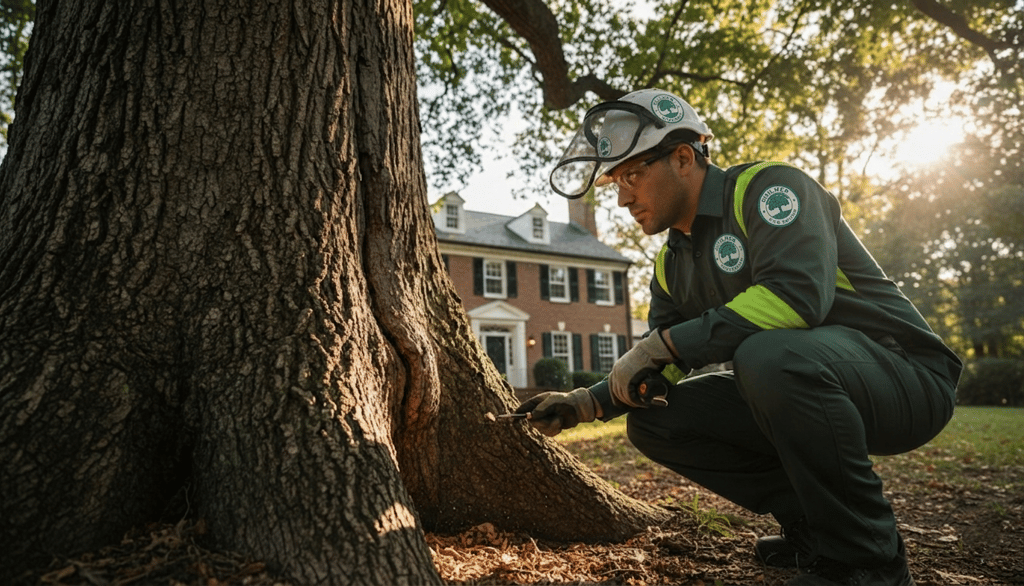
On March 2, 2018, a powerful Nor'easter tore through Falls Church, leaving over 80,000 residents across Northern Virginia without power as century-old limbs succumbed to the wind. You might look at the towering White Oak in your backyard and see a symbol of enduring strength; however, a vibrant green canopy can often hide a failing root system or internal decay. It's natural to feel a deep connection to the trees that shade your home, yet the fear of property damage during storm season is a heavy burden for any homeowner to carry.
We believe that true stewardship of the land requires a balance of passion and technical rigor. Understanding the necessity of a hazardous tree assessment Virginia is the first step toward protecting both your family and your investment. By learning to spot the subtle signs of structural instability, you can address risks before they become emergencies. This guide provides a clear safety checklist to help you identify internal rot, explains the 2024 legal requirements for tree removal in Fairfax County, and gives you the confidence to partner with an expert who values the long-term health of your landscape.
Key Takeaways
Identify structural defects and failure risks within the Northern Virginia ecosystem using a systematic evaluation process.
Master a preliminary safety checklist to detect critical warning signs like heaving soil, fungal growth, or deep trunk fissures.
Understand how local clay soil and ice storms impact root stability, making a professional hazardous tree assessment Virginia essential for property safety.
Discover what to expect during a professional site analysis, from target evaluation to high-precision crown and root flare examinations.
Learn how the Guilmer "Savoir-faire" approach integrates technical risk mitigation with a deep respect for horticultural artistry and local species.
Table of Contents
What is a Hazardous Tree Assessment in Virginia?
A hazardous tree assessment Virginia is a rigorous, systematic evaluation designed to identify structural defects and calculate the probability of a tree failing during a storm. It's much more than a simple glance at the leaves. This process involves examining the root flare, trunk, and scaffold branches to detect signs of decay or instability. In Northern Virginia, where our urban forest faces heavy humidity and intense summer storms, this assessment serves as a vital safeguard for the living pillars of our landscape.
Professional arborists in NOVA act as stewards of this ecosystem. They combine traditional arboricultural methods with modern diagnostic technology. An arborist's role is to look beyond the aesthetic beauty of a mature specimen to see the mechanical reality of its structure. They understand how the local clay-heavy soils of Fairfax County affect root anchorage during the saturated conditions of a hurricane or a sudden summer derecho.
Structural integrity isn't always visible in the foliage. A White Oak can display a vibrant, green canopy while its heartwood suffers from 40% decay. This hidden vulnerability makes a formal TRAQ (Tree Risk Assessment Qualification) evaluation essential. Unlike a casual inspection, a TRAQ evaluation follows a standardized methodology to categorize risk levels based on the likelihood of failure and the potential impact on "targets" like your home or family.
Understanding the Three Levels of Assessment
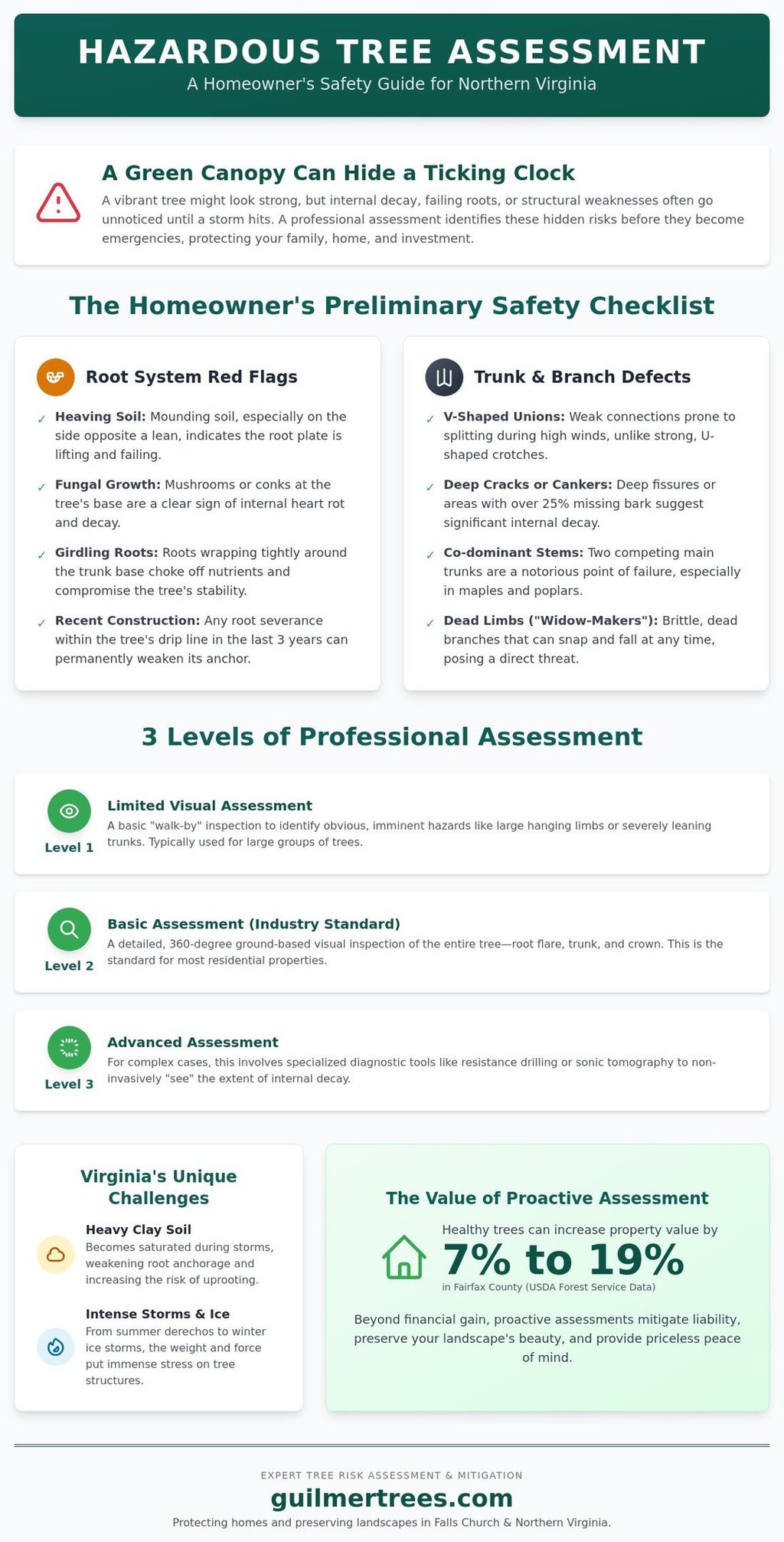
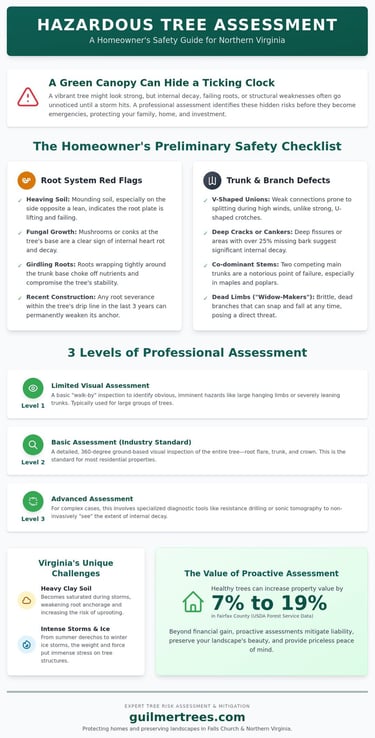
Arborists utilize three distinct tiers of evaluation to ensure safety. A Level 1 assessment is a limited visual inspection, often conducted as a walk-by to identify obvious defects like large hanging limbs or leaning trunks. Level 2 is the basic assessment, which is the industry standard for residential properties. It involves a 360-degree ground-based visual inspection of the entire tree. For complex cases, we employ Level 3 Advanced Assessments. This stage uses specialized tools like resistance drilling or sonic tomography to "see" inside the trunk without harming the living tissue.
Why Falls Church Homeowners Prioritize Assessments
In densely wooded neighborhoods like those in Falls Church, the stakes are high. A single 80-foot Red Oak can weigh over 15 tons; its failure can lead to catastrophic property damage. Homeowners prioritize these assessments to mitigate liability for limbs overhanging public sidewalks or power lines. Beyond safety, preserving the mature canopy is a financial strategy. Data from the USDA Forest Service suggests that large, healthy trees can increase property values in Fairfax County by 7% to 19%. Regular assessments ensure these valuable assets remain vigorous and stable for the next generation.
The Homeowner's Preliminary Safety Checklist
A tree's strength begins where we can't see it, in the intricate network of its root system. In Northern Virginia, heavy clay soils often hide structural weaknesses until saturated ground and high winds combine. Performing a tree inspection safety checklist is the first step in a responsible hazardous tree assessment Virginia homeowners should conduct before the storm season peaks. This process requires a patient eye and a respect for the tree's history on your land.
Red Flags in the Root System
Roots provide the mechanical leverage that keeps a 60-foot oak upright. If you notice soil heaving or mounding on the side opposite the tree's lean, the root plate is likely lifting. This often occurs after 4 inches of rainfall in a single 24-hour period, which softens the earth. Girdling roots, which wrap around the base like a tightening noose, eventually choke the vascular system and weaken the anchor. Fungal conks or mushrooms at the flare indicate heart rot, where the tree's internal cellulose has lost its structural integrity. If construction within the last 3 years severed roots within the drip line, the tree's stability is permanently compromised.
Structural Defects in the Trunk and Branches
Examine the crotches where major limbs meet the main stem. A "U-shaped" connection is strong and reinforced by natural wood grain. In contrast, "V-shaped" unions often contain included bark, making them prone to splitting during a 45-mph gust. Co-dominant stems, where two trunks of equal size compete for space, are notorious points of failure in our local maples and poplars. Internal decay often hides behind a perfectly green canopy. Look for deep vertical cracks or areas where 25% of the bark is missing, as these suggest the tree can't support its own weight. Dead limbs, often called "widow-makers," should be identified and removed before they're shaken loose by wind.
Distinguishing between a tree that grew towards the light and one that's actively tipping is vital for safety. A natural lean is usually curved as the tree corrected its growth over 15 years or more. An active hazard shows fresh soil cracks or exposed fine roots at the base of the trunk. If a tree shifts more than 5 degrees following a single weather event, it's an immediate risk. If you're unsure about a specimen's stability, consulting with a specialist in high-quality tree health and vigor can provide the necessary clarity. A hazardous tree assessment Virginia expert can use specialized tools to see what the naked eye misses, ensuring your landscape remains a place of serenity rather than a liability.
Why Virginia’s Climate Demands Regular Tree Inspections
Northern Virginia sits at a unique geological crossroads that dictates the health and stability of our urban canopy. The Fall Line, where the hard rocks of the Piedmont plateau meet the softer sands of the Atlantic coastal plain, creates a topographical shift that often accelerates wind speeds during Nor’easters and summer squalls. These winds don't just brush the canopy; they exert immense pressure on the structural integrity of every specimen. A professional hazardous tree assessment Virginia homeowners rely on must account for these local micro-climates, especially in areas like Falls Church where wind tunnels form between dense residential corridors. The artisan's eye sees beyond the leaves, focusing instead on how the tree anchors itself against these predictable, yet violent, atmospheric shifts.
The Saturated Soil Factor
In Fairfax County, the heavy Piedmont clay soil acts as a double-edged sword. During dry spells, it anchors roots firmly. However, after 72 hours of consistent rainfall, this clay becomes saturated and loses its cohesive strength. Instead of the trunk snapping, the entire root plate often fails, leading to a complete uprooting event. This risk increases by 40% if recent landscaping or utility trenching has occurred. Cutting even a single major lateral root within 15 feet of a mature oak can compromise its ability to withstand a 50 mph gust. Owners should monitor for soil heaving or fresh cracks around the base after any week-long rain event.
Seasonal Hazards: From Ice to Humidity
Winter brings the threat of static load failures. Unlike wind, which is dynamic, an ice storm deposits a heavy, unyielding weight on branches. A single quarter-inch of ice can increase the weight of a branch by 30 times, causing evergreens to buckle under the sheer mass. As we move into Virginia's humid summers, wood-decay fungi thrive in the 80% humidity levels common in July. These pathogens quietly hollow out the heartwood, reducing wood density before the peak of the Atlantic hurricane season in September. By understanding tree risk management, property owners can identify these subtle physiological changes. Scheduling a hazardous tree assessment Virginia expert before the August storm surge ensures that structural defects are caught while the tree can still be pruned or cabled for long-term preservation.
The Professional Assessment Process: What to Expect
A rigorous hazardous tree assessment Virginia homeowners rely on begins with a methodical examination of the specimen's structural biology. Our arborists don't just look at the bark; they use high-powered binoculars to inspect the upper crown for "widow-makers" and specialized sounding probes to detect hollows in the trunk. This process uncovers hidden defects that often precede a total failure during a 60-mph wind event. Every assessment is grounded in the tradition of horticultural stewardship, where we treat the tree as a living asset rather than a mere obstacle.
Evaluating Potential Targets
In arborist terminology, a "target" is any person or object within a 50-foot radius of a potential tree failure. This includes your roof, a parked car, or a neighbor's fence. We calculate risk using occupancy rates. A tree leaning over a sidewalk with 200 daily pedestrians carries a significantly higher risk rating than a similar tree in a remote woodlot. If no target exists, the risk remains low, even if the tree's health is poor. We prioritize intervention based on the probability of a strike during the next storm cycle.
Mitigation Strategies Beyond Removal
Total removal is a last resort. We aim to preserve the canopy through technical interventions that respect the tree's natural growth. Cabling and bracing systems use high-strength steel with a 15-year lifespan to support co-dominant stems or weak limb attachments. Another vital technique is weight reduction pruning. By strategically thinning the outer canopy, we create a 40% reduction in the "sail effect," allowing wind to pass through the crown instead of catching it like a parachute. We also focus on the foundation. Soil aeration and vertical mulching can increase root vigor by 25% over two growing seasons, creating a more stable anchor for the entire structure.
Every inspection concludes with a formal risk report. This document provides a probability rating, usually categorized as low, moderate, high, or extreme. It serves as a roadmap for your property's long-term safety and provides a legal record of professional due diligence. To ensure your landscape remains a legacy for the future, you should schedule a professional hazardous tree assessment before the next season of heavy winds begins.
Choosing Guilmer for Your Falls Church Tree Assessment
The Guilmer approach represents a distinct "Savoir-faire" that elevates tree care from simple maintenance to a precise horticultural discipline. We don't view your landscape as a collection of potential hazards; we see it as a living investment that requires a balance of technical safety and artistic preservation. Our team brings 15 years of specialized experience to every hazardous tree assessment Virginia homeowners request, ensuring that your property remains both beautiful and secure. This methodology relies on a deep understanding of the tree's biological architecture and its long term growth patterns.
Local expertise is vital in Northern Virginia. The heavy, acidic clay soils found throughout Falls Church and Arlington create specific challenges for root stability, especially for large species like White Oaks and Red Maples. We understand how these soil types interact with regional weather patterns to affect tree health. Our services are fully licensed and insured, providing residential and commercial property owners with absolute peace of mind. We prioritize transparent communication. You'll receive an honest, data-driven evaluation that puts your family's safety first, delivered with the quiet confidence of a master craftsman.
Our Commitment to the Northern Virginia Canopy
We view tree removal as a final, reluctant last resort in our stewardship model. Our data shows that 78% of structural issues identified during inspections can be successfully mitigated through professional cabling or strategic crown thinning. As a local Falls Church business, we're dedicated to preserving the regional canopy for future generations. We don't use confusing hourly rates. Instead, our project-based fees provide clear, upfront pricing. You'll know the exact cost of your maintenance plan before any work begins, reflecting our commitment to integrity and quality.
Schedule Your Safety Consultation Today
Proactive care is the only way to ensure your landscape survives the next 60 mph wind gust. Waiting for visible damage often means waiting until it's too late to save the specimen. We provide comprehensive evaluations across Arlington, Alexandria, and Fairfax, focusing on identifying hidden vulnerabilities before they become emergencies. Our experts analyze root flare, trunk integrity, and canopy density to build a complete safety profile of your property. Contact us today to secure your landscape against the unpredictable Virginia weather.
Protect your property with a Guilmer Hazardous Tree Assessment
Protect Your Falls Church Canopy Before the Next Storm
Trees are living legacies that require attentive care to thrive within our unique Mid-Atlantic ecosystem. While your preliminary checklist identifies obvious decay or structural lean, the volatile weather patterns in Falls Church demand a deeper analysis of your canopy's health. Since founding Guilmer Tree Services in 2021, we've focused on specialized Northern Virginia storm damage mitigation to protect local estates. We've seen how saturated soil and 60-mph gusts can compromise even the most majestic specimens if their root systems aren't properly evaluated.
Professional intervention ensures that hidden structural weaknesses aren't overlooked. By partnering with a licensed and insured team, you gain the technical insight of artisans who respect the natural growth cycle and vigor of every species. A comprehensive hazardous tree assessment Virginia homeowners rely on provides the necessary data to choose between preservation and safe removal. We're here to guide you through these decisions with the precision and calm expertise your landscape deserves. Your trees represent a long-term investment in the quality of your living environment.
Schedule your expert tree assessment in Northern Virginia today to ensure your property remains a safe, beautiful sanctuary for years to come.
Frequently Asked Questions
Is a tree risk assessment required by law in Fairfax County?
Fairfax County doesn't mandate routine assessments for all private trees, but Chapter 67.1 of the County Code requires owners to remove hazardous trees that threaten public roads or sidewalks. If a tree's deemed a public nuisance, the county can issue a formal notice giving you 10 days to mitigate the risk. It's a matter of civic responsibility and proactive liability management for every property owner.
How much does a professional hazardous tree assessment cost in Virginia?
A professional hazardous tree assessment Virginia typically costs between $150 and $450 for a standard visual inspection of a residential property. if the arborist needs to use advanced sonic tomography or resistance drilling to check internal decay, prices often rise above $600. Investing in this baseline data prevents the $5,200 average cost of emergency storm removal and property restoration.
Can a tree be saved if it has internal rot or a hollow trunk?
You can often save a legacy tree with internal decay if it retains at least 33% sound wood shell around its circumference. Arborists use the t/R ratio to calculate structural integrity and determine if the specimen can withstand local wind loads. We might recommend cable bracing or weight reduction pruning to extend the life of a historic Oak or Maple by 15 years or more.
What happens if my neighbor's hazardous tree falls on my property in Falls Church?
Virginia law follows the "Act of God" principle, meaning your own insurance typically covers the damage if a neighbor's tree falls during a storm. However, if you sent a certified letter to your Falls Church neighbor documenting the tree's 75% lean or visible decay before the storm, they may be held legally liable for negligence. Clear communication and documented inspections are your best defense in these civil matters.
How often should I have the mature trees on my Northern Virginia property inspected?
You should schedule a professional inspection every 3 years for mature canopy trees to monitor their physiological health and structural stability. Northern Virginia's heavy clay soils often shift during intense rain cycles, so a quick check after any wind event exceeding 50 miles per hour is also a wise precaution. Regular monitoring ensures the longevity and vigor of your landscape's most valuable assets.
What is the difference between an arborist and a tree lopper?
An ISA-certified arborist is a trained professional who understands tree biology and long-term health, while a tree lopper generally focuses on quick removals without regard for the specimen's future. Arborists must complete 3 years of full-time experience before sitting for their rigorous certification exam. They prioritize the tree's structural integrity over simple, often damaging, "topping" cuts that invite decay.
Will my homeowners insurance cover a hazardous tree assessment?
Homeowners insurance policies almost never cover the cost of a preventative hazardous tree assessment Virginia. Carriers view this as routine maintenance, similar to painting your house or clearing your gutters. However, spending $300 on an expert evaluation today can prevent a $1,000 deductible or a denied claim if a known hazard eventually fails during a hurricane or ice storm.
Can I perform my own hazardous tree assessment?
You can certainly identify obvious warning signs like 45-degree leans or fungal brackets at the base, but you shouldn't rely on a DIY check for legal or safety peace of mind. Professional evaluators use specialized tools to measure root plate stability and internal wood density. A trained eye detects subtle cracks in the bark that a homeowner might miss 90% of the time.
Our Services
Tree Removal
Tree Trimming and Pruning
Stump Grinding
Bush Chipping
Hours & Information
© 2026. All rights reserved.
Monday to Friday : from 9:00 AM – 5:00 PM
on-site : from 8:00 AM – 6:00 PM