🌳Leave a Stump or Get Rid of It? A Guide for Falls Church Homeowners
Wondering whether to leave a stump or get rid of it? This Falls Church guide reveals hidden risks like pests & decay. Learn stump grinding vs. extraction costs.
15 min read
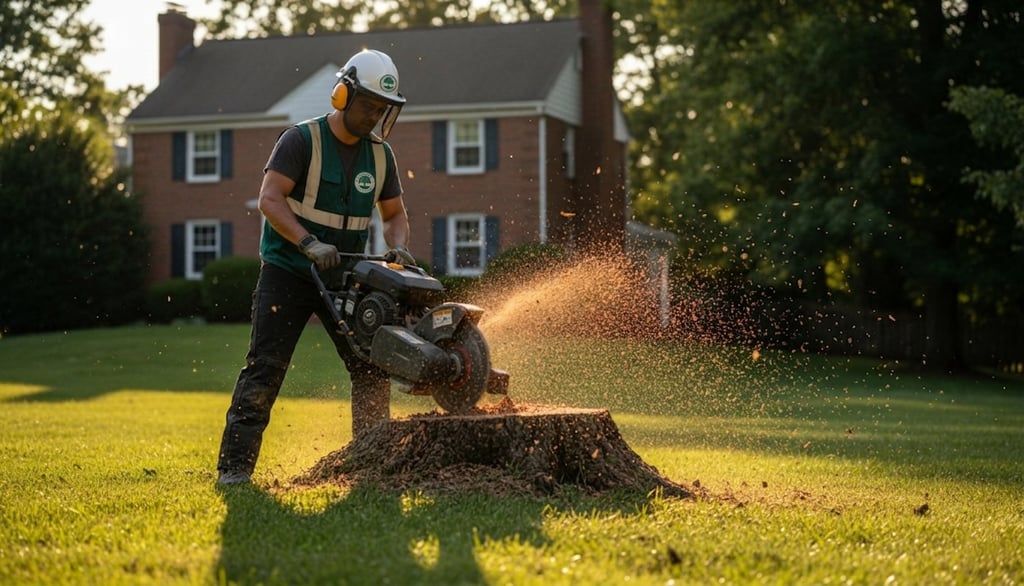
Last autumn, a resident in the West End of Falls Church discovered that a single white oak base, left to rot for three years, had become a subterranean highway for a termite colony targeting their home's foundation. It's a common dilemma for those of us who steward the land in Northern Virginia. You've likely looked at a remaining trunk and questioned whether to leave a stump or get rid of it to save on immediate labor. We agree that the sight of weathered wood can feel like a natural part of the garden's cycle. However, beneath the bark, a complex biological process begins that can compromise your yard's safety and the health of surrounding flora.
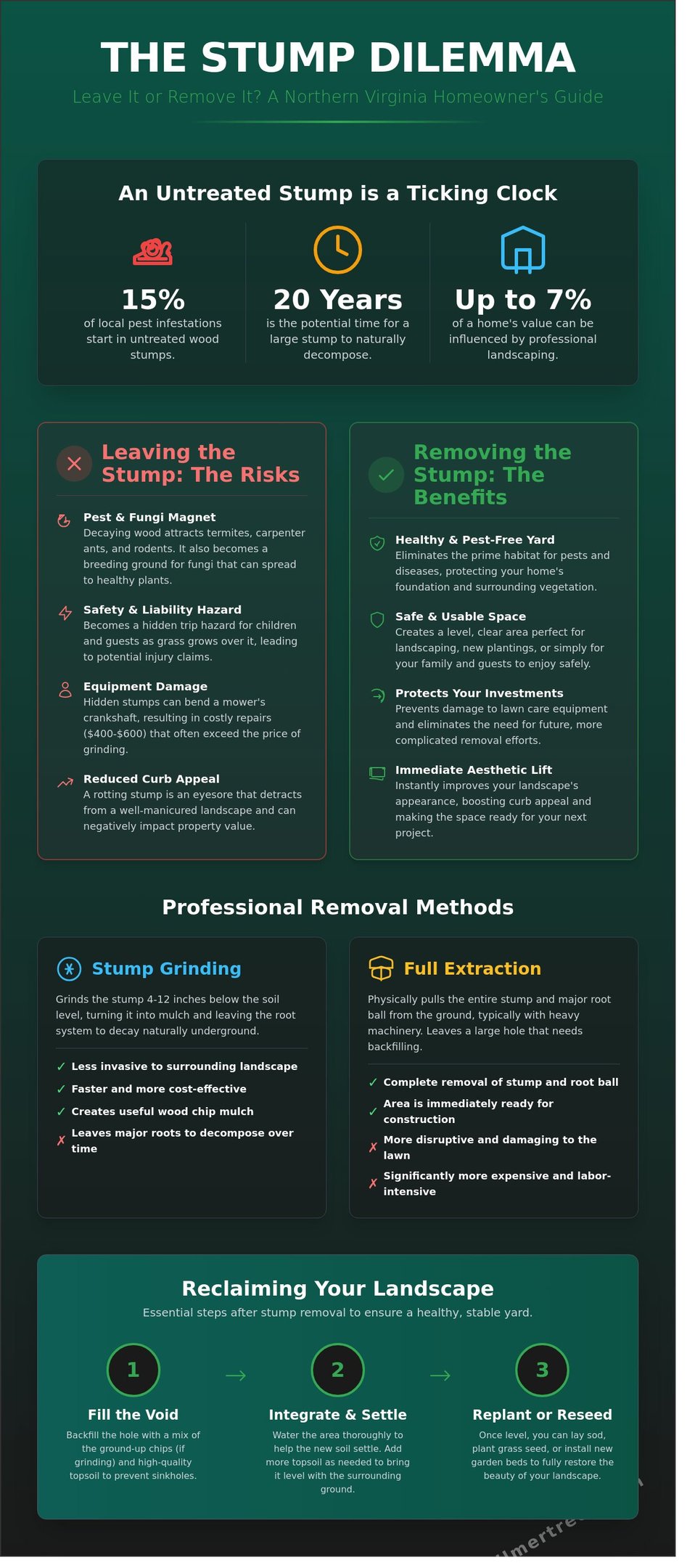
This guide reveals the hidden risks of decaying lignin and explains how to choose a removal method that respects your soil's long-term integrity. You'll gain a clear understanding of why 15 percent of local pest infestations start in untreated wood. We'll provide a cost-benefit analysis of stump grinding versus manual extraction to help you achieve a safer, more usable landscape for your family and guests. By the end, you'll have the expert perspective needed to restore the beauty and security of your outdoor space.
Key Takeaways
Understand how Northern Virginia’s humid climate accelerates biological decay, transforming an unattended stump into a breeding ground for fungi and unwanted pests.
Evaluate the long-term ecological impact on your landscape to help you decide whether to leave a stump or get rid of it.
Recognize why relying on natural decomposition-a process that can span up to twenty years-often leads to soil instability and hidden liabilities for your property.
Identify the technical differences between non-invasive grinding and full extraction to select the method that best honors your land’s future growth.
Learn the essential steps of post-removal remediation to ensure proper soil integration and prevent the formation of hazardous sinkholes in your yard.
Table of Contents
Beyond the Eyesore: Why Homeowners in Falls Church Debate Leaving Stumps
The Hidden Biology of Decay: What Happens to a Stump in Northern Virginia Soil
Leave It or Lose It? A Definitive Comparison for Your NOVA Yard
Professional Solutions: Stump Grinding vs. Full Extraction in Fairfax County
Reclaiming Your Landscape: The Guilmer Approach to Post-Removal Care
Beyond the Eyesore: Why Homeowners in Falls Church Debate Leaving Stumps
After a majestic oak or maple is felled, homeowners in Falls Church often face a quiet horticultural crossroads. The tree is gone, but the foundation remains. You might wonder whether to leave a stump or get rid of it, especially when the initial tree removal bill already reached $1,500. It's a common pause. Some believe the remaining wood adds a rustic, woodland charm to their Northern Virginia property. This "natural look" is often a romanticized myth that overlooks the biological reality of dead timber.
A stump isn't a static piece of outdoor furniture; it's a slow-motion biological event. Understanding what happens to a stump once the canopy is removed is vital for any steward of the land. Within 12 months, the lack of nutrient flow triggers a decay process that invites fungi and wood-boring insects. For a landscape in the 22046 zip code, where garden design reflects a $1.2 million median home value, a rotting relic disrupts the intended architectural flow of the yard. Our tradition at Guilmer Tree Services emphasizes that the health of a site depends on the clean transition between life cycles.
The Immediate Impact on Curb Appeal
Property values in high-demand Northern Virginia neighborhoods are exceptionally sensitive to visual clutter. Real estate data suggests that professional landscaping can influence a home’s final sale price by up to 7 percent. A fresh-cut stump might look tidy for the first 90 days, but the transition to "rotting remains" happens faster than most expect. By the second year, the bark typically sloughs off to reveal a grey, spongy core. This decay interferes with precision irrigation systems. Sprinkler heads often can't reach grass blocked by the stump's physical mass, leading to localized brown patches that mar an otherwise pristine lawn.
Safety Concerns for Families and Guests
The risks of a leftover stump extend beyond aesthetics into tangible physical and financial liabilities. These issues often surface during the high-growth season when vegetation is thickest.
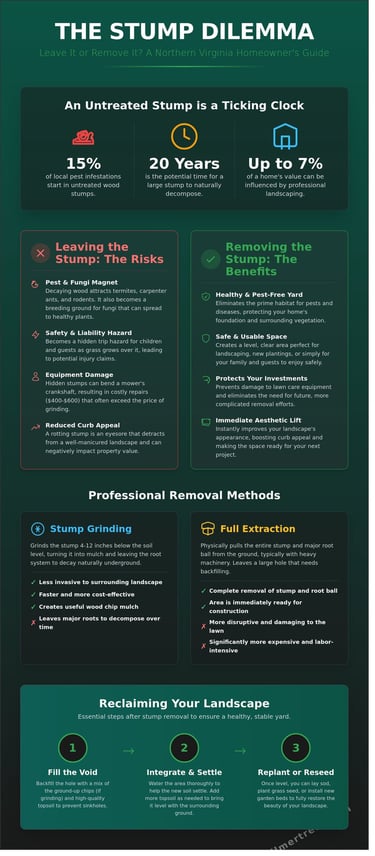
Trip hazards: Over time, turf and weeds camouflage the wood. This creates a significant risk for guests or children, potentially leading to costly personal injury claims on private property.
Equipment damage: Striking a hidden root or the stump itself can instantly bend a mower's crankshaft. This results in a $400 to $600 repair bill, often exceeding the cost of the original stump grinding.
Unwanted wildlife: A hollowed-out stump becomes a sanctuary for local rodents. In Falls Church, where residential plots are often contiguous, a stump serving as a nest for wood rats or carpenter ants can lead to infestations in the main residence within 18 months.
Deciding to leave a stump or get rid of it requires weighing a one-time $300 grinding fee against a decade of maintenance hurdles. We view the landscape as a long-term investment. True horticultural excellence requires finishing the work the earth started. Leaving a stump is rarely a tribute to nature; it's usually a delay of the inevitable. A clean site allows for the next generation of growth, ensuring your property remains a structured, vibrant sanctuary rather than a graveyard for past specimens.
The Hidden Biology of Decay: What Happens to a Stump in Northern Virginia Soil
The moment a tree is felled, the biological clock of decomposition begins its relentless march. In the rich, often heavy clay soils of Northern Virginia, this is not a silent disappearance but a complex chemical transformation. Fungi and aerobic bacteria colonize the exposed wood within 48 hours, beginning the breakdown of lignin and cellulose. Stump decay is a multi-year biological process that alters soil chemistry by cycling carbon and nutrients back into the earth through the labor of specialized microorganisms. While this sounds like a natural benefit, the localized reality for a homeowner is often less harmonious.
Northern Virginia’s climate, characterized by an average annual rainfall of 43 inches and summer humidity levels frequently exceeding 70%, creates an ideal laboratory for rot. These conditions accelerate the softening of the wood, turning a solid oak or maple remnant into a porous sponge. As the wood fibers lose integrity, the "Root Ghost" phenomenon takes hold. This refers to the vast network of underground roots, which can account for 25% of a tree's total biomass, slowly collapsing. As these subterranean structures rot, they leave behind hollow channels and air pockets. These voids often lead to localized soil subsidence, creating tripping hazards or uneven patches in a manicured lawn three to five years after the tree is gone.
Deciding whether to leave a stump or get rid of it requires an understanding of this invisible timeline. A stump left in the ground does not simply vanish; it becomes a central hub for the local ecosystem, though rarely the kind an urban gardener desires. The chemical shift in the immediate soil can also fluctuate, as the nitrogen required for the decomposition process is often pulled from the surrounding earth, potentially starving nearby smaller plants during the initial stages of decay.
The Termite and Pest Connection
In Fairfax County and surrounding areas, subterranean termites are a constant pressure, affecting approximately 1 in 5 homes. A decaying stump acts as a literal "welcome mat" for these wood-destroying insects. Unlike healthy trees that have active defense mechanisms, a dead stump offers no resistance. Once a colony establishes itself in the soft, damp wood of a stump, it creates a staging ground. From this central nursery, termites and carpenter ants often expand their foraging radius up to 300 feet, eventually targeting home foundations, wooden decks, or healthy ornamental trees. These pests thrive in the consistent moisture provided by the decaying root system, using the "Root Ghost" channels as protected highways to move through the soil undetected.
Fungal Pathogens and Garden Health
The biological activity within a stump isn't limited to helpful decomposers. Pathogens such as Armillaria, commonly known as Honey Fungus, frequently take up residence in the root systems of dead hardwoods. This fungus is particularly aggressive in Virginia landscapes; it spreads through the soil via shoestring-like structures called rhizomorphs. If you choose to leave a stump or get rid of it, consider that "letting nature take its course" can jeopardize an investment in $1,200 worth of new boxwoods or Japanese maples. These pathogens can linger in the soil for over a decade, attacking the root systems of healthy plants nearby. Proper Post-Removal Care and the use of professional methods to neutralize root systems are essential to prevent a localized ecological imbalance. Understanding the long-term health of your landscape requires a producer's perspective, much like the horticultural excellence we apply to every specimen in our nursery. Leaving a stump is rarely a neutral act; it is the choice to host a slow, biological decay that can affect your entire garden's vigor.
Leave It or Lose It? A Definitive Comparison for Your NOVA Yard
Deciding whether to leave a stump or get rid of it involves more than a simple weekend chore. It's a choice between immediate convenience and the long-term health of your Northern Virginia landscape. While leaving the wood to rot seems like a natural solution, a 24-inch diameter oak stump can take 15 to 20 years to fully decompose in our humid climate. During those two decades, the site remains a static, often problematic point in an otherwise evolving garden. At Guilmer Trees, we view the landscape as a living legacy, where every element should contribute to the vigor of the soil and the beauty of the estate.
The financial math often drives the initial decision. Grinding a stump might cost between $150 and $400 depending on the diameter and root spread. Leaving it costs nothing today. However, homeowners often find that the hidden costs of maintenance, such as broken mower blades or the repeated application of herbicides to stop new growth, quickly erode those initial savings. If you plan to leave a stump or get rid of it, consider the 7,300 days of decay you'll be hosting in your front yard.
Pros and Cons of Leaving the Stump
The primary benefit of retention is the preservation of the immediate budget. You avoid the heavy machinery and the temporary disruption of the turf. In some cases, a decaying stump provides a localized habitat for beneficial fungi and wood-boring beetles that support local bird populations. Yet, the biological reality of "suckering" is a major downside. Species like the Crepe Myrtle or the native Black Locust are incredibly resilient. Their root systems stay active long after the main trunk is gone, sending up dozens of aggressive new sprouts every spring. You don't just have a stump; you have a persistent maintenance headache that requires constant intervention to prevent a thicket from forming.
Pros and Cons of Professional Removal
Professional removal offers the immediate reclamation of your land. This is essential if you intend to plant a new high-quality specimen tree or install a stone walkway. By grinding the stump 6 to 12 inches below the surface, you eliminate the primary food source for Reticulitermes flavipes, the Eastern subterranean termite common in Fairfax and Arlington. These pests thrive on buried, decaying wood. The downside is the initial investment and the necessity of site remediation. Once the wood is gone, you're left with a hole and a mountain of mulch that must be replaced with high-quality topsoil to ensure the ground doesn't sink as the remaining deep roots settle over the next 3 to 5 years.
Many homeowners ask if they can simply turn the remains into a rustic planter or a garden seat. While this sounds charming in a lifestyle magazine, the reality is often disappointing. A hollowed-out stump holds moisture, which accelerates internal rot and creates a damp environment perfect for carpenter ants rather than prize-winning petunias. Within 24 months, the "seat" often becomes structurally unsound and aesthetically unappealing.
Local regulations also play a role in your decision. Fairfax County Code Chapter 119 and Arlington County's nuisance ordinances focus on the "accumulation of debris." While a single, clean-cut stump isn't usually a violation, allowing a stump to become a rotting, pest-infested hazard can lead to county citations if it impacts neighboring properties. Choosing professional removal ensures your property remains compliant with local standards while honoring the horticultural excellence your yard deserves.
Professional Solutions: Stump Grinding vs. Full Extraction in Fairfax County
Choosing to leave a stump or get rid of it isn't just an aesthetic choice; it's a structural decision for your landscape. In Fairfax County, our heavy clay soils and varied topography require a technical approach to site clearance. We view every property through the lens of a producer, treating the ground as a living foundation that must be preserved for future generations. Whether you're managing a small residential lot or a sprawling estate, the method of removal dictates the health of your soil for decades.
How Stump Grinding Works
Stump grinding is the most efficient, least invasive professional method for clearing a site. We utilize high-speed grinders equipped with carbide-tipped teeth that rotate at 1,500 RPM to shred hardwood into fine particles. For most Northern Virginia lawns, grinding to a depth of 6 to 12 inches is the 2024 industry standard. This depth is sufficient to allow for topsoil coverage and the establishment of healthy turf grass without interference from the remaining underground structure.
The resulting shavings shouldn't be viewed as waste. These wood chips create a nutrient-rich mulch that's excellent for suppressing weeds in established garden beds. By repurposing this material on-site, homeowners often save $55 to $85 compared to purchasing bulk mulch from a local nursery. It's a closed-loop system that honors the tree's life cycle while restoring the visual continuity of your lawn.
When Full Extraction is Necessary
There are specific scenarios where grinding isn't enough. If your 2025 plans include building a new foundation, a 450-square-foot patio, or a retaining wall, the entire root ball must go. Leaving decaying wood under a structural load leads to settling and sinkholes as the organic matter decomposes over time. Full extraction involves 5-ton excavators or heavy-duty winches to physically pull the root mass from the earth.
Replanting a new specimen tree in the exact same location also demands full extraction. New saplings require a clear path for their delicate root systems to expand. If you leave a stump or get rid of it only partially, the new tree's roots will struggle to penetrate the old, hardened wood mass. Total removal ensures the soil is loose, aerated, and ready to support a new legacy tree.
Chemical decomposition is a path we rarely recommend for residential yards in Fairfax. While products like potassium nitrate are available, they often take 4 to 8 years to fully break down a large oak stump. This slow decay creates a moist environment that attracts carpenter ants and termites to your property. Professional arborists prefer mechanical solutions because they provide immediate results and stop the clock on pest invitations.
The Guilmer standard focuses on the "Savoir-faire" of site preparation. We don't just remove an obstacle; we ensure the root zone is healthy and the soil biology is intact. This meticulous attention to detail is what separates a simple service from true horticultural care. We believe in preparing the land so that whatever you plant next has the vigor to thrive for a century.
If you're unsure which method fits your property goals, our experts can provide a technical assessment of your soil and site conditions. Consult with Guilmer Trees to ensure your landscape is ready for its next chapter.
Reclaiming Your Landscape: The Guilmer Approach to Post-Removal Care
Deciding whether to leave a stump or get rid of it marks the beginning of a landscape’s rebirth rather than just the end of a tree’s life. At Guilmer Tree Services, we view the extraction site as a biological canvas that requires precise technical intervention. When a stump is ground down 8 to 12 inches below the grade, it leaves a significant subterranean void. Simply pushing the leftover wood chips back into the hole is a common mistake; these chips consume nitrogen as they decompose, starving the surrounding soil of essential nutrients.
Our "Savoir-faire" dictates a more rigorous standard. We remove the excess mulch and replace it with a screened 70/30 topsoil mix. This prevents the formation of fungal colonies that could threaten your remaining flora. In Falls Church and surrounding Northern Virginia neighborhoods, we adhere to ANSI Z133 safety standards to ensure every site remediation protects the property's structural integrity. This meticulous cleanup respects the history of your garden while preparing it for a vigorous future.
Restoring the Soil Health
Soil compaction is the most critical step in preventing the 15% to 20% sinkage that typically occurs after a stump is removed. We layer the soil in 3-inch increments, tamping each level to eliminate air pockets that cause trip hazards. For a seamless finish, we offer premium tall fescue seeding or immediate sodding. Most homeowners find that within 21 days, the repair becomes invisible. For those planning their budget, viewing Tree and Stump Removal Costs in Alexandria, VA provides the necessary financial context for these essential restoration steps.
The decision to leave a stump or get rid of it often hinges on the long-term vision for the garden. If you choose removal, you gain the opportunity to introduce new life. In the acidic soils of Northern Virginia, we recommend planting native species like the Flowering Dogwood or a 2-inch caliper White Oak once the soil pH has stabilized. These selections thrive in our local climate and contribute to the canopy goals established by Fairfax County environmental initiatives.
Partnering with Guilmer Tree Services
Our commitment extends beyond the immediate removal; we focus on the "long life" of your entire landscape. As a licensed and insured provider serving Arlington and Fairfax since 1995, we understand the specific geological challenges of the Piedmont region. We don't just clear land; we steward the health of your soil to ensure that any new transplant has the robust root system required for a 50-year lifespan. Our team provides the stability and vision needed to transform a hazardous obstacle into a flourishing part of your outdoor sanctuary.
Ready to restore the beauty and safety of your yard? Contact Guilmer Tree Services for a professional stump assessment in Falls Church and let our experts guide your landscape's recovery.
Restoring the Vitality of Your Falls Church Landscape
Deciding whether to leave a stump or get rid of it involves more than just aesthetics; it's a choice about the long-term health of your Northern Virginia soil. Leaving a stump can invite subterranean termites, which the Fairfax County Extension Office notes are prevalent in 20% of local properties containing decaying wood. While grinding allows for immediate turf restoration, full extraction is necessary if you plan to plant a new specimen tree within a 5-foot radius of the previous site. Our team understands these technical nuances, ensuring your yard remains a sanctuary for growth rather than a harbor for decay.
The Guilmer Savoir-faire ensures your yard doesn't just lose an eyesore but gains a foundation for new life. We operate with full licensure and comprehensive insurance across Fairfax County, strictly adhering to the tree preservation standards outlined in Chapter 122 of the County Code. We're committed to meticulous site cleanup and specialized soil restoration to ensure your ground is ready for its next chapter. Get a Professional Stump Removal Quote from Guilmer Tree Services and start reclaiming your garden's potential today. Your landscape deserves the care of professionals who respect the natural cycle of every plant.
Frequently Asked Questions
Do tree stumps attract termites to my house in Northern Virginia?
Yes, decaying stumps act as primary magnets for subterranean termites, specifically the Reticulitermes flavipes species common across Northern Virginia. These pests thrive on the moist cellulose found in dead wood and can migrate to your home foundation within 18 to 24 months of a tree's removal. Eliminating the food source is the most effective way to protect your property's structural integrity.
How long does it take for a tree stump to rot away naturally?
A standard hardwood stump in a Virginia climate takes 10 to 15 years to decompose entirely. Species like White Oak possess high tannin levels that resist decay, while softer woods might break down in 7 years. When you decide whether to leave a stump or get rid of it, consider that this long biological process often creates a persistent tripping hazard and a breeding ground for fungal pathogens.
Can I plant a new tree in the same spot after grinding a stump?
You can plant a new tree in the vicinity, but it's best to offset the new hole by at least 3 feet from the original center. The soil directly under a ground stump is usually saturated with wood chips that deplete nitrogen as they break down. Adding 5 pounds of organic nitrogen fertilizer to the area helps restore the nutrient balance required for a young sapling's root development.
Will a tree stump grow back if I leave it in the ground?
Many local species like the Silver Maple or Willow will sprout vigorous suckers from the remaining root flare. These shoots can reach heights of 3 feet in a single growing season; they drain nutrients from your soil without ever forming a stable tree. Complete removal or grinding at least 10 inches below the surface is necessary to stop this persistent regrowth cycle.
Is stump grinding better than pulling the stump out entirely?
Stump grinding is the preferred horticultural method because it minimizes disruption to the surrounding soil's delicate ecosystem. Pulling a stump with heavy machinery often compacts the earth and creates a massive 5-foot crater that's difficult to stabilize. Grinding transforms the wood into mulch that can be repurposed, preserving the "Guilmer Know-how" approach to sustainable land management.
What is the average cost of stump grinding in Falls Church, VA?
The average price for professional grinding in Falls Church ranges from $175 to $425 per stump. Most local experts charge a base mobilization fee of $100 plus $3 per inch of the stump's diameter. When you weigh the choice to leave a stump or get rid of it, remember that these 2024 rates reflect the safety and specialized machinery required for urban lots.
Can I remove a tree stump myself with a rented grinder?
You can rent a portable grinder for about $160 a day, but these machines weigh over 250 pounds and require significant physical strength to operate. Statistics show that nearly 3,000 power tool injuries occur in residential yards each year due to improper equipment handling. Professional-grade machines provide a deeper, more uniform cut that DIY rentals simply can't achieve safely.
What should I do with the hole left behind after a stump is removed?
Fill the cavity with a blend of 70% screened topsoil and 30% aged compost to ensure proper drainage and settling. It's vital to pack the soil in 4-inch layers to prevent a depression from forming as the remaining underground roots settle over the next 3 years. This preparation creates a perfect foundation for high-quality turfgrass or a new ornamental garden bed.
Our Services
Tree Removal
Tree Trimming and Pruning
Stump Grinding
Bush Chipping
Hours & Information
© 2026. All rights reserved.
Monday to Friday : from 9:00 AM – 5:00 PM
on-site : from 8:00 AM – 6:00 PM