🌳Professional Tree and Stump Removal in Falls Church, VA: A Homeowner’s Guide
Need a guide for tree and stump removal in Falls Church, VA? Learn safe methods, stump grinding vs. excavation, and local permit rules to protect your home.
12 min read
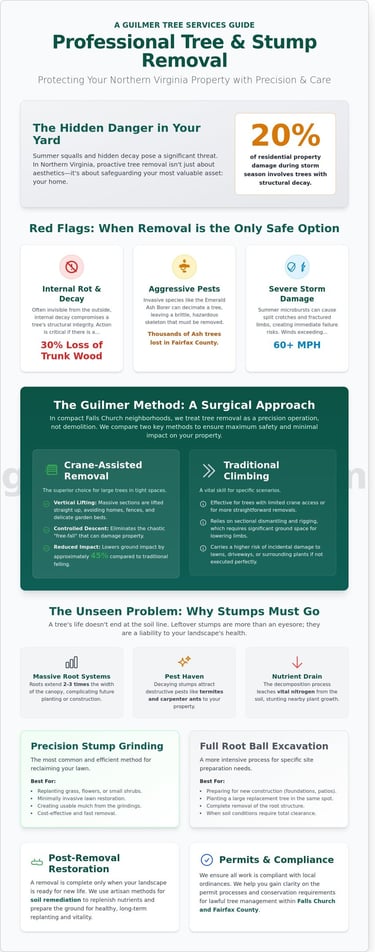
On a humid afternoon in July 2023, a Falls Church homeowner watched a 50-foot silver maple limb narrowly miss their sunroom during a routine summer squall. It's a scenario that plays out across Northern Virginia more often than many realize, as local data suggests that nearly 20% of residential property damage during storm season involves trees with hidden structural decay. While we deeply respect the longevity of our local canopy, professional tree and stump removal becomes a vital necessity when a specimen's vigor fails or its position threatens your home. You shouldn't have to choose between a beautiful landscape and a safe one, nor should you be left with a jagged stump that invites subterranean termites to your doorstep.
You likely agree that your yard is your most precious outdoor investment, and you want to protect it with the same rigor you'd apply to your home's foundation. This guide will show you the most efficient, safe, and horticulturally sound methods for removing hazardous trees and unsightly stumps from your landscape while remaining compliant with local ordinances. We'll walk through the technical merits of stump grinding versus excavation, the specific permit requirements in Falls Church, and how to ensure your soil remains healthy for future plantings.
Key Takeaways
Master the "Savoir-faire Guilmer" approach to professional tree and stump removal, ensuring the safe extraction of large species like Red Maples from narrow Northern Virginia properties.
Evaluate the advantages of crane-assisted removal versus traditional climbing to protect your property’s integrity during high-stakes arboricultural work.
Identify when to choose precision stump grinding over full root ball excavation based on your landscape's specific soil conditions and future site use.
Gain clarity on the local permit process and conservation ordinances required for lawful tree management within Falls Church and Fairfax County.
Learn the artisan’s method for soil remediation to prepare your ground for healthy replanting and long-term vitality after a tree is gone.
Table of Contents
Understanding Tree and Stump Removal in the Northern Virginia Landscape
The Professional Process: How Expert Removal Protects Your Property
Local Regulations and Permits in Falls Church and Fairfax County
Understanding Tree and Stump Removal in the Northern Virginia Landscape
In the historic neighborhoods of Falls Church, managing the urban canopy requires more than basic maintenance. Comprehensive tree and stump removal involves the strategic extraction of the entire biological structure, from the highest crown to the subterranean root network. Within the 2.2 square miles of our city, species like the White Oak and Red Maple define our local character. These giants provide immense value, yet their massive biomass becomes a heavy liability when biological health fails. Leaving a dead tree in a high-density neighborhood isn't just an aesthetic oversight. It's a direct threat to the local ecosystem and property safety.
Professional extraction differs from simple clearing. It respects the life cycle of the plant while acknowledging the constraints of modern infrastructure. We distinguish between aesthetic removal, which focuses on landscape design, and emergency mitigation. When a specimen poses an immediate risk to a structure, the process shifts from a methodical harvest to a precision operation. This ensures the integrity of your soil and the safety of your home remain uncompromised.
When is Removal the Only Option?
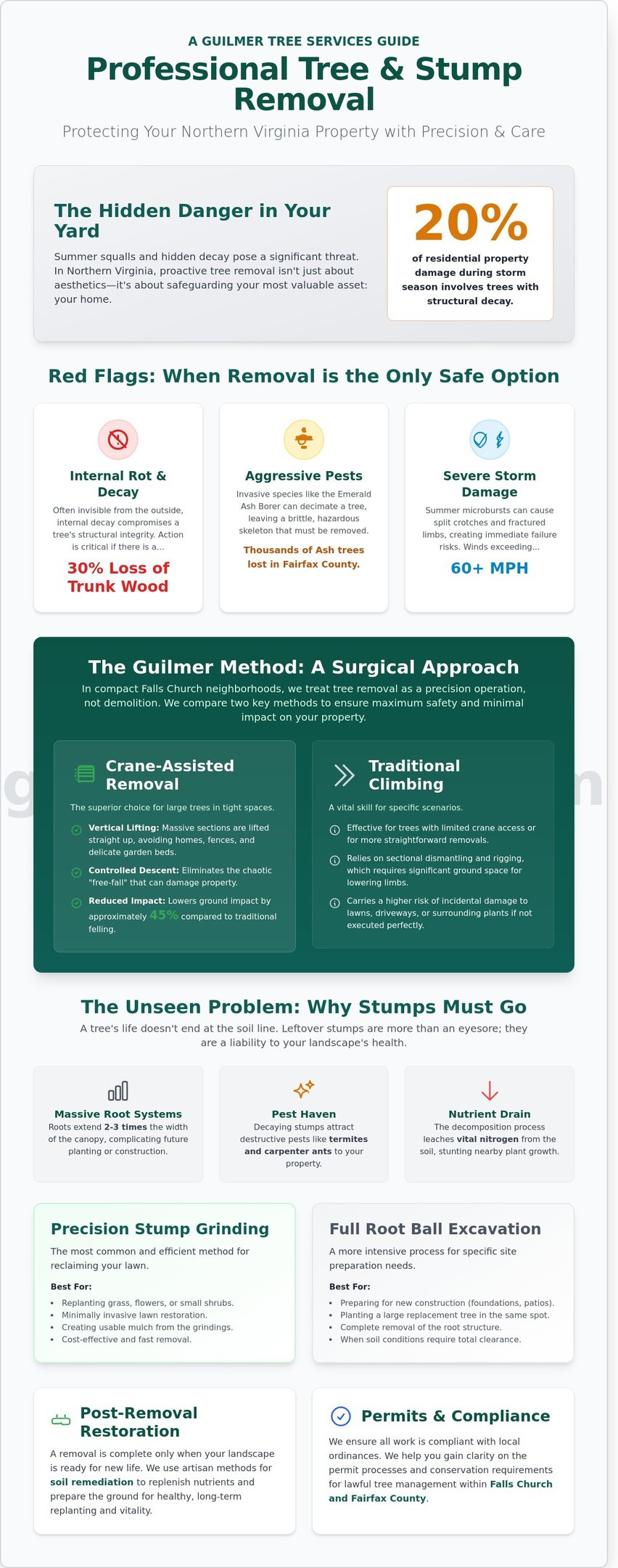
Arboricultural preservation is always the priority, but certain conditions make removal inevitable. Internal rot often hides behind healthy-looking bark. A 30% loss of trunk wood integrity usually necessitates immediate action to prevent failure. In Fairfax County, the Emerald Ash Borer has decimated thousands of trees since its 2003 discovery, leaving brittle skeletons that cannot be saved. Northern Virginia's summer microbursts, which can produce winds exceeding 60 mph, frequently leave mature specimens with split crotches. In these moments, removal is the only path to safety.
The Anatomy of a Stump: Why it Persists
A tree's life doesn't end at the soil line. The root systems of Virginia hardwoods often extend two to three times the width of the drip line. This hidden network is why a simple cut is insufficient. Decaying stumps become a harbor for the eastern subterranean termite and various carpenter ant species. Beyond pests, the decomposition process consumes significant amounts of nitrogen from the surrounding earth. This creates a localized nutrient deficit that stunts the growth of new turf. Professional tree and stump removal ensures the soil remains viable for the next generation of your garden's growth.
The Professional Process: How Expert Removal Protects Your Property
The Savoir-faire Guilmer approach treats every tree and stump removal as a surgical operation rather than a simple demolition. We view the landscape as a living legacy that requires a balance of technical force and horticultural sensitivity. In the compact residential corridors of Falls Church, where homes often sit within 15 feet of mature canopies, precision is the only acceptable standard. We prioritize the structural integrity of your remaining flora while ensuring the safe extraction of hazardous specimens.
Traditional climbing remains a vital skill, but for the 70-foot White Oaks common in Northern Virginia, crane-assisted removal is often the superior choice. Using a crane allows our team to lift massive sections vertically, bypassing delicate garden beds and ornamental fences entirely. This method reduces ground impact by approximately 45% compared to traditional felling techniques. Sectional dismantling ensures that every limb is rigged with high-strength synthetic ropes, guided by ground crews who control the descent with mechanical advantage. This meticulous control prevents the chaotic "free-fall" that often leads to driveway cracks or roof damage.
Advanced Equipment for Modern Tree Work
Modern arboriculture relies on specialized technology to protect your investment. We utilize compact aerial lifts that can navigate 36-inch backyard gates, reaching heights of 75 feet without the need for heavy trucks on your turf. These machines distribute weight to less than 6 PSI, which is essential for protecting the soil structure from compaction. Our professional-grade chippers process 100% of the organic debris on-site, turning branches into high-quality mulch that can be repurposed to nourish your garden beds.
The Safety Standards of Northern Virginia Arboriculture
Safety isn't a suggestion; it's a rigorous framework. Every project we undertake adheres to ANSI A300 standards, the national benchmark for tree care operations. In Virginia, verifying that a company is fully licensed and carries specific arboricultural insurance is a non-negotiable step for homeowners. We maintain comprehensive liability and workers' compensation to ensure your peace of mind. Our ground crew functions as a dedicated safety unit, securing the work zone with high-visibility markers and managing the debris flow to keep the site clean. Once the tree and stump removal is complete, we focus on site restoration to prepare the earth for its next phase. For those looking to replace a lost specimen with a heritage-quality plant, you can browse our collection of nursery-grown trees designed to thrive in Virginia soils.
Stump Grinding vs. Excavation: Choosing the Right Solution
Selecting the appropriate method for tree and stump removal depends entirely on your long-term vision for the landscape. While a felled tree leaves behind a silent monument, the subterranean network of roots continues to occupy the soil. Homeowners in Falls Church must decide if they require a superficial clearance or a total biological reset of the site. This decision impacts both your immediate budget and the future health of your garden bed.
Stump Grinding: The Efficient Choice
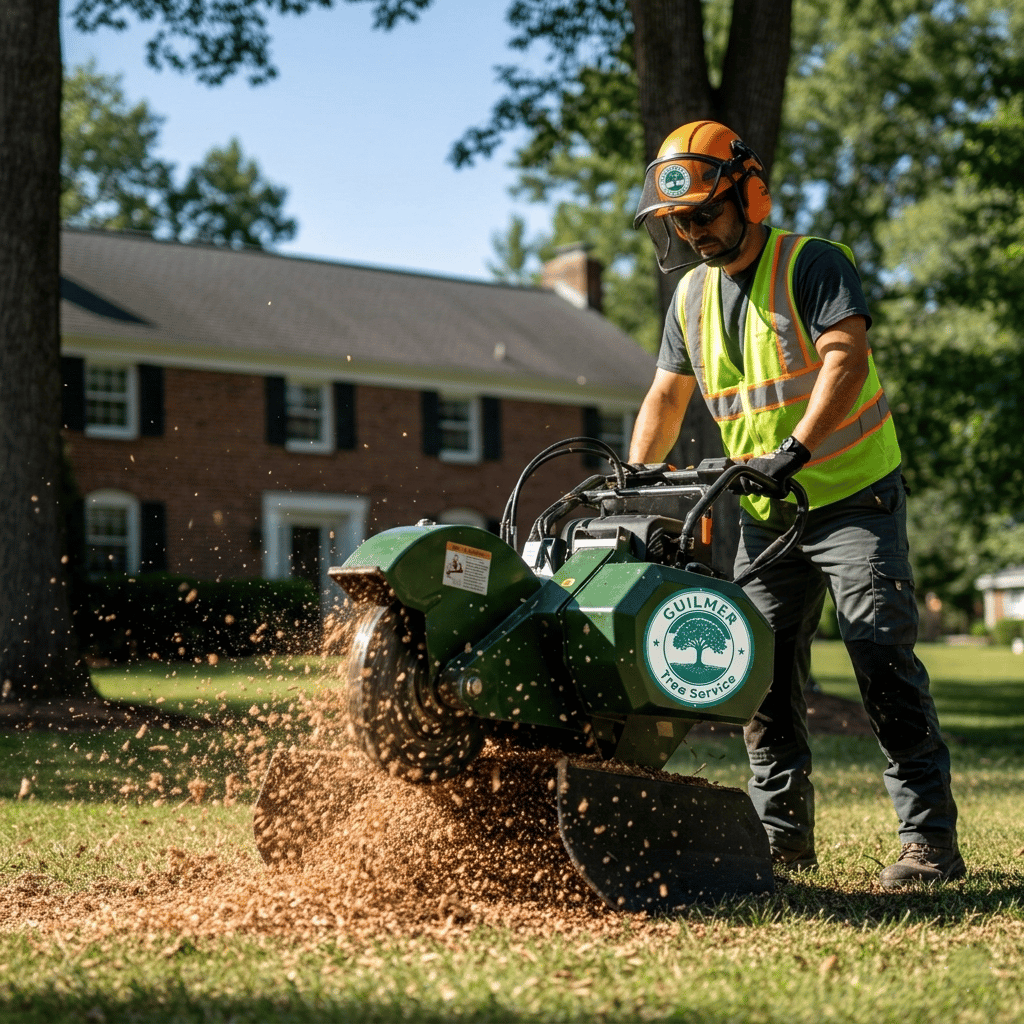
Stump grinding utilizes high-speed carbide teeth to pulverize wood into a nutrient-rich mulch. This process typically reaches depths of 8 to 12 inches below the soil grade, which is sufficient for most residential turf applications. It is a surgical approach that preserves the surrounding lawn and the delicate root systems of neighboring trees. Professional tree and stump removal via grinding is the standard for established neighborhoods where heavy machinery access is limited.
Material Management: A single 24-inch stump can produce 4 to 6 cubic feet of wood chips. You can repurpose these as garden mulch or have them hauled away to prevent nitrogen depletion as they break down.
Depth Precision: Standard residential grinding targets the visible core. This leaves deeper lateral roots to decompose naturally over 5 to 10 years, providing organic matter back to the earth.
Full Root Excavation: For the Cleanest Slate
When your project involves new foundations, swimming pools, or underground utility lines, grinding isn't enough. Full excavation involves heavy machinery, such as an excavator or backhoe, to extract the entire root ball from the earth. In high-end developments near McLean and Falls Church, builders often require this "clean slate" to ensure soil stability and prevent future settling.
Removing a root ball is a massive logistical undertaking. A mature 30-inch diameter tree often possesses a root mass weighing over 2,500 pounds. Unlike grinding, excavation leaves a significant void that requires structural fill dirt to prevent future sinkholes. While grinding might cost between $250 and $550 for a standard tree, full excavation often starts at $1,800 due to the specialized equipment and disposal fees involved. If you plan to plant a new specimen tree in the exact same spot, excavation is the only way to ensure the new root system has the uninhibited soil it needs to thrive.
Local Regulations and Permits in Falls Church and Fairfax County
Managing the botanical landscape of Northern Virginia requires more than technical skill; it demands a deep understanding of the legal frameworks protecting our urban canopy. The Tree Conservation ordinances in Falls Church and Fairfax County aren't mere hurdles. They're essential tools for preserving ecological balance. Homeowners often find that a routine tree and stump removal project intersects with specific local mandates designed to protect "specimen trees." These are individuals of exceptional size, age, or historical significance. While a standard ornamental shrub won't require a permit, a White Oak with a diameter at breast height (DBH) of 32 inches or more often falls under strict conservation status.
Fairfax County Tree Removal Guidelines
For properties in Fairfax County, the "10-foot rule" allows for the removal of trees within 10 feet of a building foundation without a permit. However, if your property sits within a Resource Protection Area (RPA), which covers approximately 10% of the county's land, the rules change. Removing any vegetation in an RPA requires a specific plan approved by the Department of Land Development Services. Failing to identify these boundaries can lead to fines exceeding $2,500 per violation. We help you navigate these maps to ensure your project respects the local watershed.
Arlington and Alexandria Specifics
Arlington County maintains an ambitious goal of 40% tree canopy coverage. Their Heritage Tree program protects specific specimens even on private land. You'll need a permit if your tree is part of a site plan or designated as a "Specimen" or "Heritage" tree. In Alexandria, the Urban Forestry Division monitors removals closely. We also coordinate with local Homeowners Associations (HOAs). Most HOAs in the 22046 zip code require written approval before any major tree and stump removal begins to ensure community aesthetic standards remain intact.
The Guilmer Savoir-faire extends beyond the soil. We act as your technical liaison, navigating the permit process with the same precision we use for root care. Our team evaluates your landscape's botanical integrity while ensuring every action aligns with the 2023 Fairfax County Tree Conservation Ordinance. We handle the paperwork so you can focus on the future of your garden.
Ensure your landscape remains compliant and healthy by consulting with our experts for professional tree assessments and permit assistance.
Restoring the Vigor of Your Landscape Post-Removal
The conclusion of a tree and stump removal marks a pivotal shift from extraction to stewardship. While the void left behind might seem stark, it represents a blank canvas for ecological renewal. Success in this transition depends on the artisan's approach to soil health. When a stump is ground, the resulting wood chips can temporarily deplete nitrogen levels as they decompose. We recommend integrating organic compost or a high-nitrogen fertilizer 14 days before any new planting to rebalance the earth's chemistry.
Preparing the ground requires patience. The soil where a mature tree once stood often needs 6 to 12 months to settle properly. Rushing this process leads to air pockets that can undermine the root stability of a successor. By focusing on the quality of the living substrate, you ensure the next generation of greenery possesses the structural integrity required to thrive in Falls Church's unique urban environment. Proper remediation ensures that the cycle of growth continues without the lingering decay of the past.
Replanting for Future Generations
Selecting the right essence for your property involves more than aesthetics; it's about choosing a lineage that withstands Northern Virginia's humid summers and erratic winters. Native species like the White Oak (Quercus alba) or the Eastern Redbud (Cercis canadensis) offer superior resilience. These trees are adapted to local Hardiness Zone 7 conditions, ensuring a higher survival rate compared to exotic varieties. Proper transplantation techniques, such as ensuring the root flare remains visible above the soil line, are hallmarks of the Savoir-faire Guilmer. We help you design a long-term landscape vision that prioritizes the health of the root system from day one.
Strategic Tree Pruning to Avoid Future Removals
Prevention is the highest form of horticultural care. Regular maintenance reduces the need for drastic tree and stump removal by addressing vulnerabilities before they become liabilities. Expert pruning can reduce a canopy's wind resistance by 25% to 30%, significantly lowering the risk of failure during Atlantic storm seasons. Identifying structural defects, such as co-dominant stems or internal decay, allows for corrective measures that extend a tree's lifespan by decades. Proactive care transforms a landscape into a legacy of strength and beauty. Schedule a professional tree assessment with Guilmer today to safeguard your property's natural assets.
Cultivate a Safer, More Vibrant Falls Church Landscape
Managing your property's canopy requires more than just a quick cut; it demands a deep respect for the horticultural integrity of Northern Virginia. By choosing the right balance between stump grinding and full excavation, you'll ensure the long-term health of your soil and surrounding root systems. Navigating the specific permit requirements of Fairfax County is essential to protect your investment and remain compliant with local ordinances. It's a process that rewards patience and technical precision.
Since 2021, our local family-owned team has combined traditional craftsmanship with modern technology to handle the most complex landscape challenges. We specialize in expert crane-assisted removal, a method that minimizes impact on your lawn while ensuring maximum safety for nearby structures. As a fully licensed and insured provider, we focus on the technical precision of tree and stump removal to help your garden reach its full potential. We take pride in every project, treating your land with the same care we give our own nursery stock.
Get a Free Estimate for Tree and Stump Removal in Falls Church
Your property deserves the care of artisans who understand the lifecycle of every branch and the strength of every root. We look forward to helping your landscape thrive for years to come.
Frequently Asked Questions
Is it cheaper to remove a tree and its stump at the same time in Falls Church?
Yes, bundling these services typically reduces your total invoice by 15% to 20% compared to booking them separately. When our crews are already on-site with the heavy machinery, we eliminate the secondary $150 mobilization fee. This integrated approach to tree and stump removal ensures a clean slate for your landscape in one single visit while respecting the soil's integrity by finishing all mechanical work at once.
Do I need a permit to remove a dead tree in Fairfax County?
You generally don't need a permit to remove a dead tree on a standard residential lot in Fairfax County, provided it's not in a Resource Protection Area (RPA). If your property falls within the 100-foot buffer of a stream or wetland, the Chesapeake Bay Preservation Ordinance requires a formal review. In 2023, 92% of residential removals outside these specific zones proceeded without any county intervention or paperwork.
How deep does stump grinding usually go for a standard residential yard?
Standard residential stump grinding reaches a depth of 8 to 12 inches below the soil grade. This depth is sufficient for laying sod or spreading 4 inches of topsoil for grass seed. For larger specimens with expansive root systems, we can grind up to 18 inches deep to ensure the main root flare is completely pulverized. This technical precision protects the vigor and aesthetic of your surrounding garden beds.
Will tree removal equipment damage my lawn or driveway?
Professional crews prevent damage by using 4x8-foot high-density polyethylene ground protection mats to distribute the weight of the machinery. These mats reduce ground pressure to less than 15 pounds per square inch, which is lower than a human footprint. We also utilize articulated loaders that pivot without tearing the turf. Your driveway stays intact because we never stabilize heavy cranes on unreinforced concrete or asphalt edges.
What happens to the wood and debris after the tree is removed?
We process smaller limbs through a brush chipper to create organic mulch, while larger trunk sections are hauled to local recycling facilities like the I-66 Transfer Station. Approximately 75% of the biomass we remove is repurposed into high-quality compost or wood chips. If you prefer, we can leave the seasoned wood on-site, cut into 16-inch lengths for your fireplace or backyard fire pit to preserve the resource.
Can I replant a new tree in the same spot where a stump was ground?
You shouldn't plant a new tree in the exact center of the old stump hole immediately. The decomposing wood chips deplete nitrogen from the soil, which often stunts the growth of a young sapling's root system for at least 24 months. It's better to offset the new planting by 3 to 5 feet. This ensures the new essence has access to fresh, nutrient-rich soil and adequate space for its structural roots to expand.
How much does professional tree and stump removal cost in Northern Virginia?
Professional tree and stump removal in Falls Church typically ranges from $950 for a medium-sized maple to $4,200 for a mature 70-foot oak. These figures include labor, specialized equipment, and debris disposal. Factors like proximity to power lines or the home can increase the price by 25% due to the need for technical rigging. We provide transparent estimates that reflect the artisan skill required for safe, surgical extraction.
Does homeowners insurance cover the cost of removing a fallen tree?
Homeowners insurance usually covers the cost, up to a $1,000 limit, only if the tree damages a covered structure like your roof or a detached garage. If a tree falls in your yard without hitting anything, most policies won't pay for its removal. In Fairfax County, 80% of standard policies exclude "land clearing" for trees that fall due to natural decay rather than a verified 50-mph wind or ice event.
Our Services
Tree Removal
Tree Trimming and Pruning
Stump Grinding
Bush Chipping
Hours & Information
© 2026. All rights reserved.
Monday to Friday : from 9:00 AM – 5:00 PM
on-site : from 8:00 AM – 6:00 PM