
🌳Stump Removal Cost in 2026: Per‑Inch Pricing & Savings
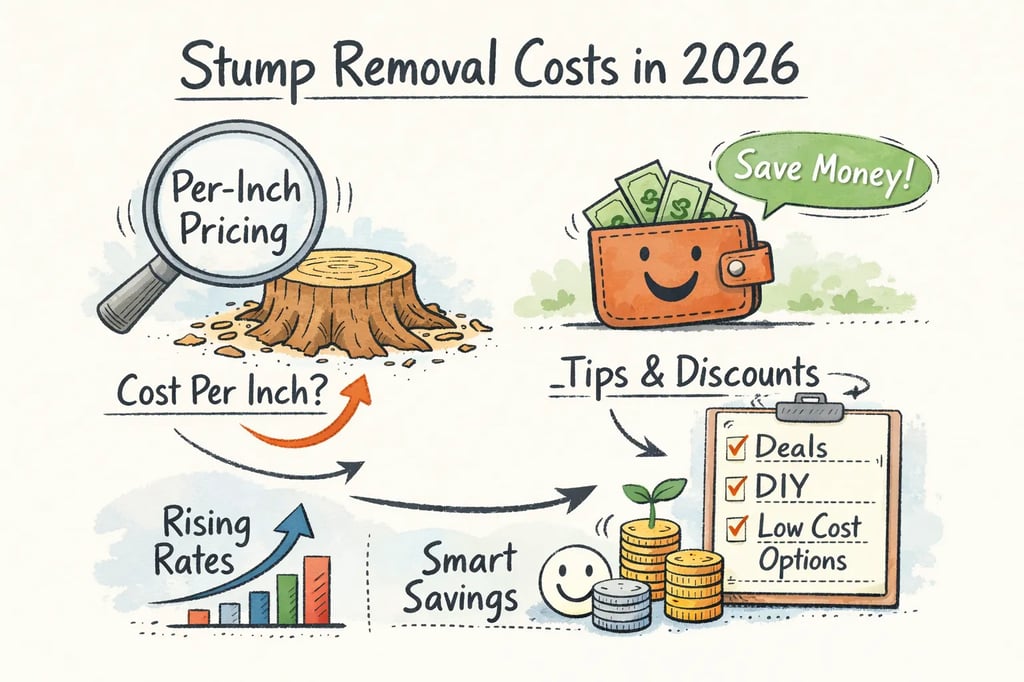
Expect stump grinding to run roughly $0.50–$6 per diameter inch, with typical per‑stump totals often falling between $180–$400 depending on stump size, access, and removal method. Get itemized quotes that list grinding depth, disposal, and turf restoration; save by bundling multiple stumps or scheduling off‑peak. Guilmer Tree Services provides free, transparent quotes and local expertise — call 571‑645‑2048 for a no‑pressure estimate.
6 min read
Intro — straight answer from your neighborhood crew
This is the question we hear every week at Guilmer Tree Services in Falls Church. Below you’ll find a fast, honest breakdown of typical 2026 prices, the factors that move a quote, a no-nonsense DIY vs. pro decision guide, what to demand on a written estimate, and seven practical ways to lower your bill. These are local averages and simple math—still get a site visit for a precise price
Quick cost snapshot — the numbers (so you can estimate fast)
Expect stump grinding to run roughly $2–$6 per inch of stump diameter. Typical invoices land around $120–$400 for the first stump and $30–$60 for each additional one. Most contractors also have a minimum callout fee in the $80–$160 range.
For method comparison: grinding usually costs $100–$600 per stump (roots remain), while full extraction—including the root plate—typically ranges $200–$1,000 (national averages cluster near $368). If you’re thinking about renting equipment, standard stump grinders rent for about $200–$400/day; mini grinders can be $60–$90/day.
Use this rule-of-thumb formula to estimate quickly:
Estimated price ≈ max(minimum fee, stump diameter × per‑inch rate) + likely extras (access, roots, disposal).
Worked example: a 20" stump quoted at a mid-range $3.50/inch gives $70 on paper, but minimums and trip fees usually push that into the $120–$150 reality. Measure at the trunk base (not the sawed surface) so your numbers match the contractor’s.
Diameter is the single biggest driver. Small stumps (under ~12") often sit in a $2–$3/inch band but still hit minimums. Medium trunks (12–24") commonly fall in the $3–$4/inch range. Large stumps (24" and up) move into the $4–$6/inch band or more because they take longer and need heavier equipment.
Access and site difficulty are next. Narrow gates, fences, steep slopes, or work next to a house or driveway can add 20–50% or a flat access surcharge ($50–$200). When crews must hand‑work or bring specialized rigs, labor time — not just diameter — becomes the cost driver.
Root structure and species matter. Hardwoods such as oak or maple with wide lateral roots slow grinding and make root-plate extractions much pricier. Root work can add $50–$350 or more depending on how deep and extensive the roots are.
Finally, quantity, region, and timing shift the final number. Multiple stumps usually reduce per‑stump pricing (10–50% discounts are common). Metro areas and high‑demand seasons push rates higher; off‑season dates can save money. Common add‑ons include hauling/disposal ($1.50–$4 per inch or a flat fee), backfill/topsoil, permit fees ($100–$500), and utility locates. Local cost compilations and national guides can help validate bands like these; see a concise national breakdown for typical stump grinding costs stump grinding cost guides.
Practical takeaway: measure the stump diameter at the base, note access constraints, and ask for an itemized quote that lists any probable add‑ons before comparing bids.
Renting tools is sensible if you have multiple small stumps, a suitable vehicle, helpers, and some mechanical comfort. If you have one or two medium-to-large stumps, hiring a pro is usually cheaper and far safer.
Rental math example: a rental at $250/day plus trailer/delivery, deposit, and your time. If a pro charges $150–$250 per stump, DIY becomes cost‑effective only when you can finish several stumps in a day without complications. Novice operators often underestimate time and nuisance costs (fuel, cleanup, restoring turf).
Safety box: always call 811 before digging, wear eye and ear protection and sturdy footwear, and never attempt root‑plate extraction near utilities or structures unless you have the training and equipment. Buried debris, rebar, or fasteners can shred grinders and create flying hazards. For seasonal tree care and safety guidance, see our Tree Care Tips & Expert Advice.
If the stump sits close to a house, fence, driveway, or buried utilities, call a licensed, insured crew. At Guilmer Tree Services we offer free on‑site estimates, handle disposal and permits when required, and run smaller rigs for tight yards so the job is efficient and safe. If you want to book a visit, we list our local stump removal service near you and can schedule a free estimate.
For readers considering rentals: industry rental price summaries show standard stump grinder rental costs, so include that in your break‑even math before committing.
Seven practical ways to lower the bill (without cutting corners)
Bundle stumps into one visit — crews give steep per‑stump discounts after the first because travel and setup are shared.
Keep the grindings as mulch on site — hauling chips is a common extra fee; using the chips cuts that charge to zero.
Prep the site before arrival — clear gates, move pots and fences, and trim brush so crews don’t spend time on non‑work tasks.
Choose grinding over full extraction unless you need the root plate removed for construction —hire a stump grinding pro near youwhen in doubt; grinding is faster and cheaper.
Schedule off‑peak or midweek — demand-based pricing can knock dollars off the final bill.
Rent only if you have many stumps and helpers — do the break‑even math (rental + transport + time vs. pro per‑stump rates) first.
Ask for line‑item quotes and negotiate disposal/backfill — know what’s optional and what’s necessary; small changes add up.
What to ask for in a written quote — must‑have items and red flags
Get these items in writing so you’re comparing apples to apples: how diameter was measured (at the trunk base or cut surface), whether the price is per‑inch or flat per‑stump, grind depth (inches below grade), exactly what cleanup/disposal is included, any haul‑away or dump fees, whether backfill or topsoil is included, the minimum fee and cost for each additional stump, who handles permits and utility locates, a start date window, and clear payment terms.
Confirm legitimacy by asking for the contractor’s license and current insurance certificate; request photos or references from similar jobs. A trustworthy crew will itemize work and explain why any premium exists.
Watch for these red flags:
Vague, “we’ll take care of it” estimates with no line items.
Unusually low bids that pressure you to pay cash.
No proof of insurance or refusal to visit the site when accessibility matters.
Copy‑paste script for calls: “Please itemize grinding vs extraction, show per‑inch and per‑stump pricing, include chip removal and any backfill costs, confirm minimums and additional‑stump pricing, and email proof of insurance.” Guilmer Tree Services uses the same checklist on every free estimate so you can see exactly what you’re paying for; for a deeper look at our process and what to ask, review our Tree & Stump Removal: Costs, Process, and What to Ask guide.
Real examples and next steps for your yard
Scenario A — small yard, 10–12" stump, open access and shallow roots. Expect to hit the minimum: commonly $120–$150 to grind. Rental is usually not worth it unless you have several stumps.
Scenario B — medium stump ~18" near a fence with moderate roots. Typical range $150–$300 depending on access and whether chip hauling or backfill is requested. For tight spaces, a pro is usually the safer, faster choice.
Scenario C — large stump 30–36" or full root‑plate removal near a driveway or planting area. Full extraction with hauling and backfill commonly runs $400–$800 or more. This job needs excavation equipment and a licensed crew.
Quick rental break‑even: if you can grind 4–6 medium stumps in one day, a rental may pay off. Otherwise, pros with per‑stump pricing, safety gear, and disposal logistics typically win on price and convenience. For a recent compilation of typical removal and grinding price ranges, see a national overview of stump removal pricing stump removal price studies.
Next steps checklist — a short to‑do before you schedule:
Measure stump diameter at the trunk base and take clear photos (from distance and close).
Call 811 to have utilities marked before any digging.
Get 2–3 itemized quotes and compare what’s included.
Confirm license and insurance for the company you choose.
If you’re local to Falls Church, schedule a free on‑site estimate with Guilmer Tree Services — we’ll show grind depth, explain extras, and leave you with an itemized proposal. We also serve neighboring neighborhoods; see our Tree Services in Arlington VA page for nearby service details.
Bottom line
Measure the stump, note access issues, and use the per‑inch bands and minimums above to form a realistic expectation before you call. For one or two stumps near structures, hire a licensed, insured crew; for multiple, simple stumps, a rental can make sense if you have time and helpers. If you’d like a free on‑site estimate from a local, safety‑first team that itemizes every charge, give Guilmer Tree Services a call — we’ll walk the yard, show you the grind depth, and leave you with clear numbers.
What really drives the bill — the four big cost factors (and the hidden ones)
DIY, rent, or hire a pro — how to choose (safety + math)
Our Services
Tree Removal
Tree Trimming and Pruning
Stump Grinding
Bush Chipping
Hours & Information
© 2026. All rights reserved.
Monday to Friday : from 9:00 AM – 5:00 PM
on-site : from 8:00 AM – 6:00 PM