🌳Stumps Tree Removal Checklist: Is Your Falls Church Property at Risk?
Is your property at risk? Our stumps tree removal checklist reveals hidden dangers from pests and damage. Learn how to safely protect your Falls Church home.
12 min read
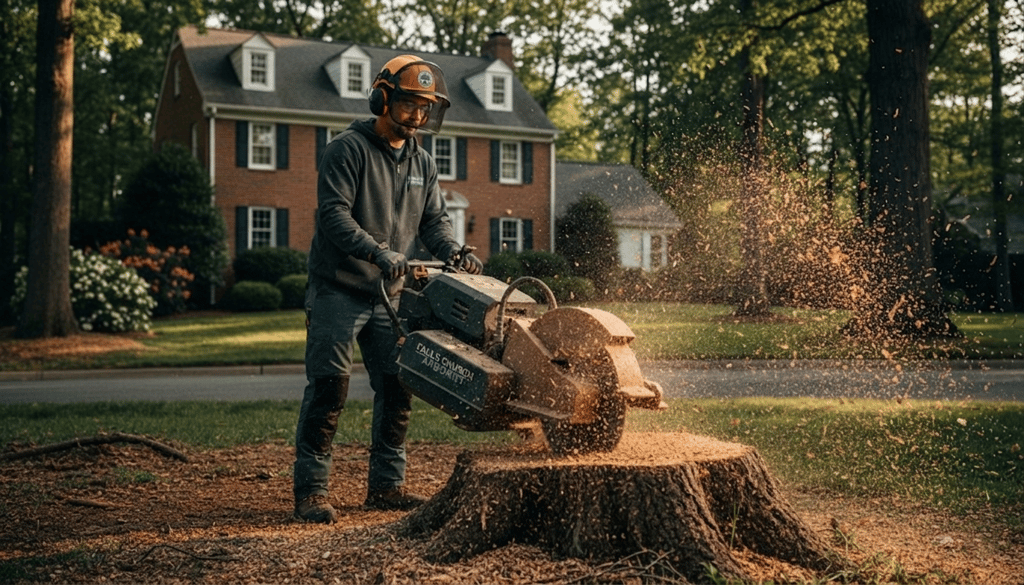
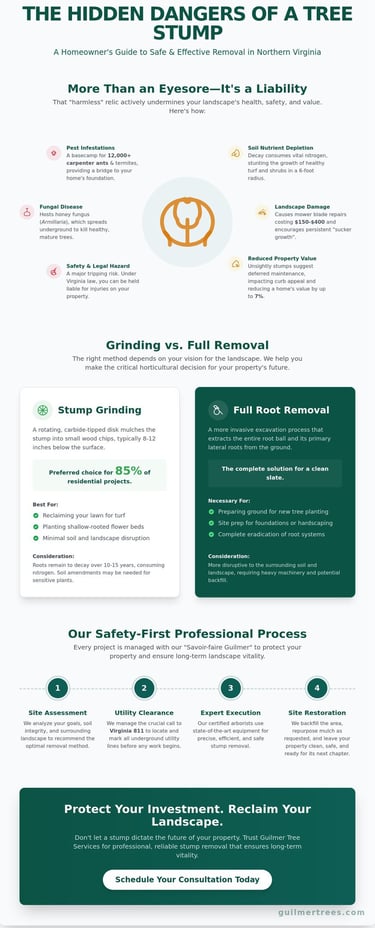
Last Tuesday, a homeowner in Falls Church discovered that a single forgotten oak base had become a silent sanctuary for a colony of roughly 12,000 carpenter ants. It's easy to view these wooden remnants as harmless relics of the past, but they often hide risks that extend far beneath the soil. When considering stumps tree removal, the health of your entire garden ecosystem is at stake. You likely want a landscape that's safe for your children and kind to your mower blades, yet these subterranean obstacles often lead to expensive repairs and persistent pests that threaten the vitality of your living space.
We approach every property with the same rigor we apply to our nursery stock, focusing on soil integrity and the vigorous growth of your future plantings. This guide identifies the hidden hazards of stumps tree removal and explains the professional criteria for safe, effective clearing in Northern Virginia. You'll learn exactly when to choose precision grinding versus full excavation to preserve the structure of your land. Our goal is to provide you with the clarity needed to maintain a safe, clean landscape that reflects the true excellence and enduring beauty of your property.
Key Takeaways
Identify the hidden liabilities of "dead" stumps, including their role as breeding grounds for invasive species and potential liability risks for homeowners.
Distinguish between surface grinding and full root excavation to choose the right method for your future horticultural goals.
Master a 5-point safety checklist to determine when professional stumps tree removal is necessary to protect your home’s foundation and utility lines.
Navigate the preparation process with ease by understanding the importance of Virginia 811 and how to clear your site before the crew arrives.
Learn why professional intervention from Guilmer Tree Services ensures long-term landscape vitality compared to the risks of DIY equipment rental.
Table of Contents
The Hidden Liabilities of Tree Stumps in Falls Church
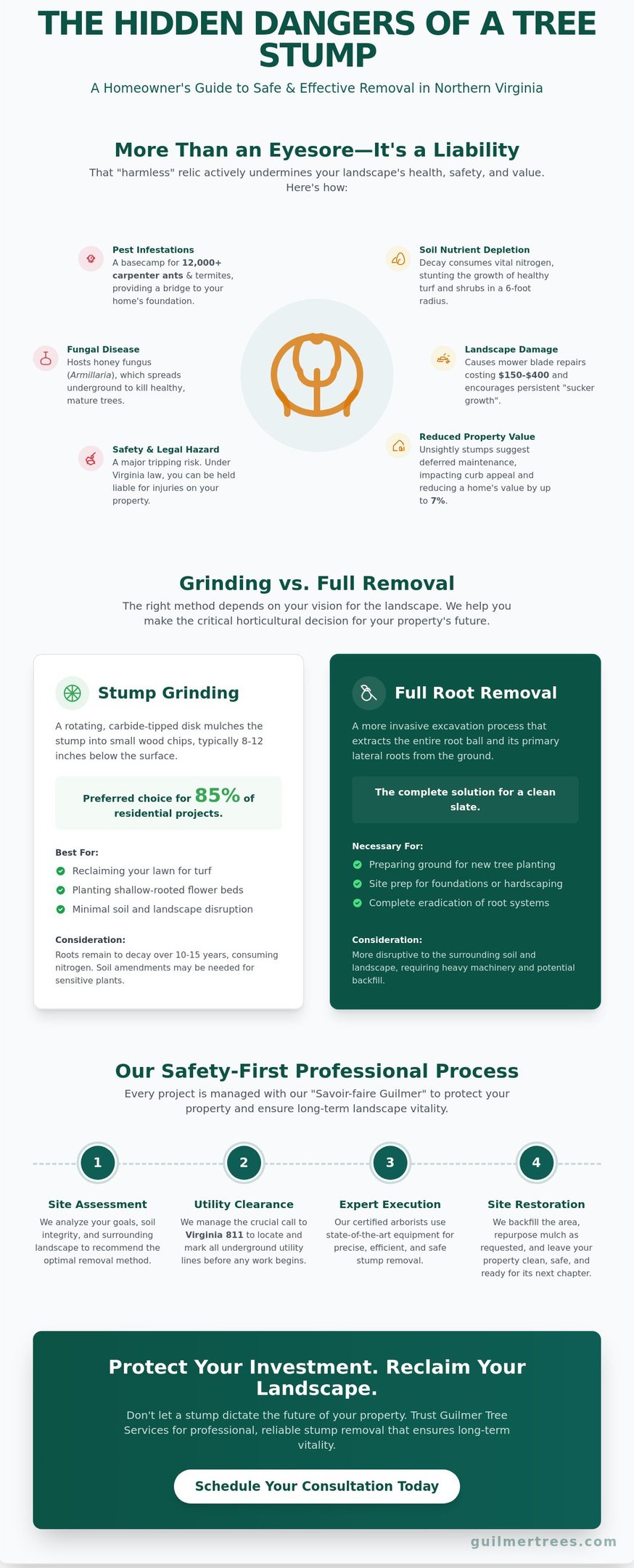
Leaving a stump in your yard after a felling might seem like a minor aesthetic choice, but it's a decision that impacts the biological health of your entire landscape. In the professional horticultural tradition, we view the stump not as a dead object, but as a decaying mass that actively competes with living plants. As the wood breaks down, microorganisms consume large quantities of nitrogen from the surrounding soil. This creates a localized nutrient deficiency that can stunt the growth of healthy turf and shrubs within a 6-foot radius. In the competitive Northern Virginia real estate market, where curb appeal accounts for up to 7% of a home's valuation according to 2023 regional data, an unsightly stump suggests deferred maintenance to potential buyers.
Safety remains a primary concern for homeowners in Falls Church and Arlington. A stump hidden by tall grass or autumn leaves becomes a significant tripping hazard. Under Virginia's premises liability laws, property owners can be held responsible for injuries sustained by guests or contractors on their land. Choosing professional stumps tree removal mitigates these legal risks while restoring the functional footprint of your outdoor space. It's a necessary step for anyone prioritizing the long-term vitality and safety of their property.
Pest Infestations: Termites and Carpenter Ants
A decaying stump serves as a primary base camp for wood-destroying insects. Termites and carpenter ants are drawn to the moist, softening cellulose of an untreated stump. If that stump sits within 15 feet of your home's foundation, you've essentially provided a bridge for pests to migrate into your structure. You should also watch for the presence of Armillaria, often called honey fungus. This white, stringy growth indicates a rot that can spread through the soil to infect the root systems of nearby healthy oaks and maples, jeopardizing the canopy of your entire lot.
Landscape Maintenance and Mower Damage
The financial impact of a stump often surfaces during routine lawn care. Striking a hidden root or the stump itself can lead to mower blade repairs and spindle replacements costing between $150 and $400. Beyond equipment damage, many local species, such as the Silver Maple or Creeping Willow, produce "sucker growth." These are small, persistent sprouts that emerge from the remaining root flare. Without complete stumps tree removal, you'll find yourself in a constant cycle of pruning these shoots; they drain energy from your soil and complicate your weekly maintenance routine for years to come.
Stump Grinding vs. Full Removal: Which is Right for You?
Choosing the right method for stumps tree removal depends entirely on your vision for the landscape's future. While some see it as a simple task of clearing space, it's actually a critical horticultural decision that affects soil health for decades. Stump grinding utilizes a rotating carbide-tipped disk to mulch the wood into small chips, typically reaching depths of 8 to 12 inches. Full removal is a more invasive excavation that extracts the entire root ball and its primary lateral roots. At Guilmer Trees, we apply our Savoir-faire Guilmer to every site, ensuring that the method chosen respects the delicate balance of your soil's microbial life and physical structure.
Horticultural integrity is our primary concern. When a stump is ground, the underground root system remains to decay naturally over 10 to 15 years. This biological breakdown consumes nitrogen, which can temporarily starve nearby sensitive plants. If your goal is a pristine lawn or a simple flower bed, this impact is manageable with proper soil amendments. However, if you're preparing the ground for a significant new planting, the physical obstruction of old roots can prevent new specimens from establishing a stable footing. We analyze each Northern Virginia lot to determine if the existing soil density can support your long-term botanical goals.
When to Choose Stump Grinding
Grinding is the preferred choice for 85% of residential landscape restorations in Falls Church. It's an efficient way to reclaim your lawn without the heavy soil disruption caused by backhoes. The process generates a rich mulch that you can repurpose for your garden beds, provided you balance it with a nitrogen-rich fertilizer to offset the carbon load. For standard turf restoration, a 6-inch depth is sufficient; if you plan to plant small perennials, we recommend grinding to 12 inches to allow for adequate soil volume and drainage.
When Full Root Removal is Necessary
You'll need a full excavation if you're planning new construction or foundation work within 12 feet of the stump. Old roots can settle and create voids as they rot, potentially cracking sidewalks or interfering with underground utilities. This method is also essential when you wish to plant a grand sujet or a large-scale tree in the same spot. Clearing the subterranean space allows the new root system to expand without competition or physical barriers. While the cost for full removal can range from $850 to $2,600 depending on the species and diameter, it's a vital investment for the longevity of your next tree. You might explore our nursery's resilient tree collections to find a worthy successor for your newly cleared site once the soil structure is restored.
The Homeowners Checklist: 5 Signs You Need Immediate Removal
A stump left behind after a felling isn't a static object. It's a biological site in transition. In the Falls Church area, where mature oak and maple canopies define our neighborhoods, managing the remnants of these giants requires a professional eye for detail. Ignoring a stump often leads to complications that extend far beneath the soil line. You'll need to evaluate your property against these five critical indicators to determine if stumps tree removal is a luxury or a structural necessity.
Structural Encroachment: The stump sits within 10 feet of a foundation, retaining wall, or driveway.
Active Infestation: Visible "frass" (fine sawdust) or insect exit holes are present on the wood surface.
Fungal Colonization: Mushrooms or shelf fungi are growing at the base or from the root flares.
Physical Obstruction: The site creates a trip hazard in high-traffic lawn areas or blocks visibility for exiting a driveway.
Pathogen Risk: The original tree died from a communicable disease like Oak Wilt or Dutch Elm Disease.
Every homeowner acts as a steward of their land. When you identify these signs early, you protect the 85% of your remaining healthy canopy from secondary infections. Proactive management ensures the safety of your family and the longevity of your landscape's value.
Step 1: Proximity and Structural Risk
You should measure the distance between the stump and any permanent structure. If the stump is within 15 feet of power lines or underground utilities, the decay process can destabilize the surrounding soil. Look for root heave, which often manifests as cracks in concrete exceeding 0.5 inches. These shifts indicate that the root system is still exerting pressure or, conversely, is collapsing and creating subterranean voids. Maintaining clear sightlines is vital; a stump that obscures more than 20% of a driver's view when exiting a property is a documented safety liability.
Step 2: The Biological Health Audit
Use a screwdriver to poke the wood surface. Soft, spongy spots indicate advanced internal decay. In Virginia, decaying maple and oak are primary targets for the Eastern subterranean termite and carpenter ants. These pests don't stay confined to the stump; they often migrate to the nearest structural timber within 48 hours of a colony expansion. Stumps tree removal stops this cycle of infestation. Additionally, fungal blooms like Armillaria (honey fungus) signal that the stump is a reservoir for pathogens. These spores can travel up to 50 miles on wind currents, potentially infecting every healthy tree on your street.
Preparing for Professional Removal in Northern Virginia
Successful stumps tree removal starts long before the grinder’s teeth touch the wood. In Falls Church and surrounding Northern Virginia neighborhoods, the earth beneath our feet is a crowded network of infrastructure. We require every homeowner to contact Virginia 811 (Miss Utility) at least three business days before our arrival. This state-mandated service marks underground gas, water, and electric lines. It prevents catastrophic service interruptions and ensures the safety of our arborists. Beyond the utilities, clear the work zone of patio furniture, potted plants, and decorative stones within a 20-foot radius of the target area.
Access is the next logistical hurdle. Our professional stump grinders require a minimum clear path of 36 inches to reach backyards. If your gate is narrower, we'll need to discuss alternative entry points or fence panel removal before the scheduled date. During the operation, the machinery generates significant kinetic energy and flying debris. We maintain a strict 50-foot exclusion zone for all pets and children. It's not just about the noise; it's about the unpredictable nature of subterranean root structures when they meet high-speed steel.
Navigating Local Regulations and Utilities
Guilmer Tree Services manages the coordination of utility markings to ensure your property's integrity. While Falls Church City and Fairfax County generally don't require permits for removing a stump on private residential property, Arlington County has specific canopy conservation rules that might apply if the stump is part of a larger clearing project. We also ask you to flag private irrigation heads or low-voltage lighting wires. These aren't covered by Miss Utility and sit just 4 to 6 inches below the turf, making them vulnerable to heavy machinery.
Site Cleanup and Restoration
A standard residential stumps tree removal and grinding session takes between 45 and 90 minutes. Once the wood is reduced to mulch, you're left with a mixture of soil and chips that occupies roughly 300% more volume than the original stump. We offer a clean site guarantee where we haul away excess debris and leave the area level. To restore your lawn, we fill the cavity with a nutrient-rich topsoil blend and apply high-quality fescue seed. This ensures the site transitions from an eyesore back to a vibrant part of your landscape.
Ready to reclaim your landscape with expert precision? Schedule your professional stump assessment with Guilmer Tree Services today.
Why Expert Intervention Defines Your Landscape’s Future
Choosing to handle a leftover stump yourself often seems like a practical Saturday project. However, the gap between renting a generic grinder and engaging in professional horticultural care is vast. A rental machine provides a surface-level fix, yet it rarely addresses the biological legacy left behind by a felled tree. Professional stumps tree removal acts as a reset button for your soil, ensuring that the 80% of root mass remaining underground does not become a breeding ground for Armillaria root rot or carpenter ant colonies.
At Guilmer Tree Services, we view every removal as a vital step in a broader property health plan. We analyze the soil density and the surrounding root systems of your remaining oaks and maples before we begin. This precision prevents the accidental compaction of earth that often occurs when heavy, unmanaged rental equipment is driven across a delicate lawn. Our team integrates the removal process with long-term vitality in mind, turning a potential site of decay into a nutrient-rich foundation for your next planting phase.
The Guilmer Standard of Excellence
Our approach is rooted in the specific needs of Northern Virginia’s urban canopy. As a fully licensed and insured provider, we offer a level of security that DIY attempts simply cannot match. We understand the local clay-heavy soils of Falls Church and how they react to different extraction methods. Since our founding, we have maintained a commitment to the "Savoir-faire Guilmer," treating your yard not as a construction site, but as a living pépinière. This local expertise ensures that our work respects the structural integrity of your landscape and the safety of nearby utility lines.
Claim Your Safe Yard Today
The transition from a hazardous obstacle to a thriving outdoor sanctuary begins with an informed decision. Attempting to pull or grind a stump without professional oversight often leads to damaged irrigation lines or personal injury; statistics show that thousands of yard-related accidents occur annually due to improper equipment use. By choosing a professional assessment, you protect your property value and your physical well-being. We make the process seamless for residents in Falls Church and Arlington, providing clear timelines and transparent methodology. When you prioritize the health of your soil, the necessity of expert stumps tree removal becomes clear. Take the first step toward a restored landscape and Contact Guilmer Tree Services for a professional stump assessment to secure the future of your outdoor space.
Restore the Vitality of Your Falls Church Landscape
A lingering tree stump is more than a blemish; it's a liability that invites pests and compromises the safety of your outdoor space. By following our checklist, you've identified the signs of decay and the necessity of professional intervention. Whether you choose precision grinding or full extraction, your decision impacts the long-term health of your soil and the structural integrity of your garden. Since 2021, Guilmer Trees has applied horticultural expertise to every project, ensuring that site cleanup isn't just about clearing debris but about preparing the land for its next chapter of growth.
We're a licensed and insured team in Virginia that treats every property with the rigor of a traditional nurseryman. Our specialized approach to stumps tree removal focuses on the root system's health, preventing the regrowth of unwanted shoots while protecting your existing flora. It's time to move past the clutter of old remains and embrace a landscape that reflects professional care and natural beauty. Don't let a hidden hazard dictate your property's future when expert help is just a click away.
Get your free stump removal quote in Falls Church today
We look forward to helping your landscape thrive for years to come.
Frequently Asked Questions
How much does stumps tree removal typically cost in Falls Church, VA?
Stumps tree removal in Falls Church typically costs between $150 and $450 per unit for most residential properties. Local arborists often set a $100 minimum fee for any site visit to cover equipment transport. For larger specimens exceeding 36 inches in diameter, prices can reach $600. These rates reflect the labor required to navigate Northern Virginia's dense clay soil and ensure the site is left in a stable condition.
Is it better to burn out a stump or have it professionally ground down?
Professional grinding is the superior method for preserving soil health and ensuring property safety. Burning a stump requires a constant fire for 48 to 72 hours and rarely destroys the deep taproot. Grinding turns the wood into organic mulch in under an hour. It avoids the 500-degree heat that kills beneficial soil microbes and eliminates the fire risks associated with suburban lot densities.
Will a tree stump grow back if I don’t remove the entire root system?
Certain species like Silver Maples or Willows have a 70% chance of sprouting new growth if the cambium layer remains near the surface. While the deep roots eventually decay, the area just below the flare can remain dormant for years. Grinding the stump at least 6 inches below the grade severes these primary nutrient pathways. This technical precision prevents unwanted suckers from compromising the aesthetic of your curated landscape.
How long does the stumps tree removal process take for a medium-sized tree?
The stumps tree removal process for a 20-inch diameter tree usually takes between 15 and 30 minutes of active grinding. Total on-site time typically spans 60 minutes when you include machine positioning and debris management. Hardwoods like White Oak require more passes than softer pines. Our experts use high-torque machinery to ensure the transition from a standing stump to a level surface is both swift and thorough.
Can I replant a new tree in the exact same spot where a stump was ground?
You shouldn't replant a new tree in the exact same spot for at least 12 to 24 months. The high volume of wood chips left behind creates a nitrogen deficiency as microorganisms work to break down the carbon. If you must plant immediately, offset the new hole by at least 3 feet. This distance provides the fresh root system with undisturbed soil and the vital nutrients needed for successful establishment.
Does homeowners insurance in Virginia cover the cost of stump removal?
Virginia homeowners insurance only covers stump removal if a covered peril, such as a 50-mph windstorm or a lightning strike, caused the tree to fall. Standard policies don't pay for removal due to rot, disease, or aesthetic preference. If a tree falls on a structure, the $500 to $1,000 removal cost is often included in the claim. Always review your policy's debris removal clause to understand your specific coverage limits.
What happens to the underground roots after the surface stump is ground?
Underground roots remain in the earth and undergo a natural decomposition process that lasts 5 to 10 years. As fungi break down the cellulose, the wood softens and eventually merges with the surrounding soil structure. You'll notice slight ground settling during this decade of decay. We recommend adding a 2-inch layer of topsoil every few seasons to keep the area level and ready for future horticultural use.
Is a permit required for stump removal in Fairfax County?
You don't need a permit for removing individual stumps on private residential lots in Fairfax County. However, strict rules apply if the stump is within a Resource Protection Area, which includes land within 100 feet of a stream or wetland. In these zones, the Chesapeake Bay Preservation Ordinance requires a specialized review. Checking the county's digital tax maps ensures your project respects local environmental regulations and avoids potential fines.
Our Services
Tree Removal
Tree Trimming and Pruning
Stump Grinding
Bush Chipping
Hours & Information
© 2026. All rights reserved.
Monday to Friday : from 9:00 AM – 5:00 PM
on-site : from 8:00 AM – 6:00 PM