
🌳Tree & Stump Removal: Costs, Process, and What to Ask
Choose stump grinding for speed, affordability, and minimal yard impact; excavate when the entire root mass must be removed for construction or utilities. At Guilmer Tree Services in Falls Church we assess access, root spread, and future plans—use our quick checklist to compare scope, price, and cleanup when three bids arrive.
5 min read
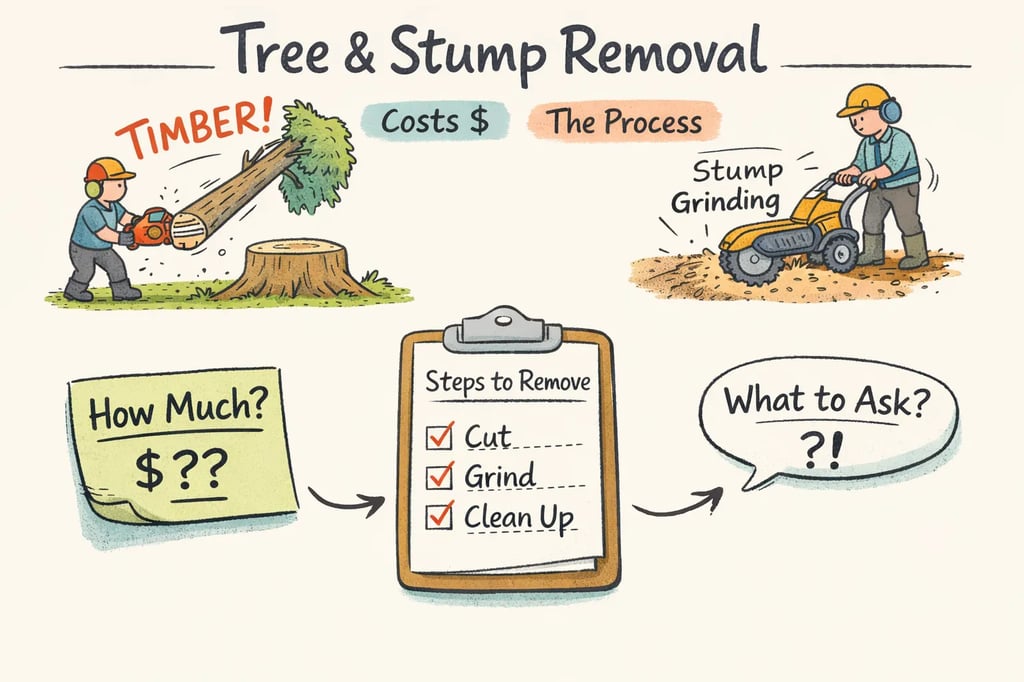
Grind the stump when you want a fast, lower‑cost fix with minimal yard disruption. Excavate the stump when you must remove the entire root mass for construction, utilities, or permanent planting. At Guilmer Tree Services in Falls Church we hear this same choice every week—here’s a short, practical guide and a checklist you can use when three bids arrive.
Decide: should you grind the stump or dig it out?
One clear rule: choose stump grinding when budget, speed, and minimal landscape disturbance matter; choose full stump extraction when a complete root removal is required for new foundations, driveways, or utilities.
Future use of the spot: hardscape, foundation, or same-spot replanting usually means excavation; lawns and garden beds usually take grinding.
Stump size and root depth: very large, deep-rooted stumps may need excavation to avoid future problems.
Proximity to utilities: grinding is safer near underground lines; digging risks hitting buried services.
Access for equipment: tight gates/fences favor compact grinders; open yards allow excavators.
Budget: grinding is almost always cheaper and faster; extraction is more invasive and costlier.
Local examples from our Falls Church crew: a 12–18" maple stump next to a patio—grind and reclaim the space in a few hours. A stump sitting where a new driveway will go—excavation and backfill are the practical choice despite the higher cost.
What this will cost you: clear price ranges and example scenarios
National averages give a useful reference point: tree removal typically averages about $750 (common range $400–$1,200). For current national estimates you can consult Thumbtack's cost guide or use Homewyse's cost calculator. By height, expect roughly $150–$450 for trees under 30', $450–$1,200 for 30–60', and $800–$2,000+ for taller or complex removals.
Stump work separates into two common approaches. Stump grinding usually runs $120–$400 for the first stump, with $30–$60 for additional stumps on the same job. Full stump extraction costs significantly more—often several hundred to $2,000+ depending on root mass, machinery, and access. Root removal labor is frequently billed hourly ($75–$150/hr). For a broader view of stump-grinding price ranges see this stump grinding cost guide.
Add-ons that raise a bid: crane or hoisting fees (typically $500+ per day), traffic control, difficult-access premiums, large debris hauling, and emergency or weekends—complex removals can push a total job into the $3,000–$7,000 range.
Three bite-size ballparks you can use immediately:
Small front-yard maple (≈30' tall) + stump grinding: $500–$1,000.
Large 60' tree with tight access requiring rigging and chip hauling: $1,200–$3,500.
Stump excavation for a future driveway or footing (big root ball + backfill): $700–$2,500+.
When you read a bid, check that common line items are called out separately: permit fees, grinding depth (how many inches below grade), chip disposal or wood removal, backfill and topsoil, replacement planting (if offered), and a clear timeline for completion.
Permits, protected trees and the rules to check before work starts
Permits matter because many municipalities regulate protected species, street trees, size thresholds, and required replacements—these rules change cost and schedule. Triggers that commonly require permits include large-diameter trees, trees in the public right-of-way or parkway, heritage or native species, clustered removals, and certain HOA restrictions.
In Falls Church the city requires a tree removal permit for many developed properties under local code; contact Development Services or the City Arborist to confirm whether your tree needs a permit and what documentation is required. You can also review state contracting guidance such as the CAL-FIRE contracting FAQ for an overview of contractor responsibilities when removing trees. Replacement requirements vary—many localities expect replanting at a 2:1 or 3:1 ratio or payment into a tree fund—get clarity before work begins to avoid fines or retroactive mitigation.
Practical steps: call your city/county urban forestry office, ask the contractor whether permit handling is included (or if you must pull them), and photograph any emergency hazards before work starts if you need fast action. Also review signs your tree needs removal to confirm urgency before you schedule emergency work.
Safety, certifications, and what you must verify on the spot
Ask for credentials. The simplest, most meaningful verifications are a current Certificate of Insurance (COI) showing general liability and workers’ compensation, and proof that the lead arborist is an ISA Certified Arborist. Additional indicators of competence include TRAQ or TCIA accreditation—but COI and ISA certification are the baseline.
How to verify: request the COI before work, get license numbers and check them online where applicable, use the ISA “Find an Arborist” tool to confirm certifications, and ask for recent photos or references for similar jobs. If a contractor refuses to provide COI or credentials, that’s a firm red flag.
Day‑of safety practices to expect: the crew will mark utilities (and you should call 811 before digging), establish controlled drop zones, use proper rigging and PPE, set traffic control when working near roads, and explain the cleanup plan. Red flags include cash-only operators, refusal to show insurance, vague scopes, or demands for large upfront payment.
From estimate to finished yard: a realistic timeline and what to expect on the day
Typical timeline: estimates and quotes returned in 1–3 days; scheduling 3–14 days depending on demand; the removal day itself can be a few hours to a full day; stump grinding or excavation is usually a half-day to a full day; cleanup/backfill often happens the same day or the next.
Crew arrival and site setup: the crew signs in, positions vehicles and chippers, and establishes safety perimeters.
Utilities and safety checks: final 811 verification, mark sprinkler heads and irrigation, and set drop zones.
Tree dismantle or rigging: sectional removal of the tree using rigging and ropes when necessary; chips are produced and loaded or left by agreement.
Stump work: the grinder is positioned and the stump taken down typically 6–12 inches below grade; if excavation is required an excavator and more time are used, then the hole is backfilled and compacted.
Haul and finish: debris and chips are hauled away or left if agreed; final grade and plant prep are completed per the bid.
Homeowner prep: move vehicles, keep pets and children inside, mark any sprinkler heads or underground utilities you know about, clear narrow gates and pathways, and tell the crew whether you want to keep firewood or chips.
Aftercare: stump grinding leaves a shallow cavity and fresh chips—plan to top with soil and seed or use the chips as mulch. For large replacement trees, wait until soil settles and consult an arborist on planting location and caliper size. For more detailed advice see our Tree Care Tips & Expert Advice.
How to compare bids and hire with confidence: a practical checklist
Are you licensed and insured? (Request COI.)
Will you provide a written, itemized scope and price?
Who will do the work (crew size and experience)?
Is permit handling included or who is responsible?
What equipment will you use and how deep will you grind?
How will debris and chips be disposed or left on site?
What is the timeline and payment schedule?
Can you provide references or recent before/after photos?
Do you carry workers’ compensation and general liability insurance?
Is there any written guarantee or warranty on the work?
Use this simple scoring approach to compare 2–3 bids quickly: clarity of scope 30%, insurance & licenses 25%, price & itemization 25%, references & reviews 20%. Common red flags: ultra‑low bids, no written contract, ambiguous disposal policy, or pressure for full payment up front.
Emergency or storm work will carry a premium—expect higher hourly or mobilization fees and document the hazard with photos and a signed scope. If you want a local, licensed option, Guilmer Tree Services offers free on‑site estimates in Falls Church and Northern Virginia; we focus on safety, proper documentation, and clean site cleanup so you see exactly what’s included before work starts.
If you’d like a free, on‑site estimate from a local, licensed crew that will walk your property and lay out options and cost ranges, Guilmer Tree Services, Professional Tree Removal is happy to help—book online or call to 571-645-2048 to schedule a visit.
Bottom line: Grind for speed, cost, and minimal disturbance; extract when the spot will become structural (driveway, foundation, utilities). Take copies of bids, verify insurance and ISA credentials, and use the ten‑question checklist above to hire with confidence.
Our Services
Tree Removal
Tree Trimming and Pruning
Stump Grinding
Bush Chipping
Hours & Information
© 2026. All rights reserved.
Monday to Friday : from 9:00 AM – 5:00 PM
on-site : from 8:00 AM – 6:00 PM