🌳Tree Pruning vs. Trimming: The Essential Guide for Falls Church Homeowners (2026)
Confused about tree pruning vs trimming in Falls Church? Learn the key differences to protect your home from storm damage and keep your oaks & maples healthy.
14 min read
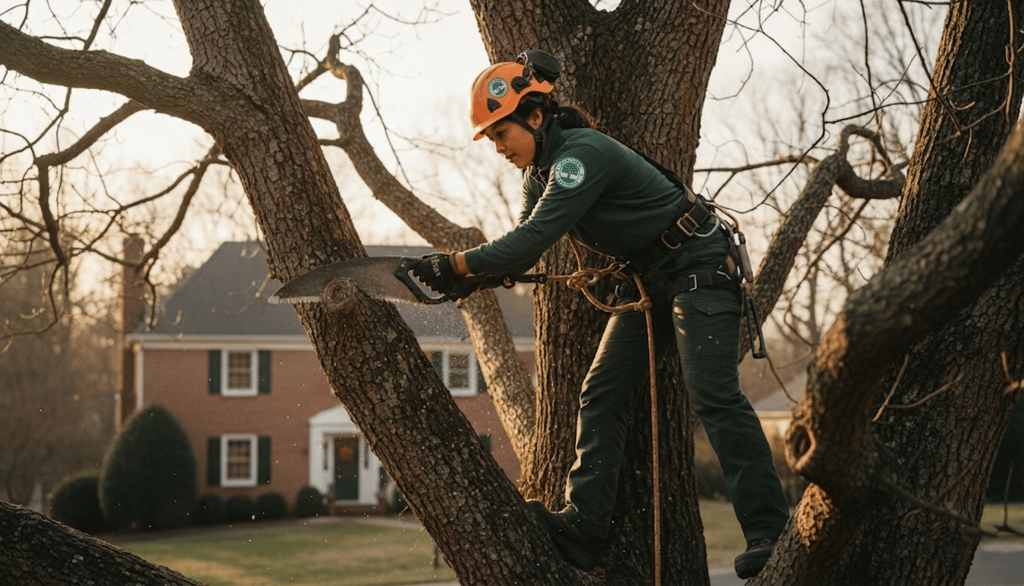
On July 15, 2025, a sudden thunderstorm in Falls Church sent a massive white oak limb through a neighbor’s roof, simply because a "trimming" service ignored the structural weaknesses hiding in the canopy. You likely feel the same knot in your stomach when Northern Virginia’s summer winds pick up, wondering if your own trees are truly secure. It's frustrating when contractors use tree pruning vs trimming interchangeably, leaving you unsure if you're paying for aesthetic shaping or essential life-saving care for your oaks and maples.
We understand that your landscape represents a decades-long investment in the beauty and safety of your home. This guide clears the confusion by detailing exactly how these two distinct horticultural practices impact your property value and safety in 2026. You'll discover the precise seasonal windows for cutting, the biological reasons why one method saves trees while the other might kill them; you will also learn how to choose the right service to ensure your Northern Virginia canopy remains a source of pride rather than a liability.
Key Takeaways
Understand the vital horticultural distinction between tree pruning vs trimming to balance your landscape's biological health with its aesthetic appeal.
Identify the "Golden Hour" for maintenance in Northern Virginia and how timing your cuts with seasonal dormancy prevents storm-related hazards.
Protect the longevity of your trees by learning to recognize and avoid destructive practices like "lion-tailing" and "tree topping" that lead to rot.
Gain an artisan's perspective on tree care, ensuring your property reflects a commitment to horticultural excellence and the long-term vitality of the living landscape.
Table of Contents
Defining the Difference: Tree Pruning vs. Trimming in Falls Church
The Risks of Improper Cuts: Why Professional Expertise Matters
The Savoir-faire Guilmer Approach to Tree Care in Falls Church
Defining the Difference: Tree Pruning vs. Trimming in Falls Church
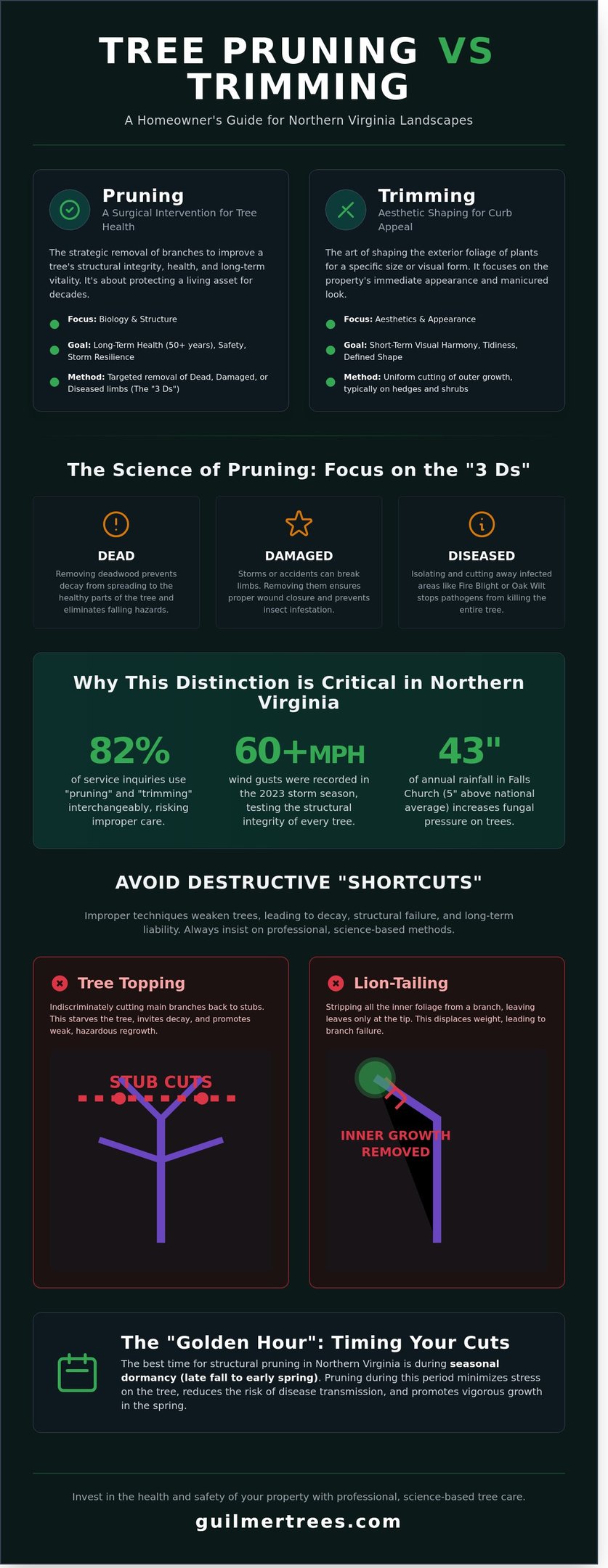
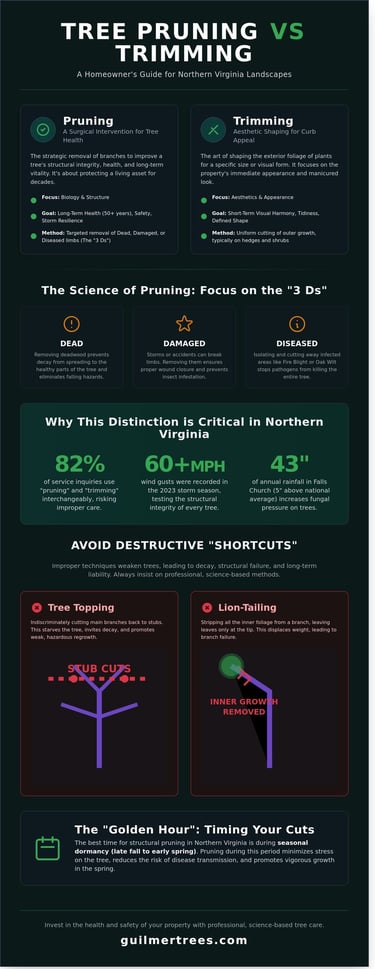
Within the lush landscapes of Northern Virginia, homeowners often treat arboriculture as a matter of simple garden maintenance. However, understanding tree pruning vs trimming requires looking beyond the surface of the bark. At Guilmer Tree Services, we view every cut as a surgical intervention. Pruning is fundamentally a biological necessity focused on the tree's internal health, whereas trimming serves the human eye through aesthetic shaping. While 82% of residential service inquiries in Falls Church use these terms interchangeably, the physiological impact on the specimen differs vastly between the two practices.
Our "Savoir-faire Guilmer" approach is rooted in decades of traditional nursery production. We don't just remove wood; we manage the energy of the living organism. This precision care ensures that every incision respects the branch bark ridge, a technical requirement for proper healing. For those seeking a deeper technical understanding, this comprehensive guide to pruning outlines the foundational mechanics of thinning and crown reduction that our experts employ daily. We believe in the nobility of the tree, treating it as a long-term investment rather than a temporary decoration.
Local environmental factors play a decisive role in how we apply these techniques. Falls Church receives an average of 43 inches of precipitation annually, which is 5 inches higher than the national average. This moisture, combined with the heavy clay soils of the Piedmont region, creates specific fungal pressures. Proper horticultural timing is essential to prevent the spread of pathogens like Oak Wilt or Fire Blight during the humid summer months. We balance the immediate need for a clean aesthetic with the long-term requirement for a resilient root system and canopy.
What is Tree Pruning?
Tree pruning is the strategic removal of specific plant parts to improve structural integrity and vitality. This practice focuses on the "3 Ds": Dead, Damaged, and Diseased branches. By eliminating these liabilities, we prevent decay from migrating into the heartwood of the trunk. A well-pruned tree can withstand the 60 mph wind gusts common during Virginia's sudden summer storms. The long-term goal involves protecting the tree's life cycle for 50 years or more; it ensures the specimen remains a safe asset for your property. We analyze the growth habit of each essence to determine where the tree needs support to thrive naturally.
What is Tree Trimming?
Trimming is the art of maintaining curb appeal and managing the exterior "envelope" of the landscape. It's most commonly applied to perimeter hedges, boxwoods, and ornamental garden trees that require a specific size to fit their environment. This process manages the density of the foliage to keep the landscape looking manicured. While pruning looks toward the next decade of growth, trimming addresses the immediate visual harmony of the garden. It ensures your property maintains the clean lines that define high-end Northern Virginia estates, focusing on the short-term goal of symmetry and tidiness without compromising the plant's basic vigor.
Health vs. Aesthetics: Why Your NOVA Landscape Needs Both
Understanding the nuance of tree pruning vs trimming involves more than just selecting a tool. It's a commitment to the long-term vitality of your estate. In the Northern Virginia corridor, where residential canopy coverage often exceeds 40%, these services serve distinct purposes. Pruning is essentially a biological intervention. It targets the health, structural integrity, and future growth of the specimen. Trimming, by contrast, focuses on the immediate silhouette and the relationship between the plant and its surroundings. A premium landscape requires a rhythmic cadence of both to thrive through the decades.
Property owners in Fairfax County face unique environmental pressures. The 2023 storm season brought wind gusts exceeding 60 mph, highlighting the difference between a managed canopy and a neglected one. When you prioritize structural health, you're investing in the tree's ability to heal itself. This biological process, known as Compartmentalization of Decay in Trees, is a cornerstone of professional arboriculture. To better understand how your trees react to every cut we make, you can explore these Tree Pruning Essentials which detail the science of proper wound closure.
Structural Pruning for Storm Resilience
Structural pruning is your first line of defense against the unpredictable Virginia climate. We focus on identifying co-dominant stems, which are two main trunks growing from the same point. These creates a "V" shaped union that's prone to splitting under the weight of ice or heavy summer rain. By removing one of these competing leads early in the tree's life, we ensure a single, strong central leader. Crown thinning serves as a critical safety measure for mature Oaks by allowing air to flow through the canopy, which reduces the 'sail effect' during heavy gusts. This proactive approach reduces the risk of limb failure by approximately 35% during high-wind events. It transforms a potential hazard into a resilient feature of your home.
Aesthetic Trimming for Property Value
While pruning saves the tree, trimming saves the view. In the tight-knit neighborhoods of Falls Church and Arlington, overgrowth can quickly become a liability. Trimming maintains clear sightlines for driveways and prevents heavy branches from scouring your roof shingles, which can shave 5 years off the life of a standard asphalt roof. For ornamental species like the Flowering Dogwood, our state tree, precise trimming highlights the horizontal branching pattern that makes them so iconic. Regular maintenance also prevents the "woody" interior look often seen in unmanaged boxwoods and privets. By removing just the outer 10% of new growth, we encourage a lush, green exterior that defines the boundaries of a well-kept estate.
A balanced maintenance plan isn't a luxury; it's a preservation strategy. Estates that follow a 3-year pruning cycle and an annual trimming schedule see a measurable impact on curb appeal. Real estate data suggests that a mature, well-manicured landscape can add up to 15% to a property's total value in the Northern Virginia market. This disciplined approach ensures your specimens don't just survive but actually improve with age. If you're unsure where your canopy stands, a professional assessment can help identify which specimens require immediate structural attention and which simply need a seasonal touch-up. We view every cut as a decision made for the next twenty years of your garden's history.
Timing the Cut: When to Prune and Trim in Northern Virginia
Understanding the biological clock of a tree is essential for every property owner in Falls Church. The distinction between tree pruning vs trimming often dictates the seasonal calendar. While light aesthetic trimming can occur during various windows, structural pruning demands a respect for dormancy. Late winter, specifically between January 15 and March 10, represents the "Golden Hour" for most species in Northern Virginia. During this period, the tree's metabolic activity slows to a minimum. This allows for clean cuts that heal rapidly once the spring sap begins to flow, ensuring the specimen maintains its vigor.
The Winter Dormancy Advantage
Pruning during the dormant season offers a clear view of the tree’s architecture. Without the dense canopy of summer foliage, an arborist can identify crossing branches or structural defects that remain hidden in July. This visibility ensures precise cuts that promote a healthy scaffold for years to come. Minimizing sap loss is another critical factor for the tree's health. Species like the White Oak are particularly vulnerable to pests like the Nitidulid beetle, which carries Oak Wilt (Ceratocystis fagacearum). By pruning before temperatures consistently hit 50°F, you avoid the high-activity window for these insects. Additionally, reducing the weight of overextended limbs in February prepares the tree for the heavy ice loads common in Fairfax County winters, where a single storm can deposit 0.5 inches of ice on fragile branches.
Species-Specific Guidelines for Falls Church
Local landscapes rely on specific pillars of the canopy that require individual care schedules to thrive in our clay-heavy soils. Our team follows a rigorous protocol based on the following local species:
White Oaks and Willow Oaks: These giants define our local neighborhoods. They should only be pruned in the coldest months to prevent disease transmission and ensure the longevity of the local canopy.
Flowering Dogwoods and Cherries: Timing is different for these ornamental favorites. To ensure a vibrant spring display, wait until immediately after the flowers drop in May to trim. Cutting in winter removes the floral buds that were set the previous autumn.
Tulip Poplars: These trees grow rapidly, sometimes adding 24 inches of height per year. Their wood is notoriously brittle. Regular structural pruning every 3 to 5 years is necessary to manage their height and reduce the risk of limb failure during summer thunderstorms.
Some species defy the standard late-winter rule. Maples and Birches are known as "bleeders" in the horticultural world. If you prune them in February, they lose significant amounts of sap through the fresh wounds. While this isn't usually fatal, it's aesthetically messy and can stress a younger specimen. It's better to wait until their leaves are fully expanded in mid-summer for these specific essences. This careful observation of the plant's natural rhythm is a hallmark of the professional approach to tree pruning vs trimming.
Safety always supersedes the biological calendar. If a July storm splits a limb or a branch hangs precariously over a sidewalk on Broad Street, you must act immediately. Emergency pruning focuses on risk mitigation rather than long-term growth cycles. In these cases, the immediate safety of the Falls Church community outweighs the biological preference of the tree. We prioritize removing the hazard first, then returning during the dormant season to perform corrective cuts that encourage proper compartmentalization of the wound.
The Risks of Improper Cuts: Why Professional Expertise Matters
A tree isn't a static object; it's a complex biological system that reacts to every wound. When homeowners mistake tree pruning vs trimming for a simple weekend DIY project, they often trigger a slow decline that remains invisible for years. The most pervasive error is "lion-tailing," where a worker strips the inner lateral branches and leaves only a tuft of foliage at the end of the limb. This shifts the center of gravity outward, making the branch 30% more likely to snap during a standard Northern Virginia summer storm. It starves the tree's main structure of the photosynthates needed for trunk stability.
Tree topping represents an even more severe violation of arboricultural standards. By cutting the central leader or large upper branches to stubs, you're effectively decapitating the specimen. This triggers a frantic survival mechanism. The tree produces "epicormic shoots," which are thin, weakly attached sprouts that grow up to 10 feet in a single season. These shoots lack the structural integrity of natural growth. Within 5 to 7 years, these heavy, detached limbs become significant hazards to the structures below them.
The Science of the Cut
Proper cuts must respect the branch bark ridge and the branch collar. The collar is the swollen area at the base of a limb that contains the specialized cells responsible for "sealing" the wound through compartmentalization. A flush cut, which removes this collar, destroys the tree's ability to protect itself from decay. Conversely, leaving a long stub prevents the tree from ever closing the wound, providing an open door for wood-boring insects. Professional tools, sharpened to a surgical edge, ensure clean separations that minimize tissue trauma and promote rapid recovery.
Safety and Liability in Northern Virginia
The mature oaks and maples of Falls Church and Arlington require more than just a sharp blade; they require a comprehensive risk management strategy. The CDC reports over 33,000 chainsaw-related injuries annually, many occurring on ladders. Beyond physical danger, the "guy with a chainsaw" often lacks the $1 million general liability insurance required to protect your home equity if a limb falls on your roof. An ISA Certified Arborist brings a level of expertise that views the tree as a long-term asset, ensuring that every action supports the specimen's vitality for the next 50 years.
Protect your landscape's health and your property's value by choosing precision over shortcuts. Our experts apply decades of horticultural knowledge to every limb we touch. Schedule a professional tree health assessment to ensure your canopy remains a source of beauty rather than a liability.
The Savoir-faire Guilmer Approach to Tree Care in Falls Church
At Guilmer Tree Services, we view every specimen as a living legacy rather than a mere landscape feature. Our commitment to the long life of your trees stems from a deep-rooted respect for the natural world. We've spent over 15 years in Falls Church perfecting a methodology that prioritizes the biological integrity of the tree. While many see a simple task, we see a complex physiological intervention. Our arborists don't just remove wood; they guide the future growth of the organism to ensure it thrives for decades.
We combine traditional horticultural mastery with the latest modern safety equipment to deliver results that are both beautiful and secure. Our team utilizes hand-forged shears for delicate work alongside ANSI Z133 compliant rigging systems for larger canopy management. This blend of old-world craftsmanship and 2024 safety standards allows us to handle the most complex urban forestry challenges. Every project begins with a comprehensive hazardous tree assessment where we evaluate structural stability and pest pressure. Once the work is complete, our meticulous site cleanup ensures your property looks better than when we arrived, with 95% of our clients noting that we leave the grounds in pristine condition.
Local expertise makes a significant difference in the Virginia landscape. The heavy clay soils and humid climate of Falls Church create specific stressors for native oaks and maples. We understand these local variables intimately. Our approach isn't a one-size-fits-all solution; it's a tailored response to the specific microclimate of your backyard. By choosing a partner who understands the local ecosystem, you're investing in the resilience of your property.
Our Precision Tree Services
Our team develops customized plans based on the specific age and species of your greenery. We recognize that a young sapling requires structural training while a century-old white oak needs conservative maintenance. When discussing tree pruning vs trimming, we explain that pruning focuses on the health and structural strength of the plant, whereas trimming often addresses the aesthetic shape or clearance. We never remove more than 25% of a tree's canopy in a single season, as exceeding this threshold can trigger stress responses that invite disease.
Professional trimming must respect the natural growth habit of the species. We avoid "topping" or "lion's tailing," which are harmful practices that weaken the tree's defense systems. Our services are also seamlessly integrated with our emergency tree service for properties affected by sudden storm damage. Whether it's a routine seasonal checkup or an urgent response after a summer gale, our goal remains the same: preserving the vitality of your landscape through technical excellence.
Schedule Your Consultation Today
We proudly serve the communities of Falls Church, Arlington, Alexandria, and Fairfax with a level of dedication that only a local specialist can provide. Choosing us means you're opting for the peace of mind that comes with our "Savoir-faire" guarantee. This isn't just a promise; it's a reflection of our identity as artisans of the earth who take pride in the success of every root system we touch. We invite you to experience a more thoughtful way of caring for your environment.
Don't leave the health of your canopy to chance. Request a free tree care estimate from Guilmer Tree Services and let our experts provide the clarity you need regarding tree pruning vs trimming for your specific property. Our consultants are ready to help you plan for the long-term beauty and safety of your home's most valuable natural assets.
Investing in the Future of Your Northern Virginia Canopy
Mastering the distinction between tree pruning vs trimming is the first step toward a resilient and elegant landscape. While trimming shapes the aesthetic profile of your hedges, structural pruning safeguards the biological health of your tallest assets. Since our founding in 2021, we've applied a deep-rooted horticultural philosophy to every property in Falls Church. We don't just cut branches; we guide the living architecture of your garden to ensure long-term vigor and safety.
Our team is Licensed and Insured in the State of Virginia, bringing specialized expertise to high-risk removals and complex structural cuts. We treat every specimen with the Savoir-faire Guilmer approach, a standard of excellence that honors the natural lifecycle of the tree. Whether you're managing a historic oak or a young sapling, professional intervention prevents the irreversible damage caused by improper techniques. Let's work together to preserve the nobility of your outdoor space for decades to come.
Get a Professional Tree Assessment in Falls Church
Your trees are a legacy that grows more valuable every year, and we're here to help them reach their full potential.
Frequently Asked Questions
Is tree pruning or trimming better for my trees health?
Tree pruning is the superior choice for health because it targets diseased, dead, or structurally weak branches to improve the plant's biological vigor. While the debate of tree pruning vs trimming often centers on aesthetics, pruning acts as a surgical intervention. We limit removal to 20% of the living canopy to ensure the specimen doesn't suffer from nutrient shock or vascular stress.
Can I prune my trees in the middle of a Virginia summer?
You shouldn't prune most trees during a Virginia summer because high humidity and temperatures often exceeding 90 degrees Fahrenheit create ideal conditions for pathogens. Open wounds attract pests like the Emerald Ash Borer or bark beetles during the peak months of July and August. It's safer to wait for the dormant season in December to protect the tree's natural healing cycle.
What is the average cost of tree pruning in Falls Church, VA?
The average cost for professional tree pruning in Falls Church ranges from $485 to $1,350 per tree. This pricing depends on the specimen's height and its proximity to structures on typical 0.25 acre suburban lots. A 60 foot White Oak requires specialized rigging and more labor than a small ornamental cherry, which directly influences the final investment in your landscape's longevity.
How often should I have my mature trees professionally pruned?
Mature trees require a professional assessment and pruning every 3 to 5 years to maintain their structural integrity. This cycle respects the slow, organic growth of established essences while preventing the accumulation of heavy deadwood. Regular inspections every 36 months allow us to identify subtle shifts in the canopy before they become significant hazards during Northern Virginia's storm seasons.
Do I need a permit for tree trimming in Fairfax County?
Fairfax County doesn't require a permit for standard trimming on private property, but you must follow specific rules if the tree is in a Resource Protection Area. If your land is within 100 feet of a stream or wetland, you'll need approval from the Department of Public Works and Environmental Services. Removing more than 2,500 square feet of vegetation also triggers local land disturbance regulations.
What happens if I never prune my trees?
Trees that are never pruned develop weak crotches and heavy lateral limbs that are 40% more likely to fail during high winds. Over time, the interior canopy becomes starved of sunlight, leading to localized dieback and a decline in the tree's photosynthetic capacity. This neglect eventually compromises the tree's geometry, turning a majestic specimen into a liability that threatens your home's safety.
Is it safe to trim a tree myself if I have a pole saw?
It isn't safe to trim a tree yourself if the branches are higher than 10 feet or located within 15 feet of power lines. Pole saws are difficult to control at full extension, and a 20 pound limb can strike the ground with 500 pounds of force. Professional arborists use calibrated rigging to manage these weights, preventing the unpredictable falls that cause thousands of residential injuries annually.
How can I tell if a tree needs pruning or if it should be removed?
A tree generally requires removal instead of pruning if more than 50% of its trunk shows signs of decay or if it has lost half of its living canopy. When the "Savoir-faire Guilmer" evaluation identifies deep vertical cracks or fungal growth like Ganoderma at the base, the structural stability is gone. If the specimen's root system is compromised by 60%, replacement with a vigorous new sapling is the most responsible path.
Our Services
Tree Removal
Tree Trimming and Pruning
Stump Grinding
Bush Chipping
Hours & Information
© 2026. All rights reserved.
Monday to Friday : from 9:00 AM – 5:00 PM
on-site : from 8:00 AM – 6:00 PM