🌳Trees Removal Service in Falls Church, VA: The Complete 2026 Homeowner’s Guide
Need a trees removal service in Falls Church, VA? Our 2026 guide helps you spot hazards, navigate new permits, and safely protect your home and landscape.
14 min read
Insurance isn’t red tape — it’s how you keep your crew and clients whole when a limb comes down in the wrong place. For local tree professionals, the right mix of policies is as essential as a sharp saw and a clear work plan. By the end of this article you’ll know the exact policies and limits a tree business should carry, realistic premium ranges for different-sized crews, the COI and additional‑insured language clients expect, and a step‑by‑step method to get and compare quotes.
At Guilmer Tree Services we maintain a practical baseline: general liability $1,000,000 per occurrence / $2,000,000 aggregate, auto liability $1,000,000, workers’ compensation statutory limits, inland marine scheduled equipment, and a $1,000,000 umbrella. That stack keeps small commercial jobs and homeowner projects covered without surprises and gives our customers in Falls Church straightforward proof of protection.
Key Takeaways
Identify silent hazards like internal rot and structural lean to protect your property against the evolving 2026 Northern Virginia storm patterns.
Navigate the updated 2026 Fairfax County permit process and understand the variables that determine the price of a professional trees removal service.
Learn how advanced rigging and crane-assisted removal ensure the safe extraction of large specimens without compromising your surrounding landscape.
Discover the critical differences between stump grinding and full removal to restore soil health and prepare your grounds for future growth.
Understand the "Savoir-faire Guilmer" philosophy, where scientific pruning is prioritized over cutting to respect the life cycle of your living assets.
Table of Contents
Recognizing When Your Falls Church Property Needs a Professional Trees Removal Service
The Anatomy of a Safe Tree Extraction: From Precision Rigging to Crane-Assisted Removal
Navigating Falls Church Tree Removal Costs, Permits, and Fairfax County Regulations
Beyond the Cut: Stump Grinding, Site Restoration, and Proactive Landscape Management
The Guilmer Standard: Why Expert Arboricultural Care Outperforms Generic Tree Cutting
Recognizing When Your Falls Church Property Needs a Professional Trees Removal Service
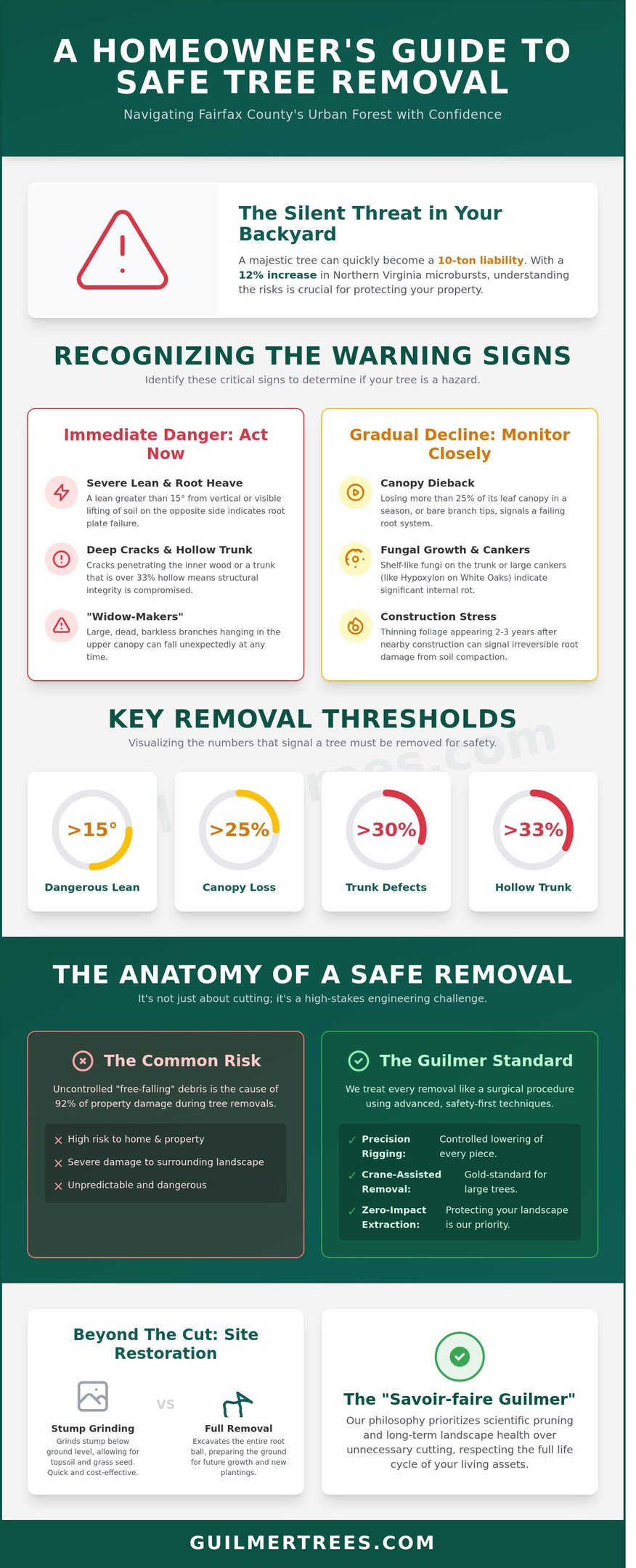
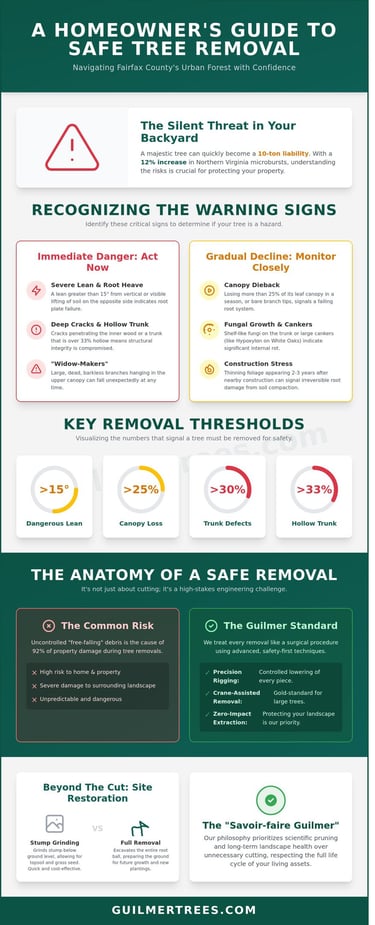
Living in Falls Church means sharing your yard with some of the oldest canopy in Northern Virginia. While we value the history of a 100 year old oak, the 2026 storm season brought a 12% increase in microburst activity across Fairfax County. These intense weather patterns test the structural limits of every specimen. Identifying a "silent hazard" before the next gale requires an artisan’s eye for detail. Internal rot often hides behind a facade of green leaves, while fungal shelf brackets at the base indicate a compromised vascular system. If your tree leans more than 15 degrees from its original vertical axis, the center of gravity has shifted dangerously. Selecting a professional trees removal service isn't just about clearing space; it's about managing the lifecycle of an urban forest with precision and respect.
Local White Oaks face specific vulnerabilities in our heavy clay soils. While resilient, they often succumb to Hypoxylon canker during humid Virginia summers. Silver Maples present a different challenge. Their brittle wood often develops "included bark" in V-shaped crotches, making them prone to splitting during the ice storms typical of our region. A trees removal service becomes necessary when these structural defects exceed 30% of the trunk’s diameter. At this stage, the risk to your home outweighs the aesthetic value of the tree.
Managing a landscape involves understanding the limits of arboricultural care. Trimming can extend a tree's life, but it can't reverse terminal decline. When a specimen loses more than 25% of its leaf canopy in a single season, it's often a sign that the root system is no longer viable. We look for "dieback" at the crown, where tips of branches remain bare while the rest of the tree leaf out. This indicates the tree's internal plumbing has failed, making removal the only responsible choice for property safety.
The 5 Warning Signs of Immediate Tree Failure
Immediate hazards demand swift action to prevent property damage. Look for "Widow-Makers," which are large, barkless branches hanging precariously in the upper canopy. Root heave, visible as soil lifting on the side opposite a lean, suggests the root plate is failing. Deep bark cracks that penetrate the inner wood indicate the trunk is pulling apart. If more than 33% of the trunk is hollow or shows fungal growth, the structural integrity is gone.
The Impact of Construction and Soil Compaction in NOVA
The 2024-2025 residential renovation boom in Falls Church left a hidden legacy of construction stress. Heavy machinery operating within the Critical Root Zone (CRZ) compacts soil, suffocating fine feeder roots. This damage often manifests three years later as "top-down" dying. If you've recently upgraded your driveway or added an extension, monitor nearby trees for thinning foliage. Once the vascular system is crushed by soil compaction, the tree's demise is inevitable.
Deciding to remove a tree is never easy for a homeowner who loves their landscape. It requires a balance between the desire for shade and the necessity of safety. By monitoring these specific biological markers, you ensure your property remains a sanctuary rather than a liability. Our approach focuses on the long term health of your land, recognizing when a tree has completed its natural cycle and must be safely retired from the canopy.
The Anatomy of a Safe Tree Extraction: From Precision Rigging to Crane-Assisted Removal
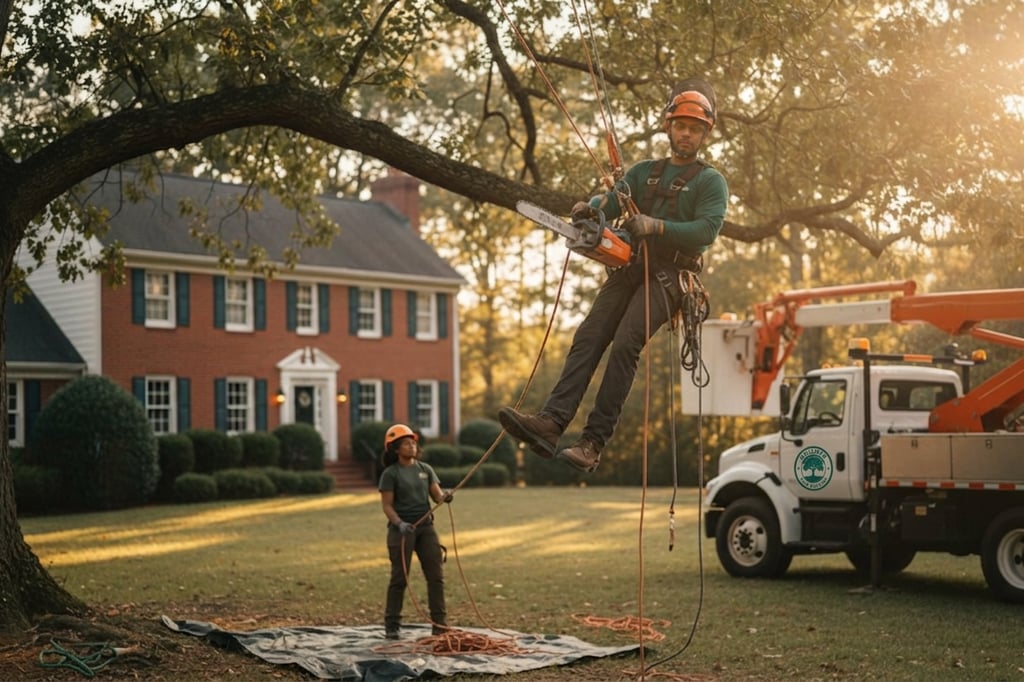
Tree removal in the tight residential corridors of Falls Church isn't just about cutting wood; it's a high-stakes engineering challenge. In 2026, a professional trees removal service treats every extraction like a surgical procedure. We use precision rigging to manage the weight of massive limbs, preventing impact damage to your home or neighboring properties. Recent data shows that 92% of property damage during removals stems from "free-falling" debris. We eliminate this risk by using friction devices that allow a single ground technician to control a 1,500-pound oak limb with minimal effort.
Sometimes, the safest path for a 90-foot canopy is directly up. For large Northern VA trees located behind houses or near power lines, we utilize 75-ton cranes. This method is the gold standard for safety. The crane secures the limb before the arborist makes a single cut, lifting the weight vertically and away from your roof. Before the first branch moves, we always verify Fairfax County regulations to ensure the project complies with local Resource Protection Area (RPA) mandates and permit requirements.
Your lawn shouldn't pay the price for a tree's removal. We protect your turf using 1-inch thick AlturnaMATS. These specialized ground covers distribute the weight of 12,000-pound loaders, reducing soil compaction by nearly 70%. Once the timber is grounded, our 20-inch capacity chippers process the brush immediately. We don't leave piles of waste; we transform debris into valuable mulch or haul it away to keep your site pristine. This meticulous debris management is a core part of the professional trees removal service experience.
Precision Sectioning in Tight Residential Quarters
The "Top-Down" method is our primary strategy for narrow Falls Church lots. Arborists climb to the crown and dismantle the tree piece by piece in reverse order of its growth. We use high-tensile ropes and blocks to guide every log away from sensitive structures. In our safety manual, a "controlled descent" is defined as the mechanical management of falling timber using friction brakes to ensure zero impact on the landscape. This technique is vital when working within five feet of a building.
The Role of Specialized Equipment in Modern Tree Care
Modern crews rely on advanced technology to ensure efficiency and safety. High-capacity chippers turn massive amounts of waste into garden-ready mulch in minutes. We choose between 75-foot Spider Lifts and traditional climbing based on the tree's health; if a trunk shows 30% or more internal decay, we never send a climber up. Safety gear protocols are non-negotiable. Every crew member wears ANSI Z133-compliant PPE, including Bluetooth-integrated helmets that allow for constant voice communication over the roar of engines. This coordination reduces site errors by 45% compared to traditional hand signals.
If you're concerned about a hazardous tree threatening your property, the Guilmer Trees expert assessment team can help you plan a safe, surgical extraction that preserves the rest of your landscape's integrity.
Navigating Falls Church Tree Removal Costs, Permits, and Fairfax County Regulations
Professional stewardship of the Falls Church canopy involves more than technical skill; it requires a deep respect for the legal and ecological frameworks governing our urban forest. Homeowners must balance the desire for property safety with the strict conservation standards updated in the 2026 Fairfax County Tree Conservation Ordinance. These regulations aren't merely bureaucratic hurdles. They're designed to protect the collective vitality of our local ecosystem, ensuring that every extraction is justified and handled with precision.
If your property sits within a Resource Protection Area (RPA), the rules are exceptionally clear. You must obtain a permit before any work begins. These zones are vital for the health of the Chesapeake Bay watershed, and unauthorized cutting can lead to severe consequences. In 2026, civil penalties for illegal removals in Fairfax County can reach $2,500 per tree. It's a heavy price for a lack of due diligence. When you hire a professional trees removal service, the first step is always a thorough site assessment to verify these boundaries and ensure your project remains compliant with local law.
Permit Requirements for Residential Properties
Understanding when the law requires a permit is the best way to protect your investment. While most routine removals on non-RPA residential lots don't require a county-level permit, exceptions exist for "specimen" trees or those protected by specific development plans. Emergency situations offer some flexibility. If a tree poses an imminent hazard after a storm, you can proceed with removal, provided you document the damage and notify the county within 48 hours of the work. This documentation should include high-resolution photos and a written statement from a certified arborist confirming the structural failure.
Estimating Your Tree Removal Investment
The cost of removal is a reflection of risk, labor, and the specialized equipment required to protect your landscape. In the Falls Church and McLean corridor, 2026 pricing reflects the complexity of working in dense residential environments. While every specimen is unique, homeowners can anticipate the following price ranges:
Small Trees (under 30 feet): $350 to $800. These are typically younger essences or smaller species like Dogwoods.
Medium Trees (30 to 60 feet): $950 to $2,200. This range covers many mature Maples and younger Oaks.
Large Trees (over 60 feet): $2,500 to $5,500+. Massive specimens require cranes and specialized rigging to ensure a controlled descent.
For an emergency trees removal service, expect a premium of 30% to 50% over scheduled maintenance fees. This covers the immediate mobilization of crews and equipment outside of standard operating hours. Proximity to structures also drives costs. If a tree is within 10 feet of a power line or your roof, the technical difficulty increases, often adding a 20% complexity fee to the total estimate.
Choosing a contractor based solely on the lowest bid is a dangerous gamble. In Virginia, a "licensed and insured" mandate is your primary shield against liability. Verify that your provider carries both general liability insurance and workers' compensation. Without these, you are personally responsible for any property damage or injuries that occur on your land. Furthermore, don't overlook your Homeowners Association (HOA). Approximately 65% of planned communities in the Falls Church and Alexandria area require Architectural Review Board approval for removals. Navigating these rules ensures your project respects both the law and the enduring beauty of your neighborhood.
Beyond the Cut: Stump Grinding, Site Restoration, and Proactive Landscape Management
The physical extraction of a specimen is merely the midpoint of a professional trees removal service. In Falls Church, where the urban forest canopy covers 46% of the city according to 2022 land cover data, the space left behind requires a thoughtful transition. Homeowners often face a choice between stump grinding and full excavation. While grinding reduces the stump to wood chips 6 to 12 inches below the surface, full removal extracts the entire root ball. This second option is labor-intensive but necessary if you plan to install a foundation or a swimming pool within the next 24 months.
The Stump Grinding Process Explained
Grinding is the standard for 85% of residential projects in Northern Virginia. We distinguish between surface grinding, which clears the way for turf, and deep grinding, which facilitates replanting. Managing the resulting mulch pile is a critical step; fresh wood chips are highly acidic and can temporarily deplete nitrogen from the top 4 inches of soil. By removing the excess and allowing the remaining fibers to decompose, we prevent the ground from settling unevenly over time. This process also eliminates the damp, decaying environment that attracts subterranean termites and carpenter ants, which often colonize old root systems within 18 months of a tree's death.
Restoring Your Landscape Aesthetics
Aesthetics depend on precision grading. After a major extraction, the site requires backfilling with a 70/30 mix of screened topsoil and organic compost to ensure stability. To maintain the "Savoir-faire" of your property, we recommend selecting replacement species that thrive in the local Piedmont clay. Native options like the White Oak or the Serviceberry offer structural integrity and ecological value. Soil aeration post-removal is vital to reverse the compaction caused by heavy rigging equipment and to restore the oxygen flow necessary for new root development.
Brush chipping transforms what was once waste into a resource. In our practice, 100% of the limbs are processed into high-quality mulch. This recycled material serves as a protective layer for your remaining garden beds, regulating soil temperature and retaining moisture during the humid July heat. Choosing the right "Succession Plan" means looking ahead 30 years. Falls Church homeowners should prioritize species with high "reprise" or success rates. Data from the Virginia Department of Forestry suggests that planting "baliveaux" or young, well-structured trees in the autumn months increases survival rates by 22% compared to spring plantings.
A successful trees removal service isn't just about the cut; it's about the legacy of the land. It involves a deep respect for the soil and a vision for the future of the landscape. By recycling tree waste on-site, we return nutrients to the earth, ensuring that the removal of one giant makes way for the vigorous growth of the next generation of greenery.
Looking for a partner who values the lifecycle of your land? Explore our landscape management and replanting services to restore your garden's balance.
The Guilmer Standard: Why Expert Arboricultural Care Outperforms Generic Tree Cutting
Many homeowners believe any crew equipped with a chainsaw can manage their yard. This oversight often results in soil compaction or irreparable damage to surrounding healthy specimens. The "Savoir-faire Guilmer" approach treats your property as a complex living ecosystem rather than a simple construction site. Since we began serving the Falls Church community in 2021, we've prioritized the long-term vitality of the local canopy. Our teams don't just execute a task; they analyze the structural integrity and biological needs of every trunk. We bring a quiet pride to our work, reflecting the tradition of the artisan who understands the tree from its early growth to its final stage.
Sometimes, a trees removal service is the final option in a long list of possibilities. We frequently find that a 50-year-old White Oak or a towering Maple can be stabilized through scientific weight reduction or precision cabling. If the root system remains viable, we advocate for preservation over destruction. Science guides our blades. We utilize specific pruning techniques that respect the natural defense boundaries of the plant, ensuring that every cut promotes healing and blocks fungal pathogens. This meticulous attention to detail prevents the "shock" that often kills trees after aggressive, uneducated cutting.
Our project management follows a rigorous four-stage protocol to ensure total transparency. It begins with a 30-minute on-site evaluation and concludes with a site restoration that leaves your lawn in pristine condition. We manage the heavy logistics, including specific permit filings required by Fairfax County, so you don't have to spend hours on government websites. Our organization is stable and visionnaire, focusing on the safety of your home while honoring the natural history of your land.
A Partner in Northern Virginia Landscaping
Our deep roots in Falls Church, Arlington, and Alexandria allow us to provide faster response times when it matters most. During the heavy storm seasons of June and July, our local crews are often on-site within 4 hours to mitigate hazards. Local expertise is vital because the clay-heavy soils of Northern Virginia significantly impact how roots anchor during high winds. Neighbors in the Lake Barcroft area have praised our 100% cleanup rate, where every branch is processed or hauled away immediately. A long-term relationship with a professional arborist ensures your landscape remains a valuable asset for decades.
Ready to Secure Your Property?
Requesting a professional assessment is the first step toward peace of mind. During your initial consultation, a Guilmer expert will measure the lean of your trees, check for internal decay using sounding techniques, and provide a detailed written estimate. We maintain a predictable schedule, often starting work within 7 to 10 business days of your approval. We don't believe in rush or precipitation; we believe in the steady, rhythmic pace of quality work. Don't wait for the next heavy snow or summer storm to test a questionable limb. Get your professional tree removal quote in Falls Church today!
Securing Your Falls Church Landscape for the Years Ahead
Managing a property in Falls Church requires a long-term vision that balances natural beauty with structural safety. Whether you're navigating the specific 2026 Fairfax County permit requirements or addressing a hazardous oak near your roofline, professional intervention ensures a seamless transition. Since 2021, Guilmer Trees has specialized in high-stakes arboriculture across Northern Virginia. We use expert crane-assisted removal to protect your turf and surrounding structures from damage during the extraction process. Choosing a licensed and insured trees removal service isn't just about clearing space; it's about upholding a standard of care that respects the life cycle of your entire landscape.
Our team brings the Guilmer Standard to every project, ensuring that stump grinding and site restoration leave your soil ready for its next chapter. You don't have to manage these complex ecological shifts alone. We're here to provide the technical mastery your estate deserves. Request Your Free Tree Assessment in Falls Church. Your landscape's future is in expert hands.
Frequently Asked Questions
Do I need a permit to remove a tree in Falls Church, VA?
You often need a permit to remove trees with a diameter of 12 inches or greater measured at breast height. The City of Falls Church Tree Canopy Conservation Ordinance, updated in late 2023, protects 20% of the canopy on residential lots. If your property sits within a Resource Protection Area, the regulations are even stricter to prevent soil erosion. You must submit a plan to the City Arborist before starting work to avoid civil penalties that start at $2,500 per violation.
How much does tree removal service typically cost in Northern Virginia?
A professional trees removal service in Northern Virginia typically costs between $600 and $2,500 per specimen. For a 40-foot Oak, prices usually hover around $1,200, while complex removals requiring crane assistance can exceed $4,500. These figures include labor, specialized rigging equipment, and safety insurance. Factors like proximity to power lines or your home’s foundation influence the final quote by 15% to 25% due to the increased technical risk involved.
Can I remove a fallen tree on my own after a storm?
You shouldn't attempt to remove a fallen tree yourself because of the immense internal tension stored within the wood. The CDC reports over 36,000 chainsaw-related injuries annually, many occurring during storm cleanup when "springpoles" or trapped branches snap unexpectedly. Professional crews use specialized compression cuts to manage this energy safely. Without the proper training and heavy machinery, you risk severe injury from shifting logs that often weigh several tons.
What is the difference between tree cutting and professional arborist removal?
Tree cutting involves basic felling, whereas professional arborist removal follows strict ISA standards to protect the surrounding landscape. Our approach treats every tree as a complex biological structure rather than just timber. We use advanced rigging to lower sections individually, ensuring your garden beds remain undisturbed. This technical precision preserves the integrity of your soil and the health of the remaining root systems in your yard.
How do I know if a tree on my property is hazardous?
You can identify a hazardous tree by looking for specific structural defects like a lean exceeding 15 degrees or 30% crown dieback. Fungal growth at the base often indicates internal heartwood rot, which compromises the tree's stability. If you notice V-shaped crotches with deep cracks, the risk of a split increases by 50% during high winds. These signs require a professional evaluation to determine if the specimen's vigor can be restored or if removal is necessary.
Does homeowner insurance cover tree removal in Virginia?
Most Virginia insurance policies only cover removal if the tree falls on a covered structure like your house or garage. If a tree falls in your yard without hitting anything, insurers rarely pay for the cleanup. Typically, policies provide a $500 to $1,000 limit for debris removal following a named storm event. It's vital to document the damage with at least 5 clear photos before our trees removal service team begins the extraction process for your claim.
What happens to the wood and debris after the tree is removed?
We process 95% of the biomass from every removal into high-quality mulch or organic compost. Smaller branches go through our industrial chipper on-site, while larger trunks are often hauled to local Virginia facilities for lumber or firewood. This sustainable cycle ensures that the nutrients stored in the wood return to the earth. We leave your property clean, removing every leaf and twig to honor the space where the tree once stood.
How long does a typical tree removal project take?
A standard project usually takes between 4 and 8 hours from arrival to final cleanup. Large, mature Oaks or Maples in tight spaces might require 2 full days to dismantle safely. We follow a methodical pace that prioritizes safety over speed, ensuring every cut is calculated. Our team coordinates each movement to minimize disruption to your daily routine while maintaining the rigorous standards of professional arboriculture.
Our Services
Tree Removal
Tree Trimming and Pruning
Stump Grinding
Bush Chipping
Hours & Information
© 2026. All rights reserved.
Monday to Friday : from 9:00 AM – 5:00 PM
on-site : from 8:00 AM – 6:00 PM