🌳What is Pruning a Tree? A Homeowner’s Guide for Falls Church, VA
Wondering what is pruning a tree? Our Falls Church, VA guide explains how proper cuts protect your home from storm damage & boost tree health for decades.
12 min read
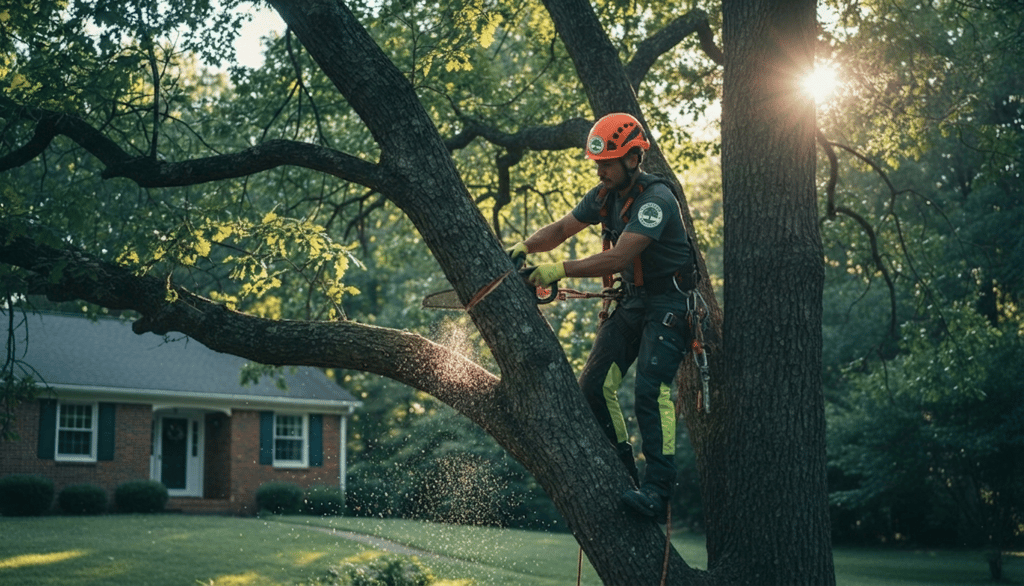
Last Tuesday, a homeowner in the West End of Falls Church watched a sudden summer storm snap a heavy oak limb, which narrowly missed their roof. It's a terrifying moment when a beloved part of your landscape suddenly becomes a structural liability. You likely value the shade and heritage these giants provide, yet you might hesitate to act for fear that one wrong cut could ruin a century of growth. It's natural to feel confused about what is pruning a tree versus mere aesthetic trimming, especially when data shows that 30% of local tree failures in Northern Virginia stem from poor structural maintenance.
This guide will help you understand how purposeful pruning acts as vital medicine for your property, ensuring your maples and oaks remain vibrant and safe for decades. We'll explore the biological necessity of correct cuts, the hidden dangers of "topping" healthy specimens, and the specific signs that tell a Falls Church resident it's time for professional intervention. By the end, you'll see your canopy not as a source of worry, but as a legacy worth preserving through expert care and a deep respect for the natural cycle of the living tree.
Key Takeaways
Understand why professional pruning is treated as a precise surgical intervention to improve structural health rather than a mere aesthetic haircut.
Learn how strategic weight reduction protects your Falls Church landscape from storm damage while promoting the long-term biological vigor of your trees.
Discover exactly what is pruning a tree through specialized methods like cleaning and thinning that optimize canopy light and airflow.
Identify the critical "Dormant Season" rule to ensure your major horticultural work aligns with the natural growth cycles of Northern Virginia.
Explore how professional tree care serves as a lasting investment that can increase property value by up to 20% while minimizing property liability.
Table of Contents
Defining Tree Pruning: More Than Just a Trim
To truly grasp what pruning is, one must view it as a biological necessity rather than a cosmetic chore. It's not a mere "haircut" for your landscape; it's a surgical intervention that requires a deep understanding of tree physiology. At Guilmer Tree Services, we apply a "Savoir-faire" approach that respects the long-term life cycle of the plant. Pruning is the selective removal of specific plant parts, such as branches, buds, or roots, to improve the specimen's structural integrity and overall vigor. When you understand what is pruning a tree, you stop seeing a chore and start seeing an investment in the 50-year future of your property.
Pruning vs. Trimming: The Key Differences
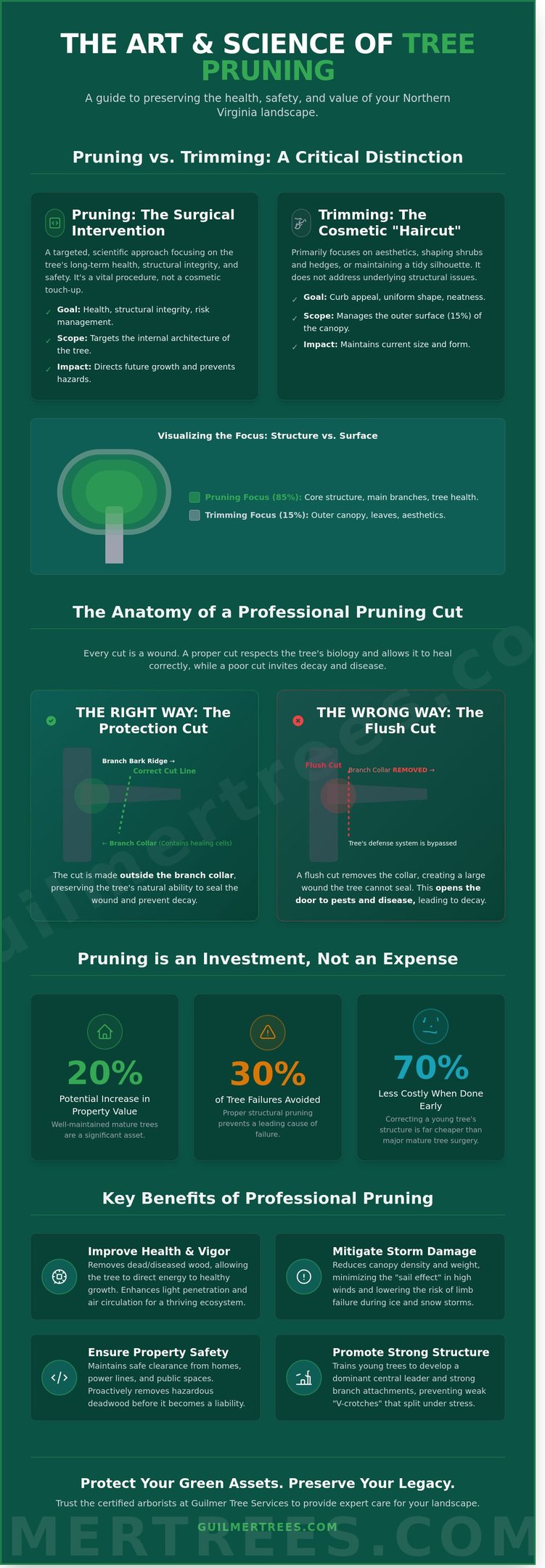
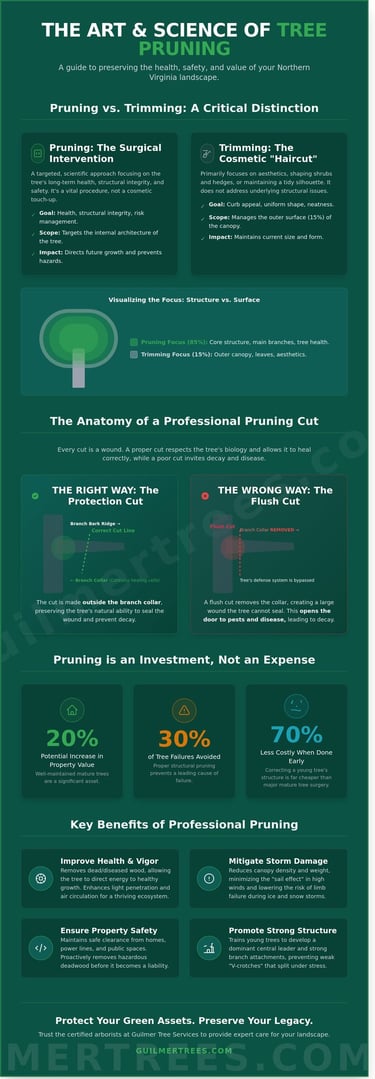
Trimming usually focuses on the outer 15% of a shrub or tree's canopy. It's a practice driven by curb appeal and the desire for a tidy silhouette. Pruning, however, reaches into the internal architecture of the tree. It targets the 85% of the structure that supports the weight of the canopy. While trimming maintains a shape, pruning directs future growth patterns and eliminates potential hazards before they manifest. For Northern Virginia trees, pruning is a health-first practice that prepares the canopy to withstand the heavy ice loads and high winds common in the Mid-Atlantic region.
The Anatomy of a Pruning Cut
Every cut made to a tree is a wound that requires a biological response. A professional arborist looks for the branch bark ridge and the branch collar, which is the slightly swollen area where the limb meets the trunk. This collar contains specialized cells that seal off the wound. If you make a damaging flush cut that removes this collar, you bypass the tree's natural defense system. This often leads to visible decay within 24 months of the intervention.
Amateur mistakes can have devastating consequences for your timber. One common error is "lion-tailing," where an untrained hand strips the inner 60% of foliage from a branch. This leaves a heavy tuft at the end of a bare limb, significantly increasing the risk of breakage during a 35-knot wind gust. Knowing what is pruning a tree means respecting these biological boundaries to ensure the tree remains a stable, vibrant part of your landscape for generations.
The Biological Benefits: Why Pruning is Vital in Northern Virginia
Understanding what is pruning a tree starts with recognizing it as a biological necessity rather than a cosmetic choice. In Northern Virginia, our native species face specific environmental stressors that require a disciplined horticultural approach. By removing dead, diseased, or pest-infested wood, we preserve the specimen's vigor and prevent the unnecessary depletion of its energy reserves. This practice allows the tree to channel its nutrients toward healthy growth and defense mechanisms.
Structural integrity remains a primary concern for homeowners in Falls Church. Before the peak of the 2024 storm season, weight reduction pruning helps mitigate the risk of limb failure. We focus on thinning the outer canopy to reduce the "sail effect" during high winds. This precision work also improves light penetration. When 15% to 25% of the inner canopy is thinned, sunlight finally reaches the lawn below, fostering a healthier ecosystem for the entire property. Managing the urban forest requires keeping growth 10 feet away from power lines and rooftops, ensuring the tree and the home coexist safely.
Disease and Pest Management in NOVA
Local threats like the Emerald Ash Borer or Oak Wilt can devastate an entire landscape if left unchecked. Sanitation pruning is a critical tool here; it involves the surgical removal of infected branches to halt the spread of fungal pathogens. Identifying hazard wood is equally vital. In Virginia, high-wind events often turn deadwood into a liability. To maintain a safe environment, consulting a guide on When to Prune in Falls Church, VA ensures these interventions happen during the optimal biological window. It's a proactive way to manage what is pruning a tree for long-term health.
Structural Training for Young Trees
Young Maples and Oaks in Arlington require subordination pruning to establish a dominant central leader. This technique involves slowing the growth of secondary branches to prevent the development of weak, V-shaped crotches. These structural flaws often lead to split trunks during heavy winter ice. Early intervention is a sound financial strategy. Correcting a tree's architecture in its first 5 years costs 70% less than attempting to fix a mature, structurally unsound canopy a decade later. For those planting new specimens, our nursery selection offers trees with already established, high-quality root systems designed for Virginia soil.
Core Methods of Professional Tree Pruning
Understanding what is pruning a tree involves more than just cutting limbs; it's an exercise in managing the biological health of a living specimen. Professionals utilize four primary techniques to maintain the vigor and structural integrity of Virginia landscapes. These methods ensure the tree remains an asset rather than a liability.
Cleaning: The removal of dead, dying, and broken branches from the crown.
Thinning: Reducing density at the edge of the canopy to increase light and air flow.
Raising: Providing vertical clearance for sidewalks, driveways, and pedestrians.
Reduction: Carefully decreasing the height or spread of a tree for utility clearance or structural balance.
Each method serves a specific physiological purpose. When applied correctly, they respect the tree's natural growth cycle and long-term vitality.
Crown Cleaning and Maintenance
For mature hardwoods in Falls Church, such as the White Oak or Red Maple, cleaning is the most frequent intervention. This process targets "suckers" and water sprouts. These are vigorous, weakly attached shoots that emerge from the trunk or main branches. Removing them is vital because they drain the tree's energy reserves. These shoots often consume more nutrients than they produce through photosynthesis. By focusing on these defects, we maintain the natural silhouette of the essence while eliminating hazards. A clean crown reduces the weight on heavy limbs; this prevents limb failure during Northern Virginia's heavy summer storms. It's a fundamental part of what is pruning a tree for longevity.
Canopy Raising and Reduction
Canopy raising provides essential vertical clearance. In Fairfax County, local guidelines often require a 14-foot clearance over public streets to accommodate emergency vehicles and 8 feet over sidewalks for pedestrians. This practice ensures your property remains compliant while improving the visual flow of the landscape. It's a precise balance between human utility and horticultural health.
When a tree grows too close to a structure, reduction is the preferred alternative to removal. We decrease the height or spread by cutting back to lateral branches that are at least one-third the diameter of the limb being removed. This preserves the tree's internal plumbing. You should never resort to "topping." Topping involves cutting the main leader or large branches back to stubs. This practice isn't a valid reduction method. It creates massive wounds that can't heal, leading to internal rot. Research from the International Society of Arboriculture (ISA) confirms that topped trees are significantly more likely to fail during high winds than those pruned with professional reduction techniques.
Timing and Tools: When to Prune in Falls Church, VA
Timing isn't just a suggestion; it's a biological requirement for the health of your canopy. In Falls Church, the dormant season between late January and early March is the optimal window for major structural work. During these cold months, the tree's metabolic activity slows significantly. This dormancy allows the specimen to retain its energy reserves, ensuring it has the vitality to seal wounds as soon as the spring growth cycle begins in April. Understanding what is pruning a tree requires recognizing these natural rhythms to prevent unnecessary stress on the plant's vascular system.
While winter is the standard, emergency pruning is an essential exception. If a June thunderstorm leaves a heavy limb hanging or if you spot signs of Emerald Ash Borer damage, you shouldn't wait for a calendar date. Removing dead, diseased, or damaged wood immediately prevents pathogens from entering the main trunk. For healthy limbs, however, avoid any cutting during the "spring flush" in late April and May. During this time, the tree is directing all its energy into new leaves and the bark is particularly susceptible to tearing.
The Northern Virginia Pruning Calendar
For large local staples like White Oaks and Red Maples, structural edits are most effective before the first buds swell in March. This provides a clear view of the branch architecture without foliage obscuring potential defects. Ornamental species follow a different set of rules. You should prune Flowering Dogwoods and Azaleas immediately after their spring blooms fade. Pruning these in late winter would mean cutting off the flower buds you've waited all year to see. A precise schedule ensures the Savoir-faire of your garden remains intact year after year.
DIY vs. Professional Pruning
Homeowners can safely manage light maintenance using sharp bypass pruners for stems under 0.75 inches in diameter. We recommend the "10-foot rule" for all Falls Church residents: if the branch requires a ladder to reach, it's a job for a professional arborist. High-altitude work involves specialized climbing harnesses and rigging to ensure heavy wood doesn't impact your home's foundation. When you do work at ground level, remember that 100% of your tools must be sterilized. Using a 70% isopropyl alcohol solution between each tree prevents the spread of Fire Blight, a common local threat that can destroy a healthy pear or apple tree in weeks.
Ensure your landscape thrives by consulting the Savoir-faire of Guilmer Trees for your seasonal maintenance and structural pruning needs.
Why Professional Pruning is an Investment in Your Property
Understanding what is pruning a tree requires looking beyond the immediate cut. It's a long-term commitment to the structural integrity and market value of your Northern Virginia home. Data from the Council of Tree and Landscape Appraisers indicates that healthy, mature trees can boost property values in Falls Church by as much as 20 percent. A single specimen oak or maple, shaped with precision, acts as a living asset that grows in value every season.
Liability reduction remains a critical factor for Virginia homeowners. Dead limbs represent a significant risk during the heavy summer thunderstorms or ice events common in our region. By removing these hazards proactively, you protect your roof, your vehicles, and your neighbors from unpredictable debris. It's a matter of safety and financial foresight. We view every branch as part of a larger biological system that demands respect and technical mastery.
Protecting Your Home and Landscape
The financial math is simple. A routine preventive pruning session might cost $450, whereas emergency storm removal involving cranes and crew overtime often exceeds $3,500 in Fairfax County. Beyond the numbers, professional care preserves the aesthetic harmony of your yard. Expert cuts ensure light reaches your lawn and keeps your landscape's "Savoir-faire Guilmer" spirit alive. For comprehensive support, explore our tree health care Virginia services to maintain your canopy's vigor year-round.
The Guilmer Commitment to Quality
We operate as a fully licensed and insured Northern Virginia tree service, but our identity goes deeper than paperwork. Our crews prioritize the biological health of every specimen over quick, aggressive cutting. We focus on the tree's vascular system and future growth patterns to ensure a long life. This meticulous approach defines our reputation among discerning property owners who value quality over speed. Our artisans understand the cycle of the seasons and the specific needs of local essences. If you're ready to secure your landscape's future, request a pruning consultation for your Falls Church home today. We'll help you understand exactly what is pruning a tree for your specific species and site conditions.
Invest in the Longevity of Your Northern Virginia Landscape
Understanding what is pruning a tree goes beyond simple aesthetics; it's a vital commitment to the biological health of our local ecosystem. By removing diseased limbs and structural defects, you're ensuring your oaks and maples can withstand the specific weather patterns of Falls Church. Proper technique protects the plant's vascular system, promoting a vigorous growth cycle that pays dividends for decades. Every cut is an act of stewardship that preserves the vitality of the living structure.
Since founding Guilmer Tree Services in 2021, our team has focused on the precise needs of Northern Virginia native species. We bring the technical rigor of licensed and insured professionals to every project, ensuring your property value grows alongside your canopy. You don't have to navigate the complexities of horticultural maintenance alone when expert guidance is available. Trusting the "Savoir-faire Guilmer" means choosing a partner who respects the slow, magnificent pace of nature.
Schedule your professional tree pruning assessment with Guilmer Tree Services today!
Your trees represent a living legacy for your home, and we're here to help them flourish for generations to come.
Frequently Asked Questions
Is pruning a tree the same as cutting it back?
No, pruning is a surgical horticultural practice while cutting back is often an imprecise reduction of the canopy. Pruning focuses on the selective removal of specific branches to improve the specimen's health and structural integrity. In contrast, "cutting back" often resembles topping, a harmful technique that removes 50% or more of the crown and triggers weak epicormic growth. Understanding what is pruning a tree involves recognizing the difference between strategic thinning and the indiscriminate shearing of vital limbs.
Can I prune my own trees in Falls Church?
You can prune trees on your private property in Falls Church, but you must follow City Code Chapter 35 regarding canopy preservation. Homeowners can safely manage small ornamental species under 15 feet using sharp bypass pruners and hand saws. However, 85% of structural failures occur due to improper cuts on larger specimens. Hiring a professional ensures the long-term vigor of the root system and prevents permanent damage to the tree's natural architecture.
What happens if you don't prune your trees?
Neglected trees develop crowded canopies that trap moisture, which increases fungal infection rates by 40% during humid Virginia summers. Without structural intervention, weak crotches and crossing branches eventually lead to limb failure during 50 mph wind gusts. Regular maintenance fosters a balanced architecture, allowing light to reach the interior foliage and stimulating healthy sap flow throughout the entire plant. Proper care prevents the $5,000 emergency removal costs often associated with fallen, unmaintained timber.
How much does professional tree pruning cost in Northern Virginia?
Professional pruning services in Northern Virginia typically range from $450 to $1,800 per tree depending on height and complexity. A 30-foot White Oak requires more specialized rigging and time than a 10-foot Japanese Maple. These costs reflect the expertise of certified arborists who protect your landscape investment. Investing in proper care every 3 years ensures the safety of your home and the long-term health of your high-value greenery.
Is it better to prune a tree in the summer or winter?
Late winter dormancy is the optimal window for most Virginia species because the tree's energy is stored safely in the root system. Pruning between December and February minimizes sap loss and prevents the spread of pathogens like Oak Wilt. While summer pruning helps restrict growth on 15% of overly vigorous shoots, the dormant season provides the clearest view of the tree's skeletal structure. This clarity allows for the precise, balanced cuts that define the artisan's craft.
How do I know if my tree needs pruning or if it's dying?
You can identify the need for care by performing a scratch test on small twigs to find green, living cambium. If more than 30% of the upper canopy shows bare wood during the July growing season, the tree is likely in decline rather than just needing a trim. Deep vertical cracks or fungal brackets at the base indicate structural decay. These signs require an immediate professional assessment to determine if the specimen can be saved or if it poses a risk.
Can pruning save a diseased tree?
Strategic pruning can halt the progression of diseases like Fire Blight if you remove infected limbs at least 12 inches below the visible canker. For many Virginia homeowners, understanding what is pruning a tree means using it as a biological shield to protect the main trunk. Removing dead or diseased wood eliminates the breeding ground for pests that compromise 60% of a tree's vitality. This targeted approach preserves the remaining healthy tissue and encourages the tree to seal its wounds naturally.
What is the 25% rule in tree pruning?
The 25% rule dictates that you should never remove more than one quarter of a tree's living canopy in a single growing season. Exceeding this limit starves the root system of necessary carbohydrates produced through photosynthesis. For mature subjects, experts often reduce this threshold to 10% to maintain stability and prevent stress. This disciplined approach respects the natural growth cycle and ensures the specimen has enough energy to recover from the intervention.
Our Services
Tree Removal
Tree Trimming and Pruning
Stump Grinding
Bush Chipping
Hours & Information
© 2026. All rights reserved.
Monday to Friday : from 9:00 AM – 5:00 PM
on-site : from 8:00 AM – 6:00 PM