🌳Find the Right Forestry Mulching Company: Costs & Questions
Looking for a reliable forestry mulching company? 🌲 Choose a contractor with modern mulching equipment, licensed and insured crews, and clear, itemized quotes that show scope, disposal, and site restoration. Ask about experience with land type, erosion control, and permit requirements for your area.
6 min read
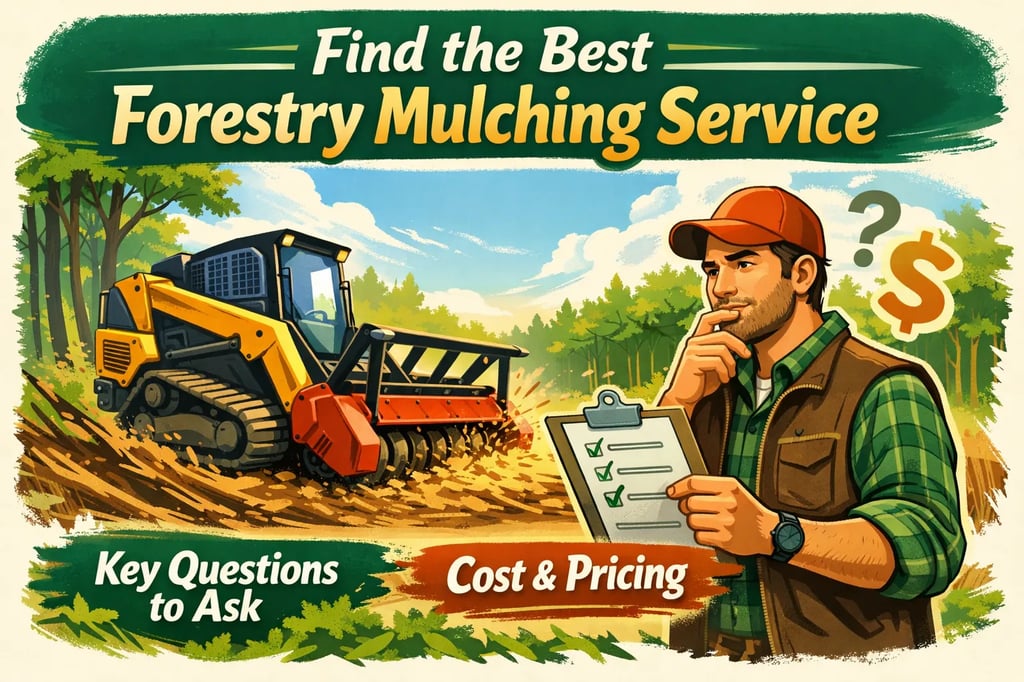
Forestry mulching is mechanical clearing that shreds brush, saplings and undergrowth into mulch that’s left on site—a fast, low‑disturbance way to open a lot without trucks of debris or deep excavation. If you’re in Falls Church or nearby, Guilmer Tree Services offers free on‑site estimates and will walk you through costs, timelines, and permits. Read on and you’ll know whether mulching fits your project, what a fair price looks like, which questions to ask, and how to compare quotes.
Is forestry mulching the right solution for your property?
Mulching machines grind vegetation into chips and small mulch that stays on the ground to suppress regrowth and reduce erosion. Homeowners choose this method because it’s faster than hand‑cutting, keeps hauling to a minimum, and leaves the site looking less scarred than full excavation or bulldozing.
Good uses: clearing right‑of‑ways, rehabbing pastures, removing underbrush beneath a healthy canopy, knocking back invasives, and prepping areas for reseeding or low‑impact landscaping. Not a good fit when you need large trees removed for foundations, require full stump extraction, or must do heavy grading and contouring for a building pad.
Quick self‑check: if most trunks you want removed are under about 6–10 inches diameter and you’re not preparing a house pad, mechanical mulching probably does the job. If you see many mature trunks over a foot or you need the ground finished flat, plan for stump work or grading beyond mulching.
Here are practical ballpark ranges so you can judge any quote at a glance:
Typical Condition Price (per acre)
Light brush/undergrowth $400–$1,200
Common/typical jobs $400–$800
Medium/dense brush or small trees $1,200–$2,500+
Extreme/heavy timber or very steep sites Can exceed $2,500/acre
Small jobs often carry a minimum fee—expect $400–$1,000 even for under an acre. Some contractors price hourly ($100–$300/hr) or by machine/crew day ($1,000–$2,500/day), which matters if your site requires frequent repositioning or rough access.
Main cost drivers:
Brush density and diameter. Thicker stems and more brush slow progress and wear teeth. A field of saplings clears far faster than a patch of 3–8" saplings mixed with vines and briars.
Access and slope. Tight yards, narrow gates, steep hills, or rocky terrain reduce machine productivity and raise labor time.
Mobilization distance. Longer truck trips for equipment add per‑job mobilization fees.
Special disposal or hauling. Mulching leaves most material on site; if you need chips hauled away or large logs removed, expect extra charges.
Permits and mitigation. Local permit fees, tree protection work, or required erosion controls add to the total.
Two quick examples: a 1‑acre lot of light brush (saplings under 2" with good access) often runs $400–$800. A 2‑acre patch of mixed 3–8" saplings with briars and steep slope can push $2,000–$5,000 total because production slows to under an acre per day.
For an additional industry cost perspective, see this forestry mulching cost guide for typical pricing and what affects estimates: forestry mulching cost guide.
A responsible quote begins with an on‑site assessment and lists mobilization, the mulching scope (acres or hours), and site access notes. An itemized scope tells you what the crew will leave behind (mulch layer depth, which trees they’ll grind vs. leave) and basic cleanup terms.
Common extras that should be listed separately are Tree Stump Grinding: Average Costs & Money‑Saving Tips | Guilmer Tree Services (per stump or hourly), removal and hauling of large logs or non‑mulchable debris, and permit fees or erosion‑control measures. Grading or finished leveling is often priced separately because mulching leaves an uneven mulch layer, and final site prep for construction is a different service.
Example itemized estimate in plain terms: Mobilization $350; 1.5 acres mulching @ $650/acre = $975; stump removal service (if requested) $250 per large stump or $150/hr; hauling of large logs $75/yd; permit coordination $150 (if required). That level of line‑item clarity keeps surprises to a minimum.
Locally, Find and Hire a Local Land‑Clearing Contractor Today | Guilmer Tree Services provides free on‑site estimates, an itemized scope, and clear options for bundling stump grinding and brush chipping so you can see tradeoffs rather than a single flat number. If you specifically need pricing on nearby options, check Local Stump Grinding Near You — Prices & Fast Quotes | Guilmer Tree Services.
Realistic costs and the things that push the price
What a clear, honest estimate should include (and what it usually leaves out)
How to vet machines, crews, licenses, and insurance
Principle: match the machine and crew to your site—don’t pick the cheapest bid. Contractors use skid‑steer mulchers (nimble for tight yards), excavator‑mounted heads (better reach and slope handling), tractor/PTO units for agricultural settings, and self‑propelled heavy mulchers for large acreage. Larger cutter widths and heavier heads work faster but leave a heavier footprint and require higher carrier horsepower.
Ask for specific specs so you’re comparing apples to apples: carrier make/model, cutter head type (drum, disc, or shaft), cutting width (typically 36–78 inches), recommended maximum cutting diameter (e.g., 6–16"), carrier horsepower and hydraulic flow (GPM), and the contractor’s expected acres per day under your site conditions. Those answers reveal whether the quoted rate matches real productivity.
For reference on carrier‑mounted cutter options see an overview of types of excavator mulchers, and for tractor/PTO applications review common PTO‑driven mulcher heads.
Credentials checklist to request before signing: business license number, a current Certificate of Insurance showing general liability of at least $1–2 million recommended, workers’ compensation proof, vehicle and equipment insurance, and any local permits or annual city permits required for Falls Church. Tip: ask the contractor to email a Certificate of Insurance listing you as additional insured for the job if you want extra protection.
If your project will likely need full tree extraction or extensive stump work rather than mulching alone, read more about the broader options in Tree & Stump Removal: Costs, Process, and What to Ask | Guilmer Tree Services.
Homeowner prep: call 811 to have underground utilities marked, flag property lines and trees to keep, remove toys and garden furniture, note septic and well locations, and provide a 10–15 ft access corridor when possible. Good prep speeds work and reduces surprises.
Timing expectations: production varies wildly—rough ranges are 0.5–5 acres/day depending on density and carrier. Very dense sites often run 0.5–2 acres/day; open acreage with heavy self‑propelled mulchers can reach 10–15 acres/day in light cover. For real‑world productivity examples, read an industry overview of how many acres can be cleared in a day. The contractor should give a realistic start date and per‑day production estimate tied to your site walk.
Can you provide a recent itemized estimate and a written scope of work?
What machine (make/model and cutter type) will you use and how many acres/day do you expect on my site conditions?
Do you include stump grinding? If not, how is it priced?
Who handles permits and inspections—you or me?
Can you email a Certificate of Insurance naming me as additional insured?
Do you have references and before/after photos of similar jobs?
What is your start date, estimated completion, and payment schedule?
How will you protect slopes, wetlands, and erosion‑prone areas?
Red flags: ultra‑low bids with no itemization, refusal to provide a COI or to name you as additional insured, no local references or photos, pressure to pay large cash upfront, vague scope language, or claims that “no permits are needed” without checking local rules.
Use a short comparison rubric when you have 2–3 quotes: compare total price and price basis (acre or hour), services included (stump grinding/hauling/chipping), equipment specs and realistic production, proof of permits/insurance, and schedule/payment/warranty terms. A quick email template you can use: “Please send an itemized estimate for mulching X acres at [address], list the machine make/model and cutter type, state acres/day expected for these conditions, and attach your COI and references. Thanks.”
Get at least three itemized bids, choose the responsible mid‑range option with proper insurance and equipment, or Find and Hire a Local Land‑Clearing Contractor Today | Guilmer Tree Services for a free on‑site estimate if you’re in the Falls Church area.
Bottom line: The right job, done with the right machine and an insured, experienced crew, is the difference between a tidy low‑impact clearing and a project that costs twice as much to fix. When in doubt, request a free on‑site look—it's the fastest way to a reliable price and timeline.
Prep, timelines, must‑ask questions, red flags, and how to compare quotes
Our Services
Tree Removal
Tree Trimming and Pruning
Stump Grinding
Bush Chipping
Hours & Information
© 2026. All rights reserved.
Monday to Friday : from 9:00 AM – 5:00 PM
on-site : from 8:00 AM – 6:00 PM