
🌳Stump Removal Service: Costs, Questions & Pro Tips
Get clear, local guidance on stump removal costs and smart ways to save. Expect pricing to vary by stump diameter, access, and disposal; always request itemized quotes that list grind depth, haul‑away, and turf restoration. Ask whether stump grinding or full excavation is recommended for your site and future plans. For transparent pricing and professional service, contact Guilmer Tree Services for a free, no‑pressure estimate — 571‑645‑2048.
6 min read
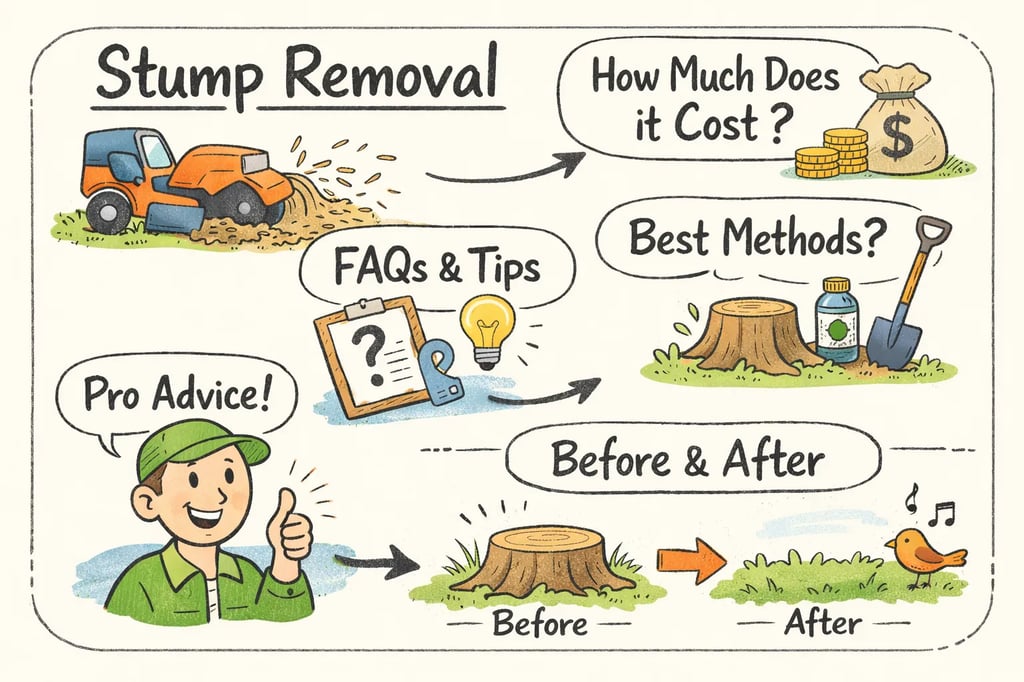
Finding a stump in your yard often comes with three surprises: cost, mess, and uncertainty about the right method. Homeowners want a fair price, minimal disruption, and a clear plan—and they don’t want to be surprised on invoice day.
By the end of this guide you’ll be able to estimate a practical price, choose between grinding and full extraction, vet and compare bids, and use a short script to get a clean written quote. Guilmer Tree Services in Falls Church sees these questions every week — here’s the practical guide we give homeowners.
Quick cost primer — a 60‑second estimate you can do now
National ranges for removing a single stump typically sit between about $150 and $420, with grinding usually cheaper than full extraction. A simple rule pros use: expect roughly $2–$5 per inch of stump diameter for grinding (with most companies enforcing a $100–$150 minimum). Complete extraction—digging out the stump and major roots—often costs roughly two times grinding, and can go much higher for complex root systems.
Measure the stump at its widest point across the top (use a tape measure or wrap string and measure the string). Note how close the stump is to the house, fences, or utilities, and count how many stumps you need removed—multiple stumps usually lower the per‑stump price.
Mini formulas you can use now: Grinding estimate = diameter (inches) × $2–$5 (expect a $100–$150 minimum); Full extraction = roughly 2× grinding price + root‑complexity fees. Example: a 24" stump will often grind for about $150–$350; full extraction for that same stump commonly lands in the $400–$700 range depending on access and root depth.
The biggest cost drivers are stump diameter, root depth/complexity, access (gates, fences, slopes), number of stumps (discounts apply), and where you live (urban/coastal areas command premiums).
Grinding is the default for most homeowners: it’s fast, affordable, and leaves a usable pile of wood chips you can spread as mulch. Extraction (uprooting the stump and major roots) is chosen when you need a completely clear site for construction, immediate replanting, or when roots threaten foundations or utilities.
Choose grinding if you want a lower‑cost, quick fix with minimal excavation and plan to let roots decompose underground or reuse the chips as mulch. Choose full extraction if you’re installing a patio, planting a new tree in the same hole, dealing with invasive roots near a foundation or sewer, or removing a diseased stump that must be eliminated entirely.
Grinding pros: lower cost, less disruption, fast turnaround, chips you can reuse. Grinding cons: roots remain, can rot or resprout, and may interfere with heavy construction later. Extraction pros: clean slate with no root regrowth and immediate readiness for hardscapes or replanting. Extraction cons: higher cost, large holes to backfill, and more lawn repair.
Chemical rotting is the cheapest option but slow and unsuitable when you need the spot usable soon. For comparative cost data and national averages, see Angi's stump removal cost overview.
Not all bids include the same items—some crews give a flat price that includes cleanup and backfill; others quote a low base rate and add every service. Ask specifically what’s included so you can compare bids fairly.
Typical add‑ons and rough ranges: hauling/disposal $125–$200 (or $1–$4 per inch); root excavation/deep root removal +$50–$350; site fill, grading, reseeding or sodding $150–$300+; permits or municipal fees $100–$500; chemical treatments $60–$200; access surcharges (tight gates/fences) $50–$150.
When you get bids, insist they spell out the essentials in writing: method (grind vs extract) and grinding depth in inches; chip disposal or hauling; whether backfill/topsoil and reseeding or sodding are included; permit handling and fees; estimated timeline and crew size; proof of insurance and license; payment schedule and cleanup/warranty terms. Ask for an itemized, written quote so you can compare line‑by‑line instead of juggling vague totals.
Grinding vs full extraction — which method suits your job?
Common add‑ons, hidden fees & how to read a quote
Vetting contractors: licenses, insurance, questions & red flags
Safety and liability matter. Never let a crew start without proof of insurance and a clear, written quote.
Must‑ask documents and credentials: commercial general liability insurance (recommend $1M minimum), workers’ compensation, state/local contractor license when required, local business license, and references with photos of completed stump jobs. ISA Certified Arborist credentials are a helpful bonus for tree‑health questions.
Key questions to ask on the call or at the site: “Can you email or show proof of insurance and your license?”; “Is cleanup, chip hauling, and backfill included?”; “Will you handle any necessary permits and who pulls them?”; “What’s your warranty on work and cleanup?” Red flags that should make you walk away include no written quote, refusal to show insurance, demands for full prepayment, an extremely low bid with vague inclusions, or no local references.
What to expect on job day — equipment, timeline, yard repair & safety
Most residential jobs use a self‑propelled or track‑mounted stump grinder operated by one or two crew members; larger removal or extraction jobs may require excavators and a bigger crew. Small stumps under about 12" can take minutes; medium stumps (12"–36") typically under one to two hours each; large or extraction jobs can take several hours to a full day.
Grinding creates a pile of coarse wood chips—many crews will leave the chips for you to use as mulch unless you request hauling. Grinding to 3–12 inches below grade is common; extraction leaves a large hole that must be backfilled and compacted. Track machines reduce turf damage, but expect some lawn disturbance and a bit of repair work afterward. Manufacturers of dedicated equipment are worth noting for their durability—see Vermeer stump cutters for examples of professional machines commonly used on residential jobs.
Homeowner prep checklist: clear access (remove cars, furniture, and obstacles); secure pets; mark any sprinklers or visible underground lines; call 811 to locate buried utilities if you haven’t already; take “before” photos of nearby structures and landscaping.
On site, crews should use PPE, cordon the work area, and communicate safety steps. If the work is near a road or high‑traffic area, ask about traffic control measures in advance. For seasonal prep and region‑specific tips, see Essential Tree Service Recommendations Before Winter in Northern Virginia | Guilmer Tree Services.
How to get accurate quotes and book confidently (templates + local option)
Include these items when you request an estimate: stump diameter(s), clear photos from three angles with a tape measure visible, distance to house or structures, gate width and access notes, and whether you prefer grinding or full removal.
Phone script (30–60 seconds): “Hi, I’m [name]. I have a [__]‑inch stump about [__] feet from my house in Falls Church. I’m looking for a quote to [grind X inches below grade / remove the root ball]. Do you provide free on‑site estimates, and will your written quote include hauling and backfill?”
Email template:
Hi [Company],
I’m requesting a written estimate for stump work at [address]. Attached are three photos (front, side, top) with a tape measure visible. Stump diameter: inches. Distance to house: ft. Access gate width: __ ft. I’m interested in: [grinding X" below grade / full extraction]. Please include chip disposal, backfill/topsoil, permits, timeline, proof of insurance, and total price.
Thanks,
[Your name] | [phone]
Permits and utility checks
Use this quick comparison table to line bids up side‑by‑side:
Total price |Method Grinding depth |Chip disposal |Backfill / reseed |Permits |Timeline |Insurance proof |Warranty
Negotiation and payment tips: ask for per‑stump discounts for multiple removals, prefer a small deposit with balance due on completion, and get every promise in writing. Avoid paying in full up front. If you want a broader cost breakdown and pricing examples, check LawnStarter's stump removal price guide.
If you’d like a local, transparent estimate, Guilmer Tree Services in Falls Church is a licensed, insured crew offering free on‑site estimates, clear itemized quotes, stump grinding and brush chipping to turn debris into usable mulch. For guidance on hiring a local crew, see How to Hire the Best Tree & Stump Removal Service Near You | Guilmer Tree Services. For fast local grinding quotes, see Local Stump Grinding Near You — Prices & Fast Quotes | Guilmer Tree Services. To speed the visit, send photos, stump measurements, gate width, and your preferred outcome (grind vs removal).
Measure the stump, use the per‑inch rule to set expectations, decide grinding or extraction based on what you’ll build or plant, and insist on an itemized written quote plus proof of insurance. For specific per‑inch pricing examples and savings tips, see Stump Removal Cost in 2026: Per‑Inch Pricing & Savings | Guilmer Tree Services. When you’re ready, send photos and measurements to a reputable local crew — Guilmer Tree Services, Professional Tree Removal | Guilmer Tree Services is happy to provide a free, transparent estimate to move you from decision to action.
Our Services
Tree Removal
Tree Trimming and Pruning
Stump Grinding
Bush Chipping
Hours & Information
© 2026. All rights reserved.
Monday to Friday : from 9:00 AM – 5:00 PM
on-site : from 8:00 AM – 6:00 PM