
🌳Commercial Stump Removal: Buy, Rent, or Hire (2026)
Commercial properties often deal with large, deep, or multiple stumps that require serious equipment and expertise. In 2026, businesses are weighing three main options — buying, renting, or hiring a professional stump‑removal service. At Guilmer Tree Service, we break down the real costs, risks, and benefits so you can make the right choice for your property.
5 min read
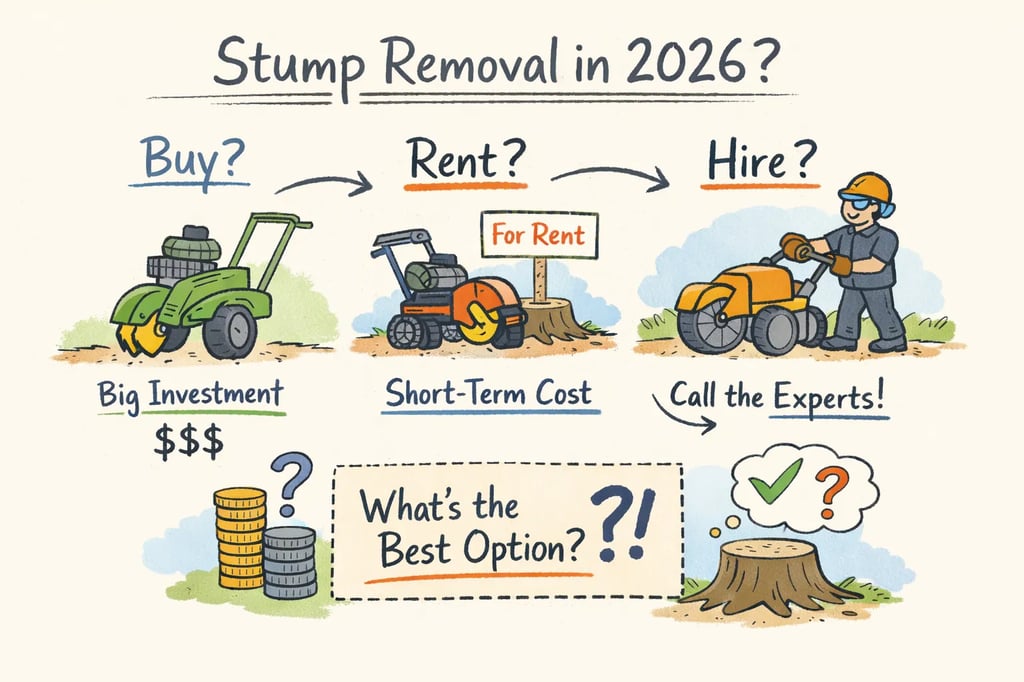
It’s a common choice for contractors and property managers: invest in a commercial stump grinder, rent for the occasional job, or hand the work to a licensed crew. The right answer affects cost, schedule, turf damage, and liability—so this is worth getting right before you commit.
We’re Guilmer Tree Services, a licensed and insured Falls Church crew that handles commercial stump grinding across Northern Virginia. If you’d rather skip the numbers, we’ll walk your site and run the math for free.
Below: a quick decision tool, a plain-language translation of machine specs, real cost math with a worked example, what ownership really looks like day-to-day, model shortlists by workload, and a one-page checklist to take action.
Quick decision: buy, rent, or call a pro
Answer these three questions in 60 seconds and you’ll have a direction:
How many stump-grinding days do you expect per year? (Count travel + prep as part of a “day”)
What are your typical stump diameters and how dense are the roots (hardwood vs softwood)?
How tight is access and how sensitive is the turf or landscape?
Rule-of-thumb outcomes
Hire a professional when you have under ~10 grind-days per year, limited access, or you prefer no hassle with insurance and equipment upkeep. For many property managers and small commercial sites this is the most predictable, lowest-risk path.
Rent when you do occasional jobs (roughly 5–25 days/year) or you need one big job handled without a long-term capital outlay—provided you can tow the machine and your crews are comfortable operating it.
Buy if you expect heavy, ongoing use (a practical benchmark: more than ~20–30 grind-days/year) or you plan to run stump grinding as a core service line.
If you’re still unsure, keep a short job log for a month—record stump diameters, travel time, and site constraints—then re-run this checklist at the end.
Specs on paper can be fuzzy. Here’s what matters in practice.
Engine horsepower (HP): More HP = more torque at the cutter wheel for thick roots and faster removal on large stumps. If most stumps are under 18 inches, 25–40 HP is often adequate; above that, step up.
Cutter wheel diameter & thickness: Larger wheels remove more material per pass and let you grind deeper below grade. Thick wheels and a higher tooth count reduce pass count and operator fatigue.
Teeth and carbide: Carbide-tipped teeth do the cutting. More teeth and higher-quality carbide increase cutting cadence and life—expect to budget for replacement teeth and rotation.
Swing radius and maximum depth: This determines how far below grade the wheel reaches and how much root system you can remove in one position. Deeper swings save time on big stumps. For guidance focused on costs and site prep when you need deeper root work, see our Root Grinding Near Me — Costs, Prep & a 5‑Point Checklist.
Machine weight and ground pressure: Heavier tracked machines distribute weight and reduce lawn damage; wheeled or tow-behind units are lighter but can rut soft turf.
Drive type—track vs. tire vs. tow‑behind: Tracked, self-propelled models are the go-to for commercial work with tight access, slopes, or delicate lawns. Tow‑behind or wheeled machines trade turf protection for lower cost and easier transport—good for flat sites with straightforward access.
Model shorthand and use-cases (short list)
Vermeer SC-series: broad range for light commercial to heavy-duty—good for contractors wanting scale.
Bandit SG‑40 and Rayco RG models: compact tracked commercial units for tight, frequent jobs.
Carlton and large Vermeer models: for heavy land-clearing and very large roots.
Prosumer/tow-behind (e.g., Barreto): for landscapers or homeowners doing occasional work who need portability more than power.
Ask a dealer about cutter wheel sizes available, specific tooth part numbers, track vs wheel options, transport dimensions, and local parts/service support. Those answers affect uptime more than sticker price.
What the machine specs actually mean — a buyer’s cheat sheet
Struggling to decide: buy a grinder, rent one for a job, or call a pro?
Money in, money out: purchase, rental and service costs
Daily reality: operations, maintenance, and safety
Realistic price bands: new commercial grinders usually sit in the $22,000–$40,000+ range. Typical used units vary widely; a common used-market average is about $15,000. Rentals typically run $300–$500 per day, $1,000–$2,000 per week, and $3,000–$5,000 per month (see typical stump grinder rental cost).
Hidden ownership expenses: truck and trailer to move the machine, insurance (~$1,500–$3,000/yr), secure storage, annual maintenance (a rule-of-thumb ~10% of purchase price), and spare teeth and belts.
Break-even formula (simple)
Annual ownership cost ÷ rental daily rate = break-even rental days/year.
Worked example: assume a $25,000 purchase amortized over five years = $5,000/year. Add annual maintenance of $2,500 (10%) and insurance $1,500 = $9,000/year total ownership cost. Divide by a typical rental daily rate of $400 → 9,000 ÷ 400 ≈ 22.5 days/year. If you expect to grind more than ~23 days yearly, buying becomes financially compelling.
Service vs buy: outsourcing at a typical per-job rate (the national average runs around $272 per job or $2–$5 per inch) removes maintenance, insurance, and operator scheduling from your ledger — for a recent survey of national pricing see stump grinding price. For under ~10–15 grind-days a year, that simplicity often wins. If you want a no-surprise option in Falls Church and surrounding Northern Virginia, Guilmer Tree Services can quote your job and supply a free site walk.
Match a grinder to your workload: shortlists and buying tips
Occasional homeowner or landscaper: rent or hire a licensed crew. Prosumer tow-behinds are okay for small stumps if you have safe transport and experience; otherwise outsource.
Small contractor (10–50 stumps/year): compact tracked 25–40 HP units (Bandit SG‑40, Vermeer SC30TX) give a balance of throughput and lower ownership cost.
Mid-volume (50–150 stumps/year): consider 48–70 HP tracked or heavy wheeled machines (mid-level Vermeer models) for faster cycle times and deeper cuts.
High-volume/commercial clearing (150+ stumps/year): 70+ HP and large cutter wheels are the right tool; plan for higher operating costs and dedicated transport.
When buying used, watch for hydraulic leaks, excessively worn teeth, missing service records, track or axle damage, and general neglect. Prefer machines with local dealer support for parts and warranty work.
Occasional homeowner or landscaper: rent or hire a licensed crew. Prosumer tow-behinds are okay for small stumps if you have safe transport and experience; otherwise outsource.
Small contractor (10–50 stumps/year): compact tracked 25–40 HP units (Bandit SG‑40, Vermeer SC30TX) give a balance of throughput and lower ownership cost.
Mid-volume (50–150 stumps/year): consider 48–70 HP tracked or heavy wheeled machines (mid-level Vermeer models) for faster cycle times and deeper cuts.
High-volume/commercial clearing (150+ stumps/year): 70+ HP and large cutter wheels are the right tool; plan for higher operating costs and dedicated transport.
When buying used, watch for hydraulic leaks, excessively worn teeth, missing service records, track or axle damage, and general neglect. Prefer machines with local dealer support for parts and warranty work.
Checklist, scenarios, and next steps
Count expected grind-days/year and average stump diameter
Note access constraints, turf sensitivity, and transport availability
Compare local rental daily rates, used machine listings, and dealer service support — ourLocal Stump Grinding: 7 Smart Ways to Save Money Safelyguide has practical comparison tips
Estimate annual ownership costs (amortization + 10% maintenance + insurance)
Get three local quotes: rental, used-purchase, and a contractor service estimate — start by readingHow to Hire the Best Tree & Stump Removal Service Near Youbefore you call
Sample outcomes: a homeowner with three small stumps saves time and headaches by hiring a pro; a landscaper doing ~30 small-to-medium jobs/year might rent and selectively buy a used 25–35 HP unit when demand steadies; a new stump‑grinding business planning 150+ jobs/year should buy a 48–70 HP tracked unit and budget for insurance and parts—ROI is typically quick once volume is steady.
Next steps: run your job log for a month, collect three local rental/used quotes, or schedule a free site walk with Guilmer Tree Services in Falls Church—we’ll size the machine, run the break-even math for your actual numbers, and give an honest recommendation. For a homeowner-facing overview on whether to rent or buy, see our Rent or Hire a Stump Grinder? Homeowner’s Cost Guide.
We’re licensed, insured, and ready to help with commercial stump grinding estimates across Northern Virginia—call or book a free site visit and we’ll run the numbers with you.
Our Services
Tree Removal
Tree Trimming and Pruning
Stump Grinding
Bush Chipping
Hours & Information
© 2026. All rights reserved.
Monday to Friday : from 9:00 AM – 5:00 PM
on-site : from 8:00 AM – 6:00 PM