
🌳Find Trusted Lot Clearing Near You: 7-Step Hiring Guide
Clearing a lot is a major project—choose a contractor who protects your property, schedule, and budget. Guilmer Tree Services’ seven‑step hiring guide helps homeowners vet contractors, compare bids, and avoid costly mistakes so your site is cleared safely and ready for the next phase of work.
6 min read
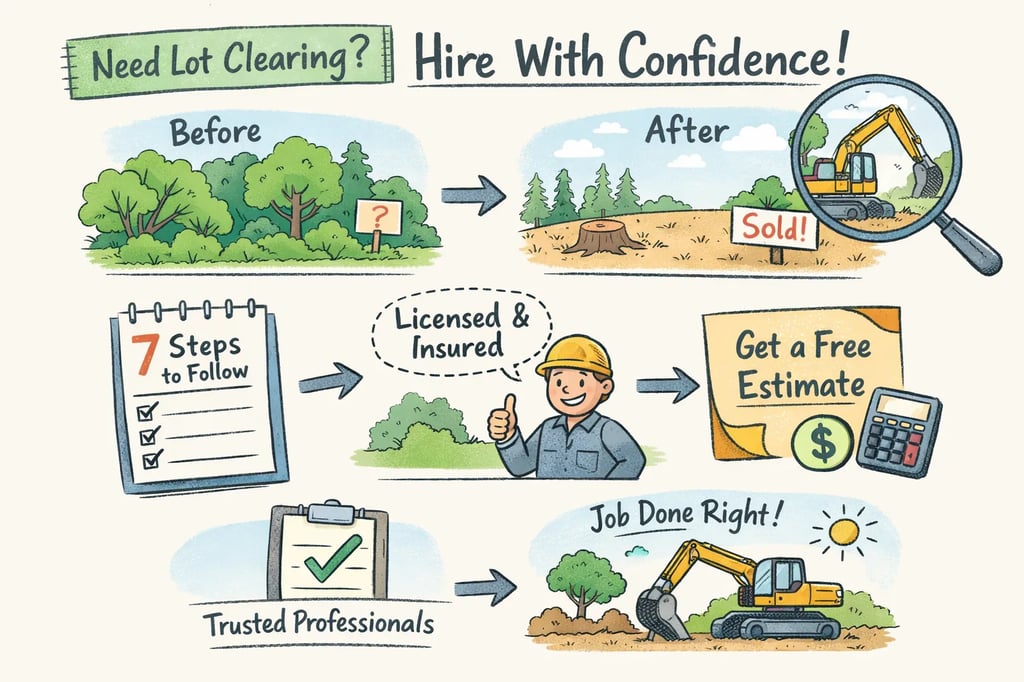

Bad quotes, surprise permit bills, and brush left in piles are the three familiar headaches of a clearing project. There’s a better way: a simple, repeatable hiring process that puts safety, paperwork, and cleanup in writing. Guilmer Tree Services — a licensed, insured Falls Church crew offering free on‑site estimates — uses this exact checklist when we quote land prep. Follow it and you’ll know where to look, what numbers are reasonable, which permits apply, and precisely what to demand in writing.
Where to find local lot‑clearing pros fast (what actually works)
Start where people in your neighborhood actually talk and where contractors advertise work they do: Google Maps and local directories, Nextdoor and neighborhood Facebook groups, municipal vendor lists, and estimate platforms like Angi or Thumbtack. Directories give volume and quick contact info; neighborhood groups give recent, candid experience; municipal lists show contractors who bid public work. Don’t skip word‑of‑mouth from builders and neighbors — they’ll tell you who shows up on time and who leaves a mess.
Look for three quick signals that separate pros from weekend operators: a current license number, an up‑to‑date Certificate of Insurance (COI) you can verify, and a portfolio of recent before/after photos for jobs like yours. A good local listing reads like this example: “Licensed & insured — free on‑site estimate — tree removal, stump grinding, brush chipping — Falls Church.” That tells you what to expect.
Two‑sentence outreach to get a fast quote (copy/paste): “Hi — I’m looking to clear about 0.5 acres at 123 Main St, Falls Church. Can you send a ballpark estimate and availability this month? Photos and driveway width attached.” When you reach out attach the property address, a quick sketch or lot lines, three photos (access point, view toward the center of the lot, close‑ups of major trees/stumps), and note any overhead lines or narrow gate/driveway access.
A professional lot‑clearing bid is itemized. Expect separate line items for tree removal, stump grinding or grubbing (root removal), brush/vegetation mulching, grading/finish work, hauling and disposal, mobilization, and permit fees. Line‑item bids let you compare apples‑to‑apples and avoid “surprise” add‑ons on finish day.
Use these ballpark figures to sanity‑check bids: a common residential midpoint is about $2,600 per acre; many projects fall in the $1,200–$3,900 per‑acre band. Per square foot, typical rates run roughly $0.89–$2.00, though dense forest or rocky terrain can push costs to $4,000–$7,500+ per acre. For a more detailed market breakdown of current pricing, see this guide to the cost to clear land.
Two quick examples you can use as conversation starters:
Lightly wooded 0.5‑acre (saplings, easy access): expect roughly $1,200–$1,800 total for mulching and light stump work. Heavily wooded 0.5‑acre (mature trees, multiple stumps, grading): expect $3,000–$4,500 once tree removal, stump grinding and finish grading are included.
Common add‑ons to watch for are surveying ($300–$750), erosion control and tree protection, and disposal fees for hauling to a transfer station. To compare bids, divide the total by acres (or total square feet) after confirming the scope so you’re not comparing a mulching job with a full grubbing and haul‑away bid.
Permits vary by jurisdiction. In Northern Virginia, disturbing 1+ acre usually triggers federal/state stormwater permitting (NPDES/CGP); local clearing or grading thresholds commonly start around 2,500 sq ft. Wetlands, stream buffers and Resource Protection Areas (often a 100‑foot riparian buffer) can prohibit clearing or dramatically change your plan. HOAs and conservation overlays add another layer. Review the relevant state rules — for example, see the Virginia stormwater permit rules for specifics on thresholds and requirements.
Practical workflow: call the local building or environmental department and ask these simple questions — does work over X sq ft require a grading/clearing permit, are there mapped wetlands or RPAs on the parcel, and what is the expected review time and fee? Clarify who will pull permits and who pays. Put permit responsibility and expected timelines in your contract; sensitive sites can take weeks to 90+ days for approvals.
In practice, a reliable contractor flags permit needs during the free on‑site estimate and lists permitting as a line item so you can budget accordingly. Guilmer Tree Services does this for Northern Virginia jobs: we identify required permits at estimate time and include permitting as a transparent line item on the quote. For seasonal considerations and local prep guidance, see our Essential Tree Service Recommendations Before Winter in Northern Virginia.
What drives price (and what you can actually control)
Vetting contractors: licences, insurance, phone script, and red flags
Non‑negotiables: a verified contractor license, a current COI showing adequate coverage, and workers’ compensation if the crew is employed. We recommend at least $1M general liability, commercial auto coverage for equipment transport, and workers’ comp. Ask to be named additional insured for the job when appropriate.
Concise on‑site phone script to use after you submit photos: “Hello — I’m [your name] at [address]. I’d like a written, itemized estimate for clearing 0.5 acres. Can you email your license and COI and two recent job photos?”
Do you carry general liability and workers’ comp? Can you email the COI now?
What is your license number and is it active?
Have you cleared lots like mine — can I see before/after photos?
Who pulls permits and will you handle them?
What equipment will you use and how long will it take?
How do you handle underground utilities and locates?
What is your payment schedule and do you hold back a final payment until cleanup?
Can I speak to two recent customers with similar sites?
Red flags: cash‑only requests, refusal to provide COI or license, very low bids with vague scope, no written contract, or no references/photos. Quick verification steps: lookup the license on your state contractor board, check Google Maps reviews, and call at least three references before signing. For ballpark brush removal figures you can reference industry cost summaries like this brush clearing cost overview to help validate low or high bids.
Permits, setbacks and environmental checks you can't ignore
Your 7‑step hiring checklist — exact sequence to hire with confidence
Verify credentials. Confirm license and COI (ask to be additional insured when appropriate) and check the state board and policy dates.
Check experience & references.Ask for two recent jobs like yours and call references about timeliness and cleanup.
Clarify permits & timeline.Get written confirmation who pulls permits, expected review times, and contingency costs if permits change scope.
Lock the contract. Define start/end dates, payment schedule (small deposit, milestone payments, holdback), change‑order terms, and cleanup standards.
Prepare the site & confirm day‑of plan.Schedule utility locates, move vehicles, protect fences, and confirm final walkthrough criteria (stump grind depth, grading tolerance, debris removal).
If a bid looks too cheap: ask for subcontractor names, verify the assumption on hauling/disposal or salvage value, and consider a performance bond or simply get another competitive bid.
Comparing bids, what to expect on the day, and final acceptance
Normalize bids to cost per acre or per square foot only after you confirm identical scope. Watch hauling and disposal fees — they often explain the biggest price swings. If any element was quoted verbally, insist on a written scope before work begins.
Day‑of expectations depend on method and density: light brush can be finished in hours; forestry mulchers commonly handle how much land can be cleared in a day under favorable conditions; bulldozers and excavators are slower but necessary for stumps, rock, or grubbing and may run several days per acre. Mulchers typically leave ground‑cover mulch in place; removal of that material is extra.
Final acceptance checklist before you release the final holdback: no large debris left, stumps ground or grubs removed per agreement, grading matches the written tolerance, receipts for disposal or mulch reuse are provided, final invoice equals the contract and documented photos show completion.
Wrap up — two things to do next
First, document the site and collect three itemized bids so you can compare like for like. Second, verify license and COI before you pay a deposit.
If you’re local to Falls Church and want a straightforward, written estimate that includes permit checks and line‑item pricing, Guilmer Tree Services offers free on‑site estimates with licensed, insured crews and clear scopes to avoid surprises. Call or message with your address and photos and ask for a permit review on the estimate — it’s the simplest way to avoid hidden costs. If you want direct help, Find and Hire a Local Land‑Clearing Contractor Today or review our Frequently Asked Questions about Tree Service for answers to common concerns.
Cut the guesswork: a straightforward 7-step plan for hiring a lot‑clearing crew
Our Services
Tree Removal
Tree Trimming and Pruning
Stump Grinding
Bush Chipping
Hours & Information
© 2026. All rights reserved.
Monday to Friday : from 9:00 AM – 5:00 PM
on-site : from 8:00 AM – 6:00 PM