
🌳Local Stump Grinding: 7 Smart Ways to Save Money Safely
Reclaim your yard without overspending. Guilmer Tree Services shares seven practical, safety‑first strategies to lower stump grinding costs while protecting your landscape and family. Learn what affects price, which DIY steps actually help, and when a licensed crew is the smarter, safer value choice.
5 min read
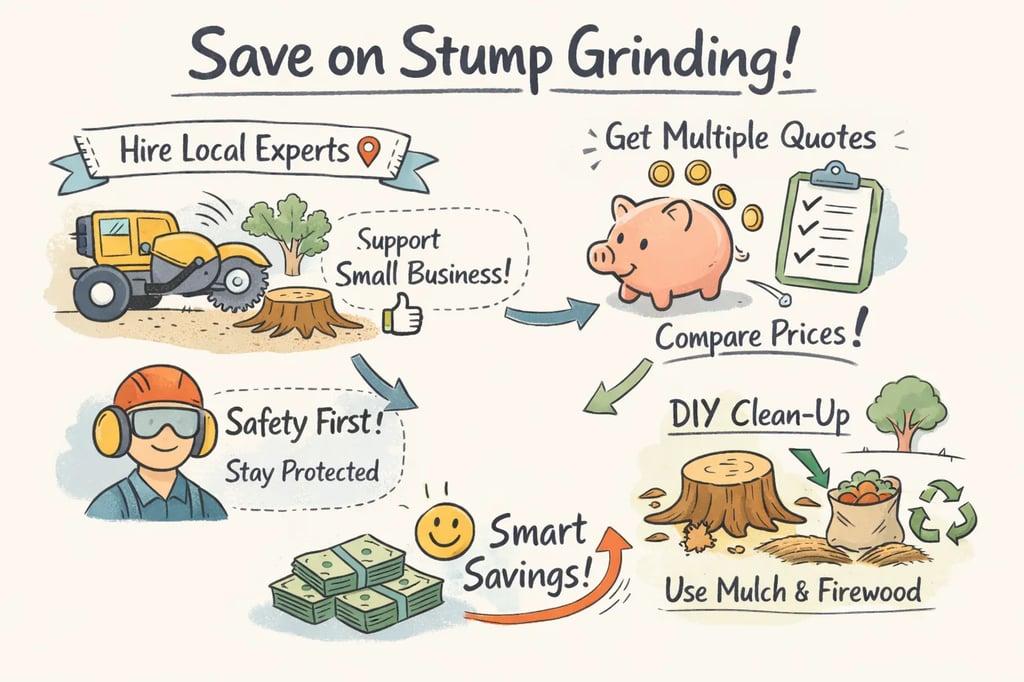
Looking for an affordable stump grinder or the lowest price without learning the hard way? It’s common to search for budget options, but "cheap" can mean liability, damage, or a ruined yard. Read on and you’ll leave with fair local price benchmarks, the main cost drivers, the exact questions to ask, and seven contractor-tested ways to lower your bill without cutting corners.
We’re Guilmer Tree Services — a licensed, insured Falls Church crew. Below are the exact questions we wish every homeowner asked before hiring. Safety-first, transparent quotes, and clean sites — that’s how we work here in the neighborhood.
Know what’s reasonable: quick price benchmarks you can use today
2026 national guidance puts most single-stump grinding jobs between $120 and $426. Common pricing models are per-inch rates (roughly $2–$6 per inch of stump diameter), hourly rates of $100–$200 for complex jobs, and minimum fees of about $80–$160 to cover travel and setup. Extra-large stumps (48" and up) routinely run $300–$800+ and often require a custom quote.
Example: 24" stump at $3/inch = 24 × $3 = $72, but the contractor’s minimum (say $120) likely applies — expect to pay the minimum.
Extra-large or very deep stumps (48"+) usually get a special quote rather than a per-inch calculation.
Typical add-ons: cleanup/disposal $50–$200; tight-access surcharges or travel fees can raise the total.
Quick Estimate you can use on the spot: measure the stump diameter at ground level, multiply by a per-inch rate you’re comfortable with ($3 is a good midpoint), compare that result to the contractor’s stated minimum, then add likely disposal or access surcharges ($50–$150). If the contractor’s all-in price is far below or above that quick number, ask for clarification.
Larger stumps take more grinding time and heavier teeth. Always measure diameter at ground level and tell contractors the measurement. That simple fact alone prevents many surprise upsells.
What to tell the contractor: "This is a 24" stump measured at ground level — does that match your per-inch rate or minimum fee?"
Fences, narrow gates, parked cars, and tight backyards force crews to use smaller machines or handwork — both increase labor. You can control much of this by clearing a path, moving vehicles, and unlocking gates before the crew arrives.
What to tell the contractor: "Backyard access is through a 3-ft gate and the closest parking is 50 ft away. Will that change your rate?"
What drives price (and what you can actually control)
Root mass and wood species
Hardwoods and deep root systems take longer to grind and wear machinery faster. If you know the tree type (oak, maple, elm), share it — contractors price hardwood stumps higher than softwood stumps for a reason.
What to tell the contractor: "This was an oak with a heavy root system — do you charge extra for hardwoods?"
Number of stumps
The first stump covers setup and travel; additional stumps usually receive discounts ($30–$75 off each). If you have multiple stumps, bundle them when requesting a quote.
What to tell the contractor: "I have four stumps — please quote the first stump and the per-stump rate for the extras."
Proximity to structures and underground utilities
Work near houses, foundations, driveways, or utility lines is slower and therefore more expensive. Call 811 before any digging or grinding to mark buried utilities — it’s your responsibility and it protects the crew and your property.
What to tell the contractor: "The stump is 6 ft from the house and 2 ft from the sidewalk — will you need to take extra precautions or obtain permits?"
Cleanup, disposal and permits
Cleanup/disposal and hauling chips away adds cost. You can often avoid disposal fees by keeping the chips as mulch. Also check local rules: some properties or specimen trees require permits before removal or grinding.
What to tell the contractor: "Can you include cleanup and disposal in the quote, or can we keep the chips as mulch to remove that fee?"
How to vet local pros and spot lowball red flags
Ask for proof of a general business license, liability insurance, and workers' compensation if they employ a crew. Request recent local references and confirm whether crew members have basic job-site safety training.
A responsible written quote should be itemized. At minimum, a proper estimate will show:
per-stump or per-inch rate, and any minimum fee;
travel or gate/access charges;
cleanup/disposal or chip‑retention option;
depth of grinding and any warranty or site-cleanup promise.
Red flags: no insurance proof, cash-only requests, refusal to provide a written estimate, unmarked trucks, or quotes far lower than local benchmarks. Those lowball numbers often hide extra charges or cut corners on safety.
Locally, Guilmer Tree Services models the process we recommend: a free on-site estimate, a written line-item quote, licensed and insured crews in marked trucks, a clear schedule, and site cleanup included. That transparency avoids surprises and protects your property.
Stump diameter (biggest factor)
Access and site obstacles
Seven contractor-tested ways to save on stump grinding
Measure and photograph before you call. Accurate photos and diameters stop ballpark guesswork and unexpected upsells. Potential savings: $25–$100. Action: send clear photos and the diameter in your first message.
Bundle stumps and ask for a multi-stump discount. Contractors typically drop $30–$75 per extra stump. Action: list all stumps and ask for an overall day or multi-stump price.
Prep the site. Clear obstacles, open gates, and move cars — crews charge less when access is quick. Potential savings: $50–$150. Action: make the yard ready before the crew arrives.
Keep the chips as mulch. Refusing disposal reducesremoval fees ($50–$200). Action: tell the contractor you’ll keep the chips for backfill or mulch.
Book off-peak. Mid-week oroff-season bookings often come cheaper. Potential savings: 10–20% on labor. Action: ask for a lower rate if your schedule is flexible.
Compare day-rate vs per-stump pricing. For multiple stumps, a day-rate can be cheaper than strict per-stump billing. Action: request both prices and pick the lower one.
Reserve DIY or rental for the right job.Rent a compact grinder only if you have several small stumps, easy access, and comfort with machinery — otherwise a pro is safer and often cheaper. Action: run the numbers (rental + time + safety gear) before deciding.
DIY and rental vs hiring a pro: a clear money + safety comparison
Rentals typically run $200–$400 per day for a standard stump grinder; compact units can be cheaper. Professionals average $120–$426 per stump depending on size and complexity. Scenario: for one small stump (≤12"), a pro is usually faster and cheaper once you factor in transport, deposit, safety gear, and the learning curve. For 3–5 small, easily accessible stumps, renting and doing it yourself can save money—only if you’re confident with the machine and accept the liability.
Safety and liability checklist: heavy rotating cutters, thrown debris, and underground utilities are real hazards; you need proper eye, ear, and leg protection, training to operate the machine, knowledge of underground lines (call 811), and an understanding that accidental damage while operating rented equipment is generally your liability.
Decision rule: if you have 3+ small, simple stumps, enough time, and comfort with equipment → consider rental. Otherwise hire a licensed, insured professional.
Book with confidence: checklist and a quote-request template
Before you sign, have these items ready: measured diameters and photos; at least three written quotes; comparison of line items (per-inch or per-stump, minimum, travel, cleanup, grind depth); verification of insurance; scheduling and guarantee terms; and a call to 811 to mark utilities. Those steps reduce surprises and protect your property.
Subject: Quote request — stump grinding at [Your Address]
Hello [Contractor Name],
Please provide an itemized quote for stump grinding at [property address]. Details:
- Stump photos attached and measured diameters: Stump A = 24", Stump B = 12", etc.
- Access: backyard via a 3-ft gate; driveway parking available 40 ft away.
- Chips: I prefer to keep chips as mulch / Please include disposal in the quote (choose one).
- Any permits required? (Please advise.)
Please include per-stump or per-inch pricing, minimum fee, travel/access charges, cleanup/disposal fees, estimated grind depth, and proof of liability insurance.
Thank you,
[Your Name] | [Phone] | [Email]
Guilmer Tree Services offers free on-site estimates in Falls Church and nearby Northern Virginia neighborhoods. We’re licensed, insured, and committed to safe, transparent work—no surprises, just clean results. Ask for a free estimate and the written quote before you schedule.
Cheap is tempting; affordable and safe lasts — and that’s what keeps yards looking good and families protected.
Our Services
Tree Removal
Tree Trimming and Pruning
Stump Grinding
Bush Chipping
Hours & Information
© 2026. All rights reserved.
Monday to Friday : from 9:00 AM – 5:00 PM
on-site : from 8:00 AM – 6:00 PM