🌳Hiring Tree‑Clearing Services: Costs, Permits & Safety
Homeowners often ask what really goes into safe, professional tree‑clearing — and why choosing the right company matters. At Guilmer Tree Service, we make the process clear, transparent, and stress‑free by focusing on three essentials: costs, permits, and safety.
6 min read
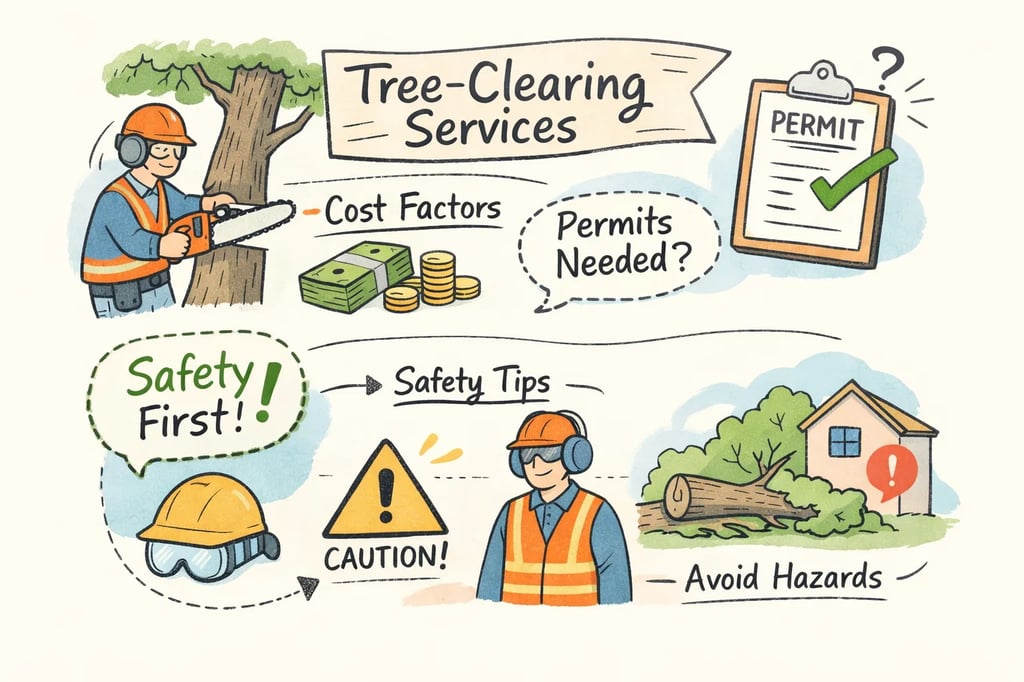
When you’re staring at a line of trees that have to come down—whether it’s for a build, storm damage, or safety—three questions jump to the front: how much will it cost, do I need a permit, and how do I avoid a mess or a liability? You don’t need to memorize local ordinances or insurance fine print. Below are headline numbers, simple ways to compare bids, and a practical 7‑point checklist that will let you hire with confidence. Guilmer Tree Services (Falls Church) is the kind of licensed, insured local crew homeowners call when they want transparent estimates and safe crews on site.
1) A clear cost picture — per‑tree, per‑acre and the factors that move the price
Headline numbers to know before you get quotes: expect roughly $385–$1,070 per tree, with national averages frequently reported between $630 and $850. Per‑foot pricing commonly runs $9.50–$14.50 per foot of tree height.
Tree size Typical cost range
Small (under 30 ft) $150–$500
Medium (30–60 ft) $435–$870
Large (60–80 ft) $800–$1,700
Extra‑large (80+ ft) $1,160–$3,000
Per‑acre clearing ranges widely: $850–$6,000+ depending on density. Lightly wooded sites commonly run about $2,500 per acre; densely wooded parcels can exceed $6,000 per acre.
Common add‑ons and ballpark numbers: stump grinding $100–$500 per stump, debris hauling $50–$100 per truckload, and crane rental (when needed for complex removals) roughly $250–$600 per day. Chipping keeps biomass on‑site as mulch and can reduce haul‑away fees; hauling everything away raises disposal costs. For projects that want to retain mulch or use mechanical site clearing, consider options from a forestry mulching company when comparing bids.
The five biggest price drivers are straightforward. Tree size and height scale labor and equipment needs. Access and setup difficulty (steep slopes, tight yards) add crew time. Proximity to houses, garages, fences or power lines raises risk and often requires specialized rigging or utility coordination. Tree condition and species matter—dead, rotten, or heavily branched trees are harder to take down. Finally, included services (stump work, grading, erosion control) add direct cost. For multi‑tree or acreage work, ask contractors for both a per‑acre rate and a per‑tree fallback so you can compare bulk discounts and spot hidden fees.
Never accept a verbal price. A credible estimate is written and itemized. At minimum it should list:
Scope of work and number of trees to be removed or trimmed
Pricing method (per‑tree, per‑acre, or per‑foot) and unit prices
Crew size or estimated labor hours and equipment to be used
Disposal charges, stump grinding, and cleanup specifics
Who files permits (and any permit fees)
Start and estimated completion dates
To compare bids, normalize them into a single line: total cost, included services, explicit exclusions, deposit amount, and start/completion dates. Fair payment terms are usually a 20–30% deposit, progress milestones for larger jobs, and final payment due after a signed walk‑through. Red flags in a quote include vague scope, no timeline, no Certificate of Insurance mentioned, or an unusually low price with no explanation. If you need a quick refresher on common questions to ask contractors, see our Frequently Asked Questions about Tree Service.
Permits are highly local. Typical triggers include clearing above a certain acreage, removing trees above diameter thresholds, work within a set distance of public roads or sidewalks, and properties in historic or conservation overlays. Street or park trees almost always require city approval.
The usual application flow runs through planning/zoning or parks/forestry: you’ll provide a site plan, photos, and sometimes a tree survey or an arborist letter. Reviews often take 20+ business days; fees commonly fall in the $50–$150 range, and approvals may carry replacement or mitigation conditions.
How to check your local rules quickly: search “[your city or county] tree removal permit,” call your planning or public works office, or use your municipality’s permit portal. For a clear example of municipal permit requirements and how park/forestry offices handle tree work, review your city’s tree work permit guidance such as the New York City Parks tree work permit page. If this feels like too much paperwork, a certified arborist or licensed crew can file on your behalf and reduce mistakes. Guilmer Tree Services routinely prepares permit paperwork and arborist documentation for Falls Church and Northern Virginia jobs to help homeowners move projects forward correctly.
2) How to read a quote — what every written estimate should show
3) Permits, local rules and who files them (yes, it matters)
4) Insurance, bonding and certifications — what you must see before work begins
Tree work is high risk. Require a current Certificate of Insurance (COI) and verify the policy directly with the insurer. Minimum coverages to expect:
General liability: at least $1M per occurrence (a $2M aggregate is preferable)
Workers’ compensation: state‑required coverage to protect against employee injury
Commercial auto liability: $1M for on‑road vehicles and equipment transport
Umbrella liability: $1M excess coverage for major claims
Ask for a performance or payment bond on large land‑clearing or commercial projects. Confirm credentials: request an ISA Certified Arborist on site when risk assessments are needed and check for any required state contractor license. Get the COI directly from the insurer (not a photocopy), ensure you’re listed as an additional insured, and confirm effective and expiration dates by phone.
For a consumer‑facing breakdown of the common insurance types tree service contractors should carry, the Angi article on contractor insurance explains the usual coverage buckets and why they matter for homeowners (what insurance tree service contractors should carry).
Homeowner script (first call): “Can you email your COI and license number? Who is your insurer and may I call them to verify the policy and expiration date?” If a contractor resists providing these documents, treat that as a hard stop.
5) Your 7‑point safety & hiring checklist (use this before you sign)
Written, itemized estimate with timeline and start/completion dates — Action: keep the signed estimate.
Current COI listing you as additional insured with adequate limits — Action: request the insurer’s phone number and call to verify.
Proof of workers’ comp and commercial auto coverage — Action: confirm policy names and expiry dates on the COI.
Licenses and an ISA Certified Arborist (or equivalent) on the job for risk assessments — Action: ask for license numbers and credentials; check online.
Permit plan or confirmation who files/performs permitting — Action: require permit copies before work begins.
Safety plan and property‑protection measures — Action: ask for the rigging plan, traffic control strategy, and whether 811 will be called for underground utilities.
Cleanup, stump and disposal plan plus payment terms — Action: include cleanup and disposal details in the contract.
Avoid cash‑only offers, pressure for large deposits, refusal to show COIs, or no written contract—these are common signs of underinsured or fly‑by work crews. For industry guidance on inspection and safe practices for tree care and removal operations, consult the OSHA inspection guidance on tree care and removal operations (OSHA inspection guidance).
6) On the day and afterward — what to expect, what to do, and a local option
Before the crew arrives, move cars and outdoor furniture, secure pets, and mark irrigation heads or fragile plants. Call 811 to flag underground utilities if excavation or stump grinding is planned.
On site, expect a pre‑job briefing, clearly marked drop zones, staged equipment (chipper, stump grinder, lift if needed), and deliberate sectional cuts in tight areas. Crews should cordon off work zones and use rigging to guide heavy falls away from structures and lines.
After the job, insist on a final walk‑through, photo documentation, and signed completion or cleanup confirmation before making the final payment. Request a lien waiver if subcontractors were used and confirm whether logs, chips, or whole trees were left on site or hauled away.
For aftercare: schedule stump grinding promptly if you want to regrade; topsoil and seed or sod will restore lawn grades. Learn smart, safe options for removing or grinding stumps in our guide to local stump grinding. Set a routine trimming schedule—every 3–5 years is common for many species—to reduce future hazards; see our Tree Service Care & Maintenance in Fall article for seasonal care tips.
If you want a local, licensed and insured crew that provides free on‑site estimates and help with permits and paperwork, How to Hire the Best Tree & Stump Removal Service Near You explains what to expect and how Guilmer Tree Services supports Falls Church and Northern Virginia homeowners with safety‑first crews, transparent bids, and permit assistance across the region.
Hiring tree work doesn’t have to be a gamble. Use the headline numbers, insist on clear paperwork, run the 7‑point checklist, and you’ll bring the right crew to your property—safe, compliant, and fair.
Our Services
Tree Removal
Tree Trimming and Pruning
Stump Grinding
Bush Chipping
Hours & Information
© 2026. All rights reserved.
Monday to Friday : from 9:00 AM – 5:00 PM
on-site : from 8:00 AM – 6:00 PM