🌳Tree Service Insurance: Coverage, Costs & How to Choose
Hiring a tree service without proper insurance can put homeowners at serious financial risk. From property damage to worker injuries, the right coverage protects you, your home, and the crew doing the work. At Guilmer Tree Service, we believe transparency matters — so here’s what every homeowner should know before choosing a tree‑care company.
6 min read
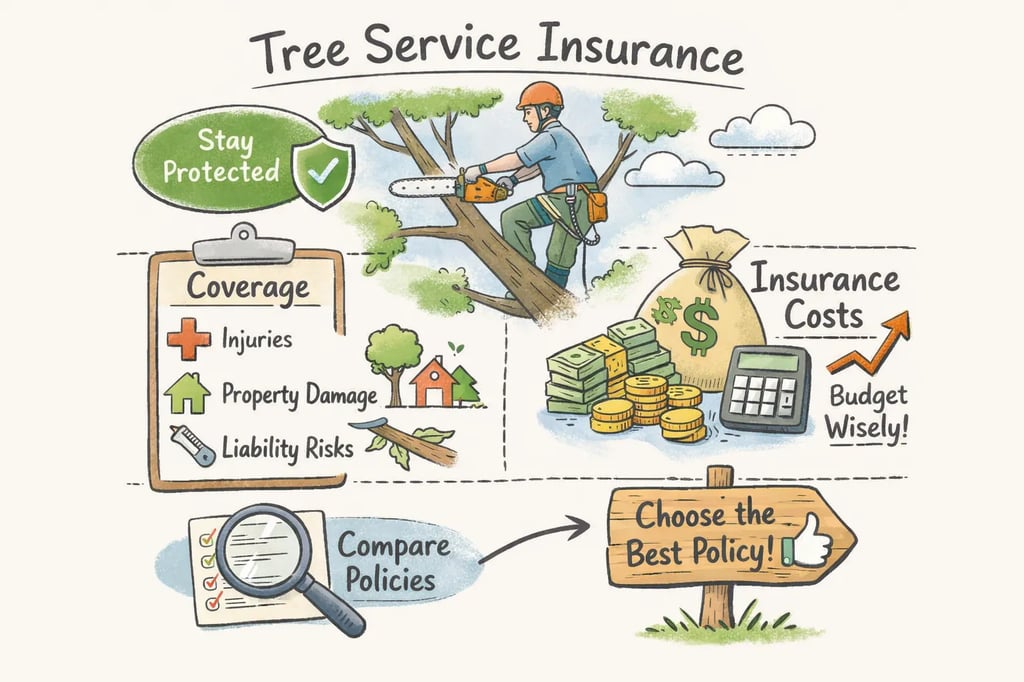
Insurance isn’t red tape — it’s how you keep your crew and clients whole when a limb comes down in the wrong place. For local tree professionals, the right mix of policies is as essential as a sharp saw and a clear work plan. By the end of this article you’ll know the exact policies and limits a tree business should carry, realistic premium ranges for different-sized crews, the COI and additional‑insured language clients expect, and a step‑by‑step method to get and compare quotes.
At Guilmer Tree Services we maintain a practical baseline: general liability $1,000,000 per occurrence / $2,000,000 aggregate, auto liability $1,000,000, workers’ compensation statutory limits, inland marine scheduled equipment, and a $1,000,000 umbrella. That stack keeps small commercial jobs and homeowner projects covered without surprises and gives our customers in Falls Church straightforward proof of protection.
The must-have policies for tree work — what each one actually protects
Tree work combines height, heavy equipment, and public exposure; no single policy covers every outcome. Below are the core policies every arborist should understand, what they protect, and a short field example for context.
What it covers: third‑party bodily injury and property damage (for example, a falling branch that cracks a roof or dents a parked car). Recommended baseline: $1M per occurrence / $2M aggregate. When you should ask for more: commercial sites, municipal contracts, or jobs next to high‑value property — push for $2M+ or an umbrella. For practical guidance on trimming and job‑site exposures, see The Hartford's tree trimming guide.
What it covers: medical care, lost wages, and rehabilitation for employee injuries on the job. Most states require it for any payroll; tree work is high‑risk (falls, chainsaws), so statutory limits apply. Example: a climber falls during a dismantle — workers’ comp handles the claim and limits employer liability when properly in place. For an example of state rules and employer obligations, see California's workers' compensation requirements.
General liability
Workers’ compensation
Commercial auto
What it covers: liability for work trucks, chippers, trailers and incidents during transport. Personal auto policies usually exclude commercial activity. Typical limit: $1M per accident for vehicles used in operations.
Equipment / Inland marine
What it covers: tools, chainsaws, stump grinders, chippers and other mobile equipment against theft, loss, or damage while in transit or on site. Schedule high‑value items (vs. a blanket limit) to avoid insufficient payouts if a grinder or chipper is lost.
Umbrella / excess liability
What it covers: additional limits above primary policies. A $1M umbrella makes sense when taking on commercial or municipal work that could generate claims beyond the GL limits.
Bonds and professional liability (E&O)
Bonds (performance or bid) are often required for municipal or large commercial contracts. Professional liability is useful if you provide written assessments or specifications — it covers errors or omissions in advice rather than physical damage.
Guilmer Tree Services — our policy stack and why
General Liability $1M/$2M: Keeps routine homeowner and most commercial risks covered while meeting typical contract minimums.
Auto Liability $1M: Covers our trucks and trailers during transport to and from jobs.
Workers’ Compensation (statutory): Required and essential for crew safety and legal compliance.
Inland Marine (scheduled equipment): Protects our high‑value grinders and chippers where blanket limits would underpay.
Umbrella $1M: Provides an extra layer for larger jobs or unexpected large claims.
For homeowners a baseline $1M/$2M GL plus auto and workers’ comp typically suffices. Commercial and municipal work usually requires higher limits, scheduled equipment listings, and specific additional‑insured wording.
Typical premium ranges by business size — realistic ballparks
Premiums vary by state, claims history, and operations. Use the ranges below for planning, not as firm quotes. For current market cost references, see industry cost breakdowns like tree service insurance cost estimates.
Sole proprietor / one‑person operator: Basic general liability or a small BOP commonly ranges roughly $372–$1,860 per year. Adding workers’ compensation or a commercial vehicle will increase premiums; a single scheduled grinder or inland marine listing adds a modest extra premium.
Small crew (1–5 employees): Baseline GL+BOP runs ~$1,650–$2,500/year. Expect total program cost to rise when you add workers’ comp, multiple vehicles, and scheduled equipment — mid‑range operators often pay in the low thousands annually.
Mid‑size company: Baseline insurance costs typically start around $2,300/year and climb rapidly with heavier equipment, multiple trucks, aerial lifts, or cranes. Firms running grapple trucks or large-scale land clearing can see premiums in the many thousands or higher.
Biggest cost drivers are payroll (workers’ comp), claims history, equipment value, vehicle fleet size/type, and the state legal climate. Example: adding a scheduled stump grinder or insured chipper will trigger inland marine premiums; adding a bucket truck or grapple crane moves you into a much higher rate tier.
Endorsements, exclusions and common policy pitfalls
A standard liability form can still leave gaps. Endorsements tailor coverage to tree work; exclusions quietly remove it. Know these traps and ask for fixes.
Rigging and dismantling exposure often needs explicit endorsement because uncontrolled falling objects create large third‑party losses. Professional‑services exclusions remove coverage for written assessments — get E&O if you provide recommendations or reports. Hired & non‑owned auto gaps surface when employees use personal vehicles or rented trucks; add the right auto endorsement. Inland marine must show scheduled high‑value gear; blanket limits frequently underpay. Watch for waiver of subrogation and primary/non‑contributory wording in client contracts — poorly worded clauses can shift risk unfairly. Finally, misclassifying employees as subcontractors can void workers’ comp and liability protections.
Action: request specific endorsements in writing, schedule expensive equipment on the policy, and get explicit endorsement numbers on the COI.
COI and contract checklist — exactly what clients will ask for
Certificates of insurance are the shorthand clients use to confirm coverage. A clean COI shows both protection and competence.
General Liability: policy type and limits (per‑occurrence and aggregate), e.g., $1,000,000 / $2,000,000.
Auto Liability: company vehicles and trailers, typically $1,000,000.
Workers’ Compensation: evidence of statutory coverage or state waiver if applicable.
Inland Marine / Equipment: scheduled items listed if client requires coverage for on‑site gear.
Umbrella/Excess: shown where required.
Certificate holder name/address, policy numbers, effective/expiration dates, and a 30‑day cancellation notice line.
Sample additional‑insured request you can give a client or agent:
"Please provide an ACORD certificate showing General Liability limits of $1,000,000/$2,000,000; name [Client Name] as Additional Insured on the CGL policy, with coverage primary and non‑contributory; include Auto Liability $1,000,000 and Workers’ Compensation per statutory requirements; include 30 days' notice of cancellation."
Short email to your agent for a COI:
"Please issue a COI for [Company Name] showing GL $1M/$2M, Auto $1M, WC statutory. Add [Client Name] as Additional Insured (primary & non‑contributory) and list scheduled equipment X,Y,Z on inland marine. Please return the ACORD within 48 hours."
Internal tip: track COI expirations in your CRM and require updated proof before work begins.
How insurers calculate premiums — drivers and practical levers to reduce cost
Underwriters price your program by forecasting likely losses from measurable data. Claims history, payroll, revenue, job mix (dismantling vs light pruning), equipment value, vehicle fleet, location, years in business and EMR are prime drivers.
Controls that lower premiums: document a safety program and ongoing crew training (daily briefs, PPE, rescue procedures); schedule equipment and vehicles accurately so premiums match exposure; implement driver screening and MVR monitoring; bundle policies with one insurer for package discounts; and respond quickly to claims with return‑to‑work plans to keep EMR down. Industry guidance shows sensible safety and administrative changes commonly reduce premiums in the 10–12% range over time; larger reductions require demonstrable, long‑term loss control.
Step‑by‑step: get quotes, compare offers, and choose the right policy
Prepare these documents before you call brokers or carriers:
Last 3 years' loss runs
Payroll and revenue figures
Equipment list with values
Driver MVRs and vehicle list
Sample contracts / scope of work
Safety manual and training logs
Ask agents these questions: Do you specialize in arborist accounts? Which endorsements come standard for dismantling? How do you handle additional‑insured endorsements and primary/non‑contributory wording? How will our loss runs and EMR affect comp rates? Can you schedule equipment on inland marine and name values? What discounts or trade‑association programs do you offer?
Compare quotes by scoring coverage completeness (endorsements and inland marine), limits against client demands, exclusions that matter for tree work, insurer experience with arborists, price, and service speed (how fast they issue COIs). Red flags: limits that are too low for your contracts, missing hired & non‑owned auto or inland marine, ambiguous additional‑insured wording, or an agent who can't provide loss‑run references.
When you accept, place the policy, obtain COIs for active projects, notify clients, and schedule an annual policy review tied to payroll or equipment changes.
Insurance is manageable when you know what to ask for and how to read a COI. If you’d like Guilmer Tree Services’ COI template or a one‑page checklist to give your agent, contact our office and we’ll send a copy — we use the same checklist with our local partners in Falls Church. If you need hiring guidance, see our guide on How to Hire the Best Tree & Stump Removal Service Near You.
Key takeaways: carry the right mix of GL, WC, commercial auto and inland marine for your equipment, and always secure clear additional‑insured and primary/non‑contributory language on the COI. Good underwriting and a documented safety program lower costs over time and keep your crew and customers protected.
Our Services
Tree Removal
Tree Trimming and Pruning
Stump Grinding
Bush Chipping
Hours & Information
© 2026. All rights reserved.
Monday to Friday : from 9:00 AM – 5:00 PM
on-site : from 8:00 AM – 6:00 PM