🌳Tree Removal Permits: When You Need One and How to Apply
Tree removal rules vary widely depending on your city, property type, and the condition of the tree. While many Virginia homeowners can remove trees on private residential property without a permit, certain situations do require approval — especially for protected species, hazardous locations, or commercial properties. Understanding these rules helps you avoid fines, delays, and unnecessary stress.
6 min read
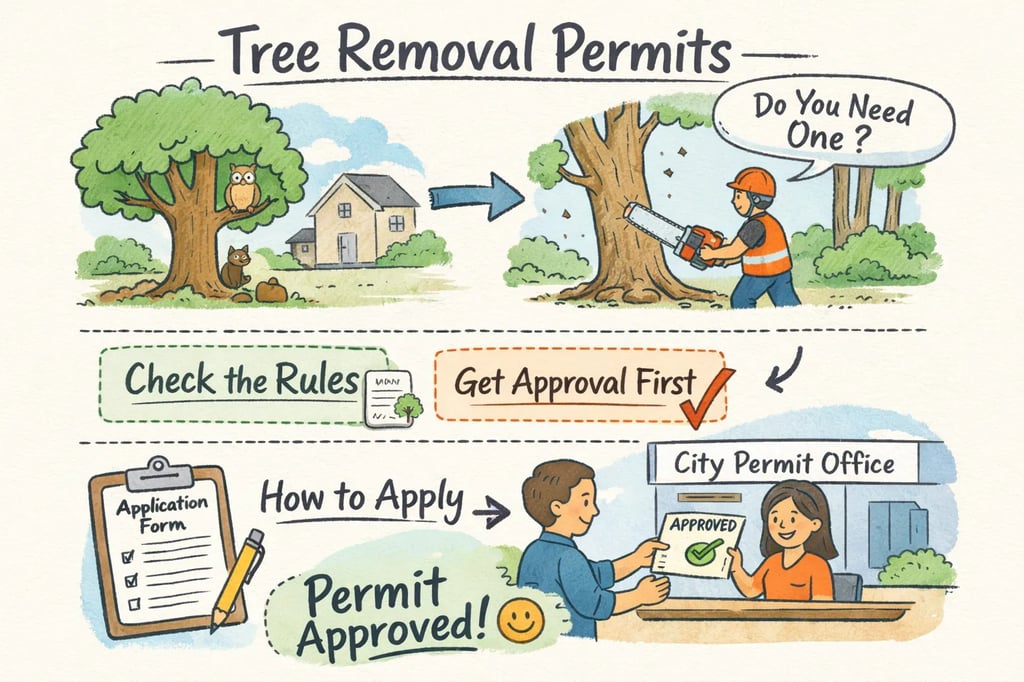
Getting permission to remove a tree shouldn’t be a mystery. Start with three quick facts and you can usually self-triage in under five minutes: the trunk size, where the tree sits, and whether it carries special protection.
At Guilmer Tree Services, we help Falls Church and Northern Virginia homeowners measure trunks, prepare the simple reports cities expect, and file the forms when needed—so you avoid delays and fines.
Quick decision check: DBH, location, special status
Measure three data points and you’ll have a strong sense of whether local rules apply.
DBH means diameter at breast height. Measure circumference with a tape at 4.5 feet above the ground, then divide by π (or use a DBH tape or smartphone app). For multi‑trunk trees, note each trunk’s measurement—some cities add circumferences, others treat the largest trunk as the reference. Typical triggers you’ll see in U.S. cities:
6 inches DBH: common threshold in many Pacific Northwest municipalities (Seattle-area cities, Bellevue).
8–12 inches DBH: used by some Eastern and California jurisdictions; San José treats 38 inches circumference (≈12.1" diameter) as an ordinance-size trigger.
3 inches DBH: Miami‑Dade County treats trees ≥3" DBH (or 12' tall) as regulated for permit purposes.
If you don’t have a tape, take a photo with something of known width beside the trunk (a door, a yard stake) and call for a quick pre‑check.
Getting clarity fast: do you need a permit?
Street or right‑of‑way trees are almost always the city’s responsibility and usually need a separate permit. Trees on private yards may still be protected if they are “heritage” or in a conservation overlay.
Find and file the right application — step by step
Heritage, historic, or protected species and trees within environmental buffers usually require permits regardless of size. If a tree has a plaque, appears on a municipal tree map, or sits on a multifamily or commercial parcel, assume a permit is likely.
Micro‑takeaway: measure DBH, note whether it’s a street/right‑of‑way tree, take clear photos, and call your city’s urban forestry office or Guilmer Tree Services for a free pre‑check if you’re unsure.
Permit names vary. Look for terms like private tree removal permit, street tree permit, heritage tree permit, or after‑the‑fact application on your city’s planning, public works, or urban forestry pages. When in doubt search “[Your city] tree removal permit” or call the urban forestry counter. If you’re evaluating contractors or larger projects, our Find Trusted Lot Clearing Near You: 7-Step Hiring Guide can help you screen firms before you sign anything.
Identify the permit category: private yard vs. street/right‑of‑way vs. heritage. That determines the form and reviewer.
Open the portal or download the form: many cities accept online uploads; some require hard copies for protected trees (Los Angeles asks for hard copies of a Protected Tree Report in some cases).
Assemble a simple site plan: draw the property outline, north arrow, house and driveway, approximate tree locations with distances to the house/driveway, and a scale note (e.g., “1" = 10'”). A clean sketch is usually sufficient for residential requests.
Photograph the tree: at least three angles—wide shot showing the tree in context, a close shot of the trunk base, and an image showing distance to structures or the street.
Fill and submit: complete the application, attach photos, site plan, tree list (species + DBH) and any required arborist report; submit per the portal instructions and note the confirmation number.
Phone script to the city: “Hi, I’m calling about a possible tree removal at [address]. The trunk measures about [X]" DBH at 4.5'. Is a private tree removal permit required, or can I get a quick pre‑check?”
Documents, fees and processing times — what to expect
Most municipal applications request the same core items: a completed application form, a simple site plan, current photos, a tree list (species and DBH), and a removal rationale. Additional requirements for large or protected trees often include an arborist report, a replacement or mitigation plan, proof of ownership or agent authorization, and proof that your contractor is licensed and insured.
A basic arborist report should name the tree species, list DBH(s), describe condition and hazard factors, explain the reason removal is recommended, and recommend mitigation or replacement. It should be signed by an ISA‑certified arborist or locally licensed professional. See our guide on Tree & Stump Removal: Costs, Process, and What to Ask for details on typical report elements and questions to ask an arborist.
Processing times and fees vary: non‑development residential removals in Portland commonly clear in around two to three weeks; Los Angeles reviews for protected or complex removals can run 90–120 days; some Florida counties process routine requests in about three weeks. As an example from county guidance, Hillsborough County posts an application fee (around $81.65) with a 3.5‑week processing target—see the Hillsborough County tree removal permit guidance for current forms and fees. For Portland-specific removal and replanting rules and timelines, consult Portland's removal and replanting permits. If your project involves Los Angeles protected trees or ordinance questions, review the city's documentation such as the municipal materials available from the city clerk's office (Los Angeles documentation).
Many cities offer a fee‑in‑lieu option instead of planting, and replacement rules range from simple 1:1 plantings to inch‑for‑inch calculations. Estimate your timeline by the complexity: one small backyard tree with no public comment usually moves quickly; heritage trees, development‑linked removals, or requests requiring public notice take longer.
1. DBH — how to measure and common thresholds
2. Location matters
3. Special status
Emergency removals and after‑the‑fact filings
Immediate action is allowed when a tree poses an imminent risk to life or property. The pattern across jurisdictions is consistent: document first, get professional confirmation, act to make the site safe, then notify authorities.
Photograph the hazard from multiple angles immediately; timestamp if possible.
Obtain a written assessment from an ISA arborist or licensed pro stating the imminent risk and why removal is the only practical mitigation.
Remove or make safe the hazard if it’s unsafe to wait; preserve cut sections or trunk pieces if the municipality may need inspection evidence.
Notify the city within the timeframe the ordinance requires (many ask for notification within 24–72 hours or up to 7 days).
Submit an after‑the‑fact application as soon as possible with photos, the arborist statement, and a mitigation plan to reduce or avoid fines.
Legal note: some state laws, such as Florida’s Chapter 163.045, allow emergency removals when documented by a qualified professional; local ordinances still dictate the notification and ATF process—confirm with your local office. If your situation is in the Seattle area and you need quick guidance on permit triggers, review local resource pages like those covering tree permits in the Seattle area for common rules and contact points.
Common mistakes include assuming small equals exempt, removing a street tree without permission, mismeasuring DBH, neglecting arborist documentation, and hiring unlicensed crews. Fines, replacement requirements, and stop‑work orders can make an impulsive removal far costlier than a compliant approach.
Quick compliance checklist (do these before any cutting): measure and record DBH and species; confirm if the tree is on the right‑of‑way or listed as heritage; photograph the tree in context; prepare a simple site plan sketch; decide whether an arborist report is needed and hire an ISA professional if in doubt; confirm your contractor is licensed and insured; secure the permit or follow emergency/ATF steps if you act immediately. If you need help evaluating contractors, our posts on How to Hire the Best Tree & Stump Removal Service Near You and Hiring Tree‑Clearing Services: Costs, Permits & Safety outline key questions to ask and red flags to avoid.
Phone/email script for your HOA or city: “Hello — I’m preparing a removal request at [address]. I’ve attached photos and measured the trunk at [X] inches DBH. Can you confirm which permit I should submit and the preferred contact for filing?”
How Guilmer Tree Services helps: we provide on‑site DBH measurement, full arborist evaluations and written reports, simple site plans and permit‑quality photos, and we can file municipal applications on your behalf. When removal is approved, our licensed and insured crew performs the work, followed by stump grinding and brush chipping for neat cleanup. For urgent needs we offer emergency storm response and can prepare an after‑the‑fact package to reduce risk of fines. Our free estimate and permit consultation gets you a clear next step without guesswork. For seasonal maintenance and pre‑winter work in our service area, see our recommendations in Essential Tree Service Recommendations Before Winter in Northern Virginia.
What to have ready when you call Guilmer Tree Services:
Property address (and APN if known)
Photos of the tree(s)
Approximate DBH or the tape measurement
Preferred timing and whether the tree is near utilities or on the right‑of‑way
Call us for a free estimate and permit consultation — we’ll tell you whether your removal needs a permit, prepare the paperwork, and handle the safe, insured removal so you don’t have to worry about fines or surprise delays.
Three takeaways to remember: check DBH and location first; document everything before you cut; and when in doubt, get a quick professional review. Local rules vary—call your urban forestry office or Guilmer Tree Services for a fast, safe answer.
Common pitfalls, a short compliance checklist, and how Guilmer can help
Our Services
Tree Removal
Tree Trimming and Pruning
Stump Grinding
Bush Chipping
Hours & Information
© 2026. All rights reserved.
Monday to Friday : from 9:00 AM – 5:00 PM
on-site : from 8:00 AM – 6:00 PM